



SpaceX flies Falcon 9 more than twice a week. In the same stretch, the booster launching this week's Space Development Agency mission will be making its sixth flight, landing itself back at Vandenberg like it's routine — because at this point, for SpaceX, it is (SpaceX). That cadence is the actual competitive bar in American medium-lift launch, and for more than a decade nobody else has come close to clearing it.
Rocket Lab wants to be the first. In May 2026, the company announced its largest contract to date: an unnamed customer booked five dedicated flights on Neutron, plus three more on Electron, pushing Rocket Lab's backlog past $2.2 billion and its total manifest past 70 missions (KeepTrack). The catch is right there in the deal — Neutron has never flown.
Buying a Position in Line, Not a Finished Rocket
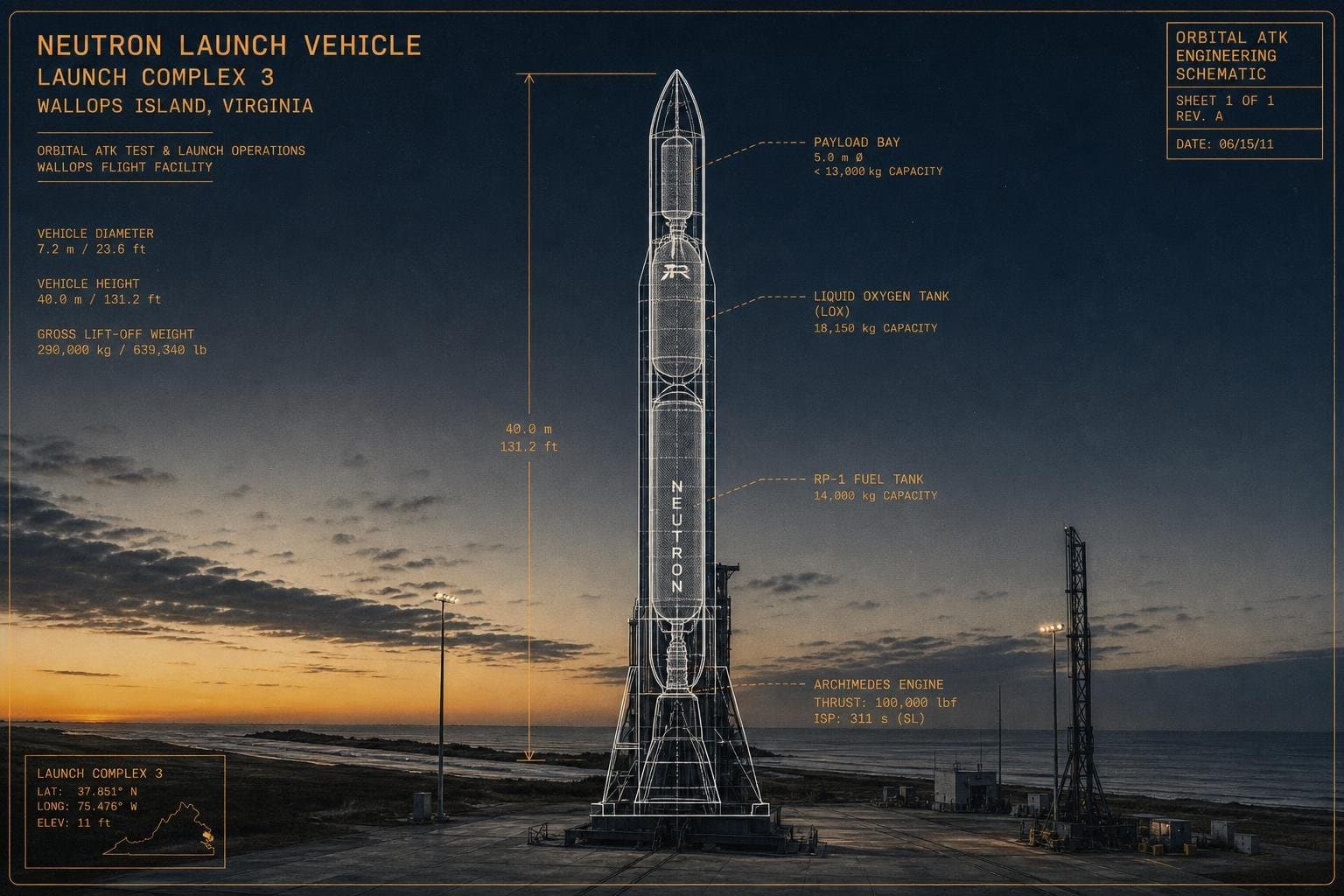
Selling flights on an unflown vehicle sounds like the kind of promotional overreach this newsletter usually flags. But the hardware behind the contract is further along than a glossy renderings-and-promises pitch. By the time that deal closed, Rocket Lab's Archimedes engine had been test-firing at NASA's Stennis Space Center for close to two years, and Launch Complex 3 at Wallops Island — the pad Peter Beck opened in August 2025, framing it as a matter of "assured access to space and the launch site diversity that is needed within the United States" — was finished and standing on the Virginia shoreline (KeepTrack). Flight hardware is reportedly moving through factories in Maryland and Virginia. The customer bought a queue position in a program with real metal in it, not a PowerPoint deck.
That distinction matters because the gap Neutron is trying to fill is genuinely empty. Vulcan and New Glenn fly, but they're heavy-lift vehicles priced for a different job. Terran R and Stoke's Nova haven't reached a pad. If you wanted eight tons to low Earth orbit on an American rocket at a commercial price for the last several years, Falcon 9 was the only call you could make — not because competitors weren't trying, but because none of them got hardware to the pad (KeepTrack).
The Execution Argument Comes From Electron, Not Neutron
Here's where Rocket Lab's pitch gets more interesting than most "we're building a Falcon 9 competitor" stories: the company has receipts, just not from the rocket in question. This week, Rocket Lab signed its largest Electron launch agreement ever — a 20-mission deal with the Japanese radar-imaging company Synspective, extending that customer's total bookings to 47 launches including 13 already flown (Ars Technica). Peter Beck called it "a massive vote of confidence not just in Electron but in the launch cadence, mission reliability, and orbital precision that Rocket Lab consistently delivers" — and for a company whose light-class rocket has now flown repeat missions for the same customer for six years, that's a defensible claim, not just a quote for the press release.
Electron's track record doesn't prove Neutron will work. Different engine, different scale, different reusability architecture, different pad. But it's the closest thing Rocket Lab has to evidence that when it commits to a launch cadence on paper, it tends to eventually deliver one in practice — which is exactly the trait a medium-lift challenger needs and the one every failed Falcon 9 competitor has lacked. Terran R and Nova haven't just missed their debut dates; their parent companies haven't built the operational muscle of flying dozens of missions for the same repeat customers.
What Actually Decides This
None of this settles whether Neutron competes with Falcon 9. Competing means matching reuse economics, turnaround time between flights, and a flight rate measured in dozens per year, not matching a press release. SpaceX got there by iterating publicly through failures over years, including its current run of Starship test flights that only recently reached orbit after fourteen attempts (SpaceX). Rocket Lab hasn't shown the market that iteration yet, because Neutron hasn't flown.
Watch for Neutron's first launch attempt from Launch Complex 3 — that single flight will tell you more about whether this contract was rational than any backlog number can. Until then, the honest read is that Rocket Lab has earned the right to be taken seriously, not the right to be called a Falcon 9 rival.