


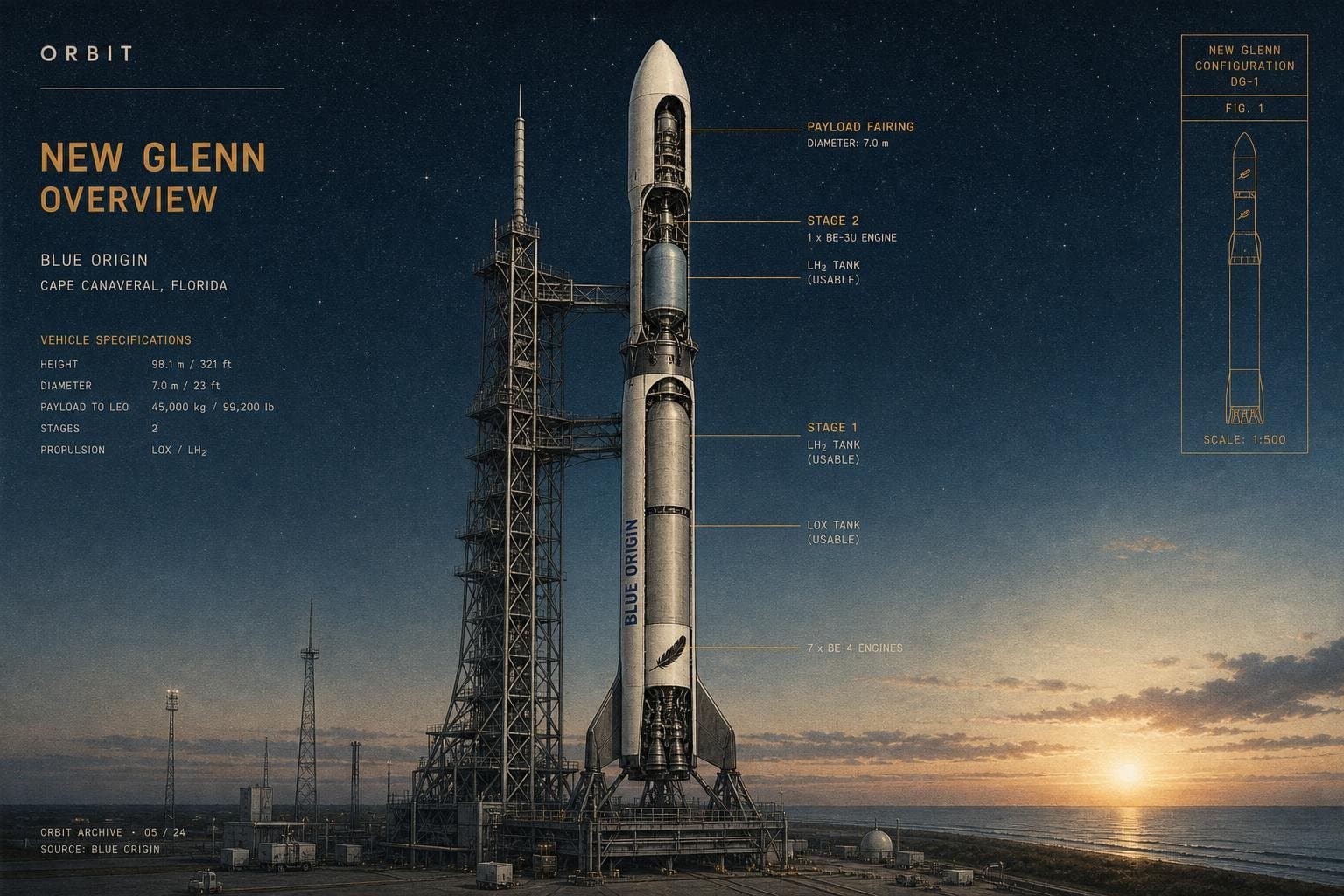

Blue Origin's rocket isn't sitting on a pad counting down to anything right now. According to Aviation Week, the company is "on track" to resume New Glenn pad operations in November — which tells you the more interesting story isn't a launch date, it's a recovery timeline. If you came looking for news of a second New Glenn flight already happening, the sources don't support that yet. What they do support is a company quietly repositioning itself for something bigger than one more launch: a sustained flight rate.
That distinction matters more than it sounds like it should.
The Real Number to Watch Is 50, Not "Next Launch"
While Blue Origin works to get pad operations running again, the FAA is reviewing something that says more about the company's ambitions than any single mission would: a proposal to raise New Glenn's authorized annual launch limit at Cape Canaveral Space Force Station from 12 to 50, according to New Space Economy, which cites the FAA's project page for the licensing review.
A 12-to-50 jump isn't a rounding adjustment. It's the regulatory paperwork equivalent of a company telling the government "we intend to fly constantly." Whether New Glenn can actually support that cadence is a separate question from whether Blue Origin wants the legal room to try — and getting that ceiling raised now, before the flight history exists to justify it, is the kind of move a company makes when it's planning years ahead rather than quarters ahead. SpaceX built its reputation on exactly this pattern: secure the regulatory headroom first, then grow into it. Blue Origin appears to be following the same playbook, even if its flight cadence so far looks nothing like SpaceX's.
New Glenn's Actual Competitive Edge Isn't Speed — It's Simplicity
Here's where New Glenn's position in "orbital competition" gets genuinely interesting, and it has nothing to do with launch pads. NASA's updated Artemis architecture, laid out in detail during a briefing covered by Ars Technica, calls for four New Glenn launches to support the Blue Moon lander — with no spacecraft-to-spacecraft refueling required, and the option for Blue Moon to rendezvous with Orion in low-lunar orbit rather than a more energy-intensive halo orbit.
Compare that to the architecture's other half. SpaceX's Starship lunar lander needs orbital refueling before it can head to the Moon — and the number of tanker flights required to do that is now a public fight. A NASA safety panel put the figure at around 22 refuelings; Elon Musk called that wrong and said the real number is six to eight, per the same Ars Technica report. Nobody in that exchange sounds fully confident, which is itself useful information: this is still an open engineering problem, not a settled one.
Set next to that uncertainty, Blue Origin's four-launch, no-refueling path to the lunar surface looks almost old-fashioned — more expendable, less elegant, but mechanically simpler and easier to schedule around. That's the real competitive axis right now, not who gets off the pad first. NASA isn't choosing between two companies racing toward the same finish line; it's funding two different bets on how much operational complexity in lunar logistics is tolerable versus how much reusability and refueling infrastructure is worth the risk.
What Actually Changes From Here
None of this resolves until hardware flies. Blue Origin still has to get New Glenn back on the pad in November as planned, the FAA still has to rule on the cadence increase, and NASA is still targeting a summer 2027 Artemis III demonstration that would have Blue Moon and Starship both docking with Orion near Earth before any lunar landing attempt, according to the Ars Technica briefing coverage. That timeline, and whether either lander architecture holds up against its own complexity, is the thing worth tracking — not whether New Glenn launches again this quarter, but whether the four-launch, no-refueling path proves to be the tortoise in a race everyone assumed the hare was going to win.