


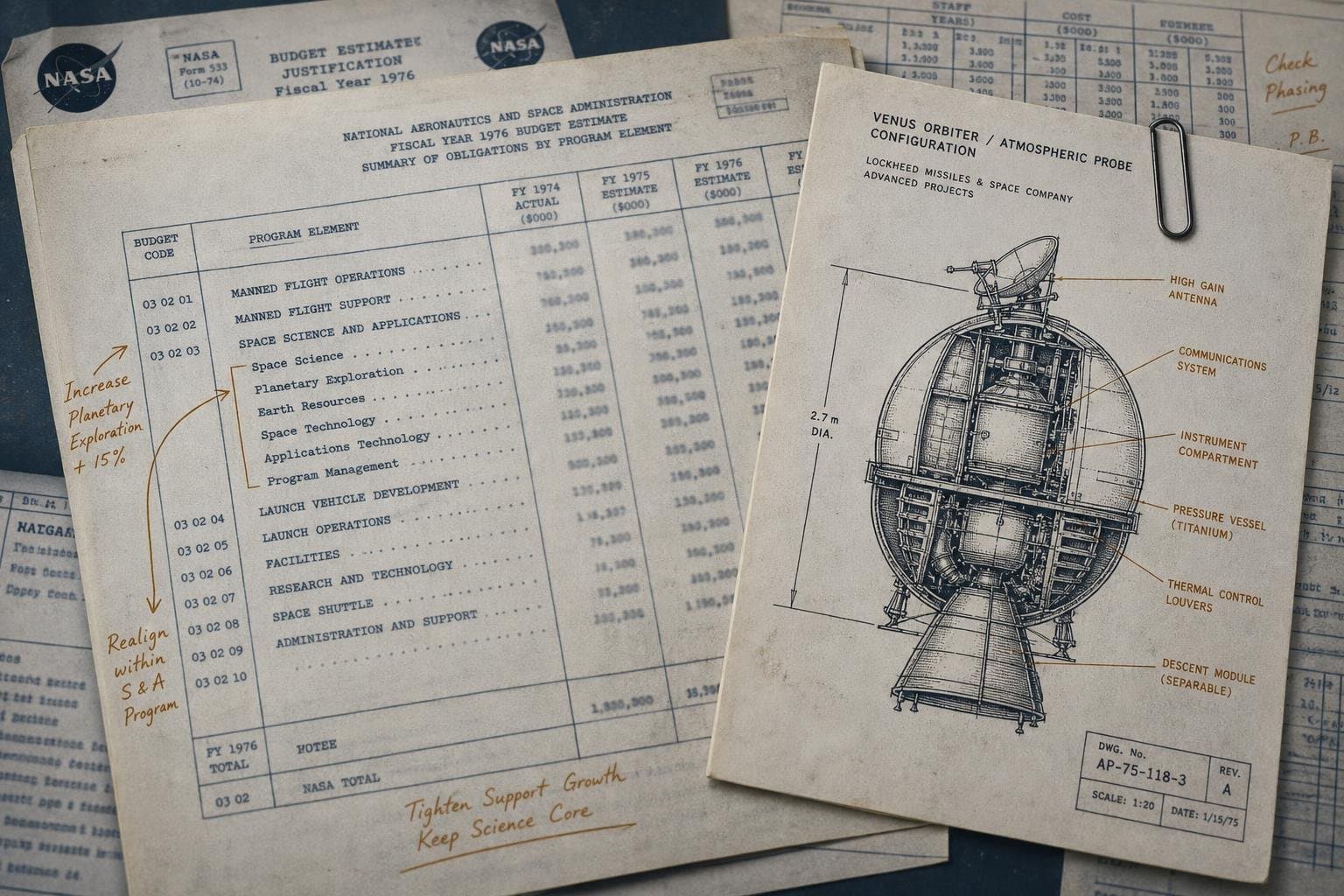

Here's a story that sounds almost mundane until you notice what it reveals: NASA's long-planned missions to Venus looked headed for cancellation, and now, according to Ars Technica, they're not. No dramatic press conference, no triumphant NASA statement — just a quiet walk-back from the edge. That's usually how science missions actually die or survive inside NASA's budget process. Not with headlines, but with a line item that either stays funded or quietly disappears between budget cycles.
The assigned question this week was "which missions are actually at risk." The honest answer, based on what's publicly documented right now, is narrower than that framing suggests. NASA doesn't publish a running scoreboard of which science missions are on the chopping block, and most of what circulates about specific cancellations is speculation built on budget request language that changes every cycle. What we do have is one concrete case — the Venus program's reprieve — and a clearer picture of where NASA's leadership is choosing to point its remaining discretionary dollars.
The Venus Reversal Is a Case Study, Not a Trend Line
Ars Technica reports that NASA's Venus-bound science effort faced a real cancellation threat and has since been put back on a stable footing. That's worth taking seriously precisely because it's rare: missions that get flagged for cancellation in a budget request don't usually come back. When they do, it's typically because of a mix of congressional pushback, scientific community lobbying, and political calculation about what a cancellation would cost the administrator politically versus what keeping it funded costs the budget. The fact that this one survived is a data point about leverage, not proof that NASA's science budget is suddenly healthy.
What it doesn't tell us is anything about the dozens of other missions in the queue — astrophysics, heliophysics, planetary science programs that haven't generated enough public attention to produce a reversal story. NASA's FY 2026 budget request is the actual document where those decisions live, and it's the place to look for specifics rather than secondhand summaries. I'd rather tell you that than make up a list of "at-risk missions" based on vibes.
Where the Money Actually Seems to Be Moving
The more revealing document this week isn't about what NASA is cutting — it's about what NASA is building toward. The agency released its long-awaited request for proposals to commercial companies to build private space stations that would succeed the International Space Station starting as early as 2030, per Ars Technica. Administrator Jared Isaacman framed the move explicitly in budget-tradeoff terms: commercial stations, he said, "may provide that capability while creating new opportunities for American industry and allowing NASA to concentrate more of our resources on the near-impossible missions ahead."
That's the clearest public statement of NASA's current resource logic: offload low-Earth-orbit infrastructure to industry so the agency can redirect funding toward exploration and science that only NASA can do. It's a defensible strategy on paper. Whether it actually frees up science dollars, or just shifts them into Artemis and human spaceflight priorities that compete with planetary science and astrophysics for the same shrinking pie, is the part nobody's published numbers on yet. Industry responses to that solicitation are due December 8, with NASA planning to select two or more contractors and make a final decision in April — a real near-term checkpoint worth watching, separate from any science-budget story.
What's Actually Verifiable Right Now
SpaceNews has described Isaacman as someone "trying to reshape the agency" while juggling an unusually high public profile for a NASA administrator. That reshaping instinct — visible in the commercial station push and in whatever political capital got spent saving the Venus program — is the throughline here. NASA's budget fights this year aren't being settled by a single dramatic cut. They're being settled mission by mission, in negotiations that mostly happen out of public view until something either survives or doesn't.
The honest takeaway: don't trust any list claiming to know exactly which science missions are doomed right now. Watch the actual budget documents as they move through Congress, watch which missions get public reprieves like Venus did, and watch whether the commercial station transition genuinely frees up science funding or just becomes the next thing competing for it.