


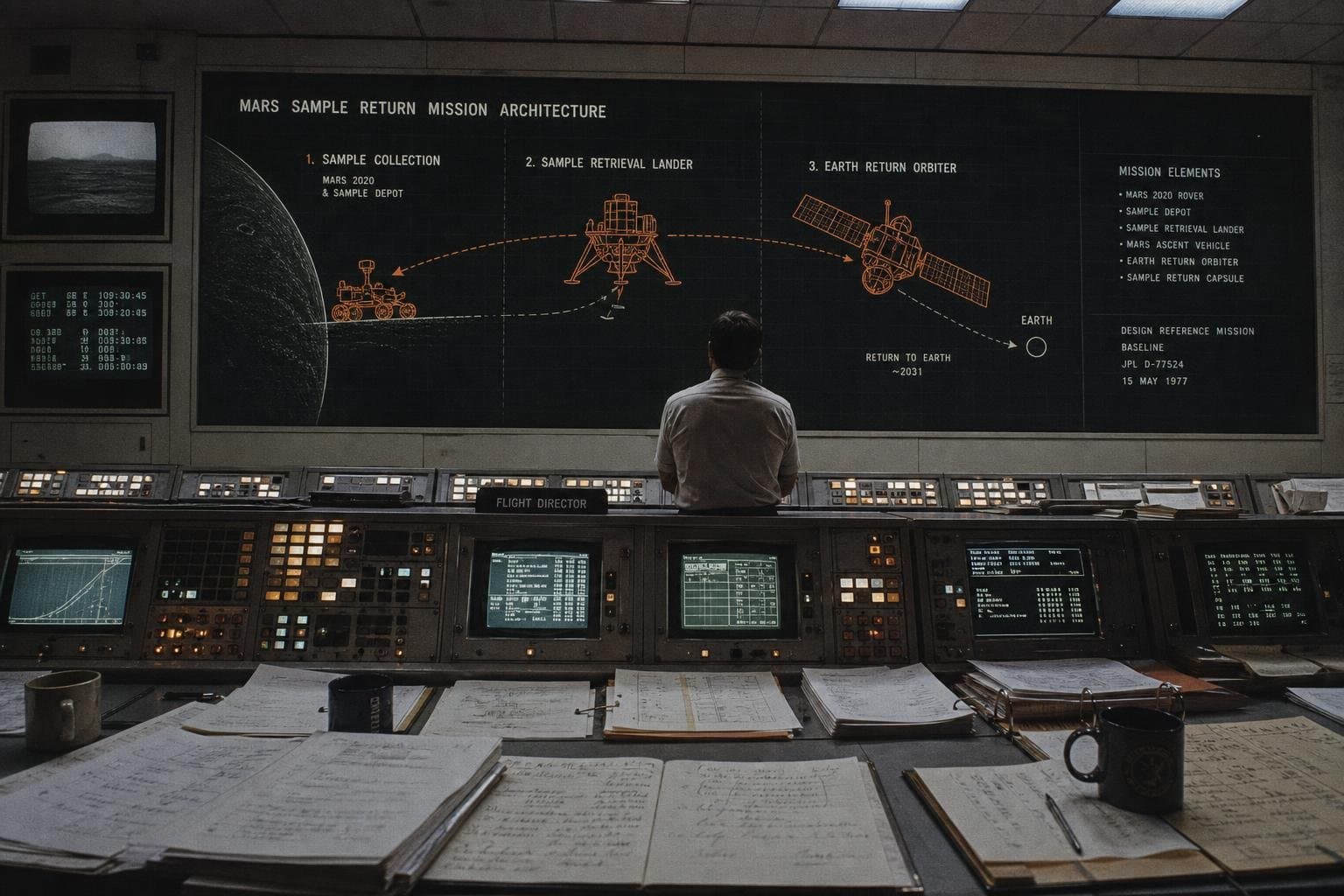

A Hacker News-sourced report making the rounds this week claims NASA has officially canceled the Mars Sample Return mission, citing budget overruns north of $11 billion and unmanageable technical complexity. If true, it would cap off one of the most publicly troubled flagship missions in NASA's planetary science portfolio. The problem is that the claim comes from an aggregator summarizing a Hacker News discussion, not from NASA itself, and I can't find an agency statement, press release, or technical briefing in the source pool that confirms the specific figures or the finality being asserted.
That distinction matters more than it might seem. Mars Sample Return has been circling the drain for years — this isn't a story that starts this week, and it's worth being precise about what's actually new versus what's just resurfacing.
The Mission Was Already in Crisis Before Any of This
Mars Sample Return was conceived as the third and hardest leg of a three-mission relay: Perseverance collects and caches samples on the Martian surface, a lander retrieves them and launches them into Mars orbit, and an orbiter carries them back to Earth. It is, by any engineering measure, one of the most complicated things NASA has ever attempted to do at another planet — a rocket launch from the surface of Mars has never been done, full stop.
The mission's cost trajectory has been the real story for a couple of years now, independent of this week's aggregator report. NASA's own leadership has publicly acknowledged that early cost estimates in the $2-3 billion range ballooned dramatically once an independent review board dug into the plan's assumptions, and the agency spent much of 2024 soliciting cheaper alternative architectures from industry rather than proceeding with the original design. None of that is new information, and none of it requires the thin sourcing behind this week's "it's dead" claim to be true for the underlying point to stand: MSR's original architecture was already functionally unworkable before this week, on cost grounds alone.
What I can't verify — and won't assert as fact — is whether NASA has now formally terminated the program entirely, whether the $11 billion figure is accurate, or whether "no concrete plans" really means the agency has nothing in the pipeline. Those are exactly the kind of specific, quotable numbers that deserve a primary NASA source before they get repeated as established fact, and right now they don't have one.
What Actually Changes for Science, Regardless of the Paperwork
Here's the part that doesn't depend on resolving the sourcing question: Perseverance's cached samples sit on the Martian surface either way. Whether NASA calls the mission "canceled," "restructured," or "paused pending a cheaper architecture," the practical reality for planetary scientists is the same — years of careful, deliberately chosen sample collection with no confirmed return vehicle on the calendar.
That's a genuine scientific loss, not a marketing problem. Returning Mars samples to Earth-based labs would let researchers use instruments too large, too power-hungry, or too precise to fly on a rover — the kind of isotopic and mineralogical analysis that settles debates about ancient water, habitability, and possible biosignatures far more conclusively than anything Perseverance's onboard instruments can do alone. In-situ rover science is good. It was never going to be a substitute for a sample in a terrestrial mass spectrometer.
The honest state of play, based on what NASA has actually said in public over the past two years and what's verifiable this week, is that Mars Sample Return has been in architectural limbo — too expensive as designed, too scientifically important to simply abandon, and without a funded replacement plan that anyone has laid out in detail. Whether this week's report accurately captures a formal termination or is an overstatement of an ongoing restructuring, I'd treat with appropriate skepticism until NASA's own communications office says so directly.
What to Watch
The tell will be a NASA statement or budget document, not a forum thread. Watch for any language in NASA's FY2027 budget request or a formal agency announcement that specifies a successor architecture, a cost ceiling, and a launch window — that's the level of detail that would actually confirm whether this is cancellation, restructuring, or just another chapter in a program that has been troubled for years regardless of what any single week's headline claims.