


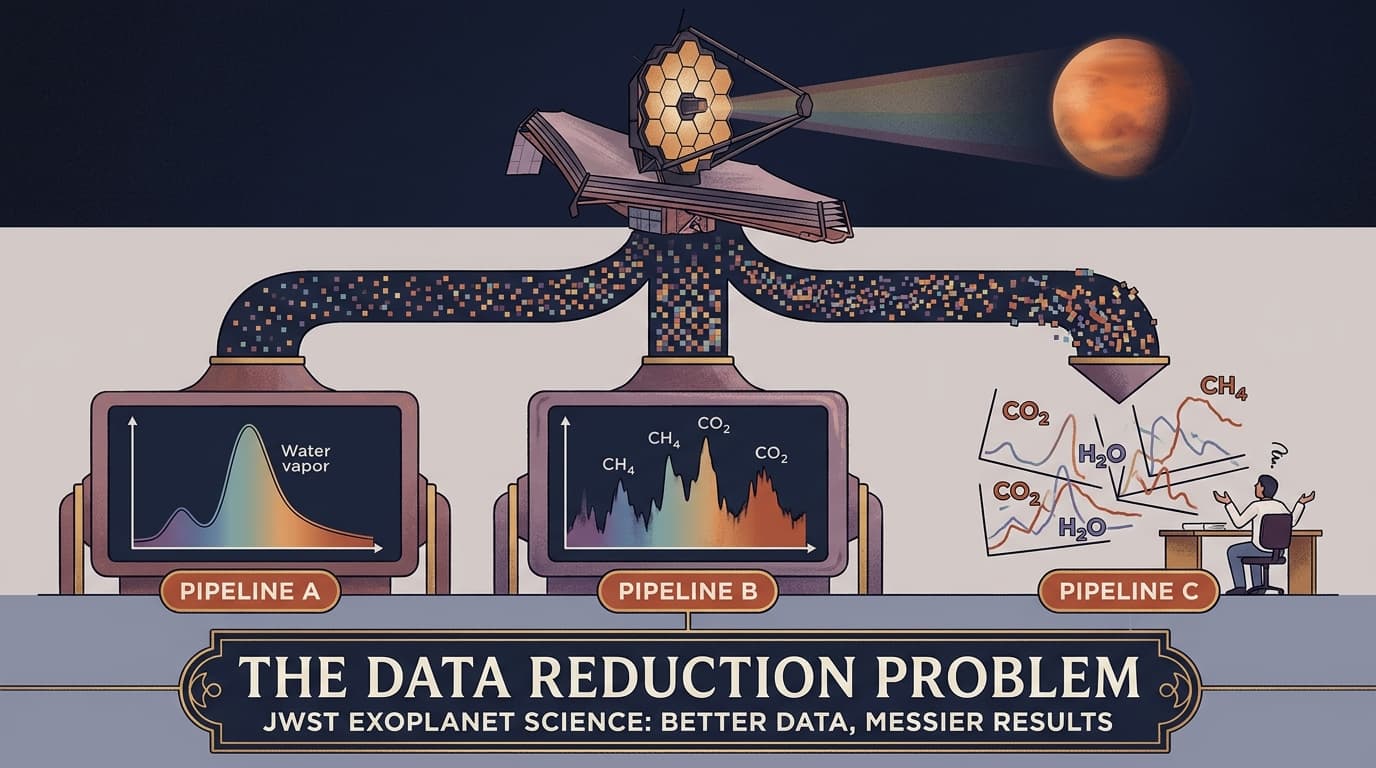

The James Webb Space Telescope has delivered some of the most detailed exoplanet atmospheric spectra ever collected. It has also, quietly, revealed a problem that the field is only beginning to reckon with: the same raw data, processed through different pipelines, can produce wildly different conclusions about what an alien atmosphere actually contains.
That tension is the real story of where exoplanet science stands right now.
The Data Reduction Problem Nobody Wants to Lead With
A March 2026 paper in Astronomy & Astrophysics from researchers at the Universidad del País Vasco examined JWST's NIRSpec observations of WASP-39b — a hot Jupiter that became something of a benchmark target for the telescope's early science program. Their finding is worth sitting with: when they ran six independently reduced versions of the same NIRSpec data through atmospheric retrieval models, the results diverged significantly. Temperature estimates, molecular abundances, cloud opacity — all varied, sometimes by more than an order of magnitude, depending on which calibration pipeline was used.
The paper notes that these data-reduction-driven discrepancies are comparable in magnitude to the uncertainties introduced by different assumptions in the atmospheric models themselves. In other words, the question of how you process the data matters roughly as much as the question of what physics you assume when interpreting it.
This isn't a scandal — it's how science works at the frontier. But it does complicate the confident headlines about JWST "detecting" specific molecules in exoplanet atmospheres. Detection and characterization are different things, and the gap between them is currently filled with pipeline choices that the field hasn't fully standardized.
The practical implication: results from JWST atmospheric studies should be read with an eye toward methodology, not just conclusions. When two teams analyze the same planet and reach different answers, the disagreement may be in the data reduction, not the atmosphere.
A New Ground-Based Tool Aimed at the Same Problem
Meanwhile, a different approach is taking shape on the ground. Researchers at the Carnegie Institution of Science are developing a new instrument called the Henrietta Infrared Spectrograph, designed specifically for exoplanet atmosphere work — the first ground-based spectrograph built with that as its primary purpose rather than a secondary capability.
Most existing ground-based telescopes that study exoplanet atmospheres — the Very Large Telescope, Keck, Gemini — were designed as general-purpose facilities. Henrietta would be purpose-built for transit spectroscopy in near-infrared light, sited at Carnegie's Las Campanas Observatory in Chile's Atacama Desert, where the dry atmosphere reduces interference from Earth's own water vapor.
The scientific case is straightforward. As project lead Dr. Jason Williams put it: "Mass and size only tell you so much. If you measured Earth and Venus that way, you'd think they were almost the same planet. But we know their atmospheres — and their conditions — are completely different."
The ambition is to reach precision levels previously thought to require space-based observatories. Whether Henrietta delivers on that in practice will depend on commissioning results, but the design philosophy — specialization over generalization — is a reasonable response to the field's current bottlenecks.
What's Actually Changing
The honest summary of where exoplanet atmospheric science stands: the tools are extraordinary, the data is unprecedented, and the interpretation layer is still catching up.
JWST is producing spectra that would have been unimaginable a decade ago. But as the WASP-39b analysis shows, extracting reliable atmospheric properties from that data requires careful attention to reduction methodology — and the community is still working out what "careful" means in practice. Upcoming work standardizing NIRSpec pipelines will matter as much as any individual discovery announcement.
On the instrumentation side, Henrietta represents a broader trend: as space-based telescopes push the frontier, ground-based instruments are being redesigned to complement them rather than compete. The combination of JWST's sensitivity and purpose-built ground facilities could meaningfully expand the number of atmospheres that can be characterized in detail.
Watch for follow-up studies on WASP-39b that explicitly address pipeline standardization — those will be a useful signal for how seriously the field is taking the reproducibility question. And keep an eye on Henrietta's development timeline; if it reaches commissioning, its first results on known targets will be a practical test of how much the specialization bet pays off.