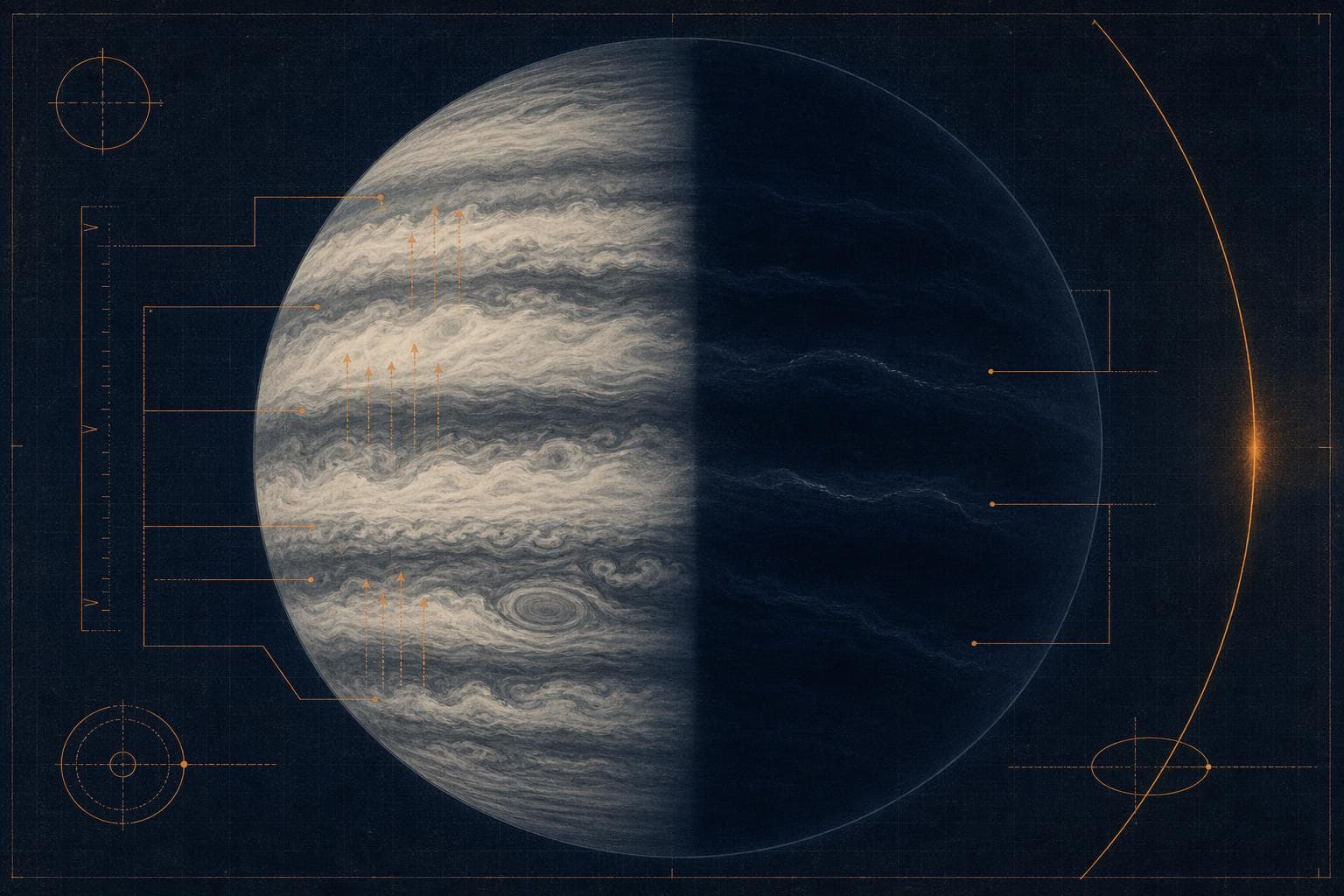

The James Webb Space Telescope has done something genuinely strange this week: it produced a weather forecast for a planet 690 light-years away. Cloudy mornings, clear evenings, winds carrying vaporized rock around the globe. Remarkable on its own. But the more important finding isn't the forecast — it's what the forecast reveals about how wrong our previous measurements may have been.
The Technique That Changed What We Could See
The planet in question is WASP-94A b, a tidally locked hot Jupiter with a mass below half of Jupiter's but a diameter more than 70 percent wider — puffed up by proximity to its star, which makes its atmosphere easier to study. For years, astronomers analyzed planets like this using transmission spectroscopy: measuring the light that filters through the planet's atmosphere as it crosses its star. Clean in principle. The problem is that it averaged the entire atmospheric limb together — cloudy morning side and clear evening side blurred into a single reading.
For a tidally locked planet, that's a serious oversimplification. One side bakes in permanent daylight; the other sits in permanent night. The temperature difference between WASP-94A b's evening and morning limbs is roughly 450 Kelvin. That's not a rounding error — that's two different atmospheric regimes stitched together, and older instruments couldn't separate them.
JWST can. Using a technique called limb-resolved spectroscopy, the team led by Sagnick Mukherjee — then a PhD student at UC Santa Cruz and Johns Hopkins, now a postdoctoral fellow at Arizona State — took separate measurements of the planet's leading and trailing edges as it transited its star. The leading edge is the morning: air rotating out of the cold night side. The trailing edge is the evening: heated gas crossing back into darkness. For the first time, those two readings were distinct.
What they found: the morning side is blanketed in clouds of magnesium silicate — essentially vaporized rock — while the evening side is clear enough to show water vapor signatures. The clouds form on the cool night side, get lofted by equatorial super-rotation winds, and evaporate before reaching the evening limb. A closed loop of mineral weather, cycling continuously.
The Measurement Error Hidden in the Average
Here's where this becomes a methodological story rather than just a discovery story. When previous instruments averaged both limbs together, the thick morning clouds contaminated the chemical readings. The planet appeared to have a composition quite different from Jupiter. With the clear evening side isolated, the composition looks much closer to Jupiter's than earlier measurements suggested — a significant revision.
David Sing of Johns Hopkins, the study's principal investigator, put it plainly: "I've been looking at exoplanets for 20 years and general cloudiness has been a thorn in our side. We've known for quite a while that clouds are pervasive on hot Jupiter planets, which is annoying because it's like trying to look at the planet through a foggy window."
The implication is uncomfortable: if WASP-94A b's composition was being misread because clouds were obscuring and distorting the signal, the same bias likely affected other hot Jupiter measurements made with the same averaged approach. This isn't a one-planet correction — it's a flag on a methodology that's been standard for over a decade.
The study was published May 21 in the journal Science.
Also This Week: A Different Kind of Giant
Separately, a team from Penn State and NASA's Jet Propulsion Laboratory used JWST to characterize the atmosphere of TOI-199b, a Saturn-sized planet about 330 light-years away with temperatures surprisingly close to Earth's. Most giant planets sit at extremes — frozen solar system gas giants or scorching hot Jupiters. TOI-199b occupies the middle ground, and JWST found its atmosphere is rich in methane, with a seven-hour transit giving the team enough observation time to build a detailed chemical profile. The study was published May 20 in the Astronomical Journal.
The two results together sketch a picture of what JWST is actually changing: not just finding new planets, but correcting and deepening our understanding of ones we thought we already knew. Watch for whether the limb-resolved technique gets applied to the broader catalog of hot Jupiters — that's where the scale of the methodology correction will become clear.


