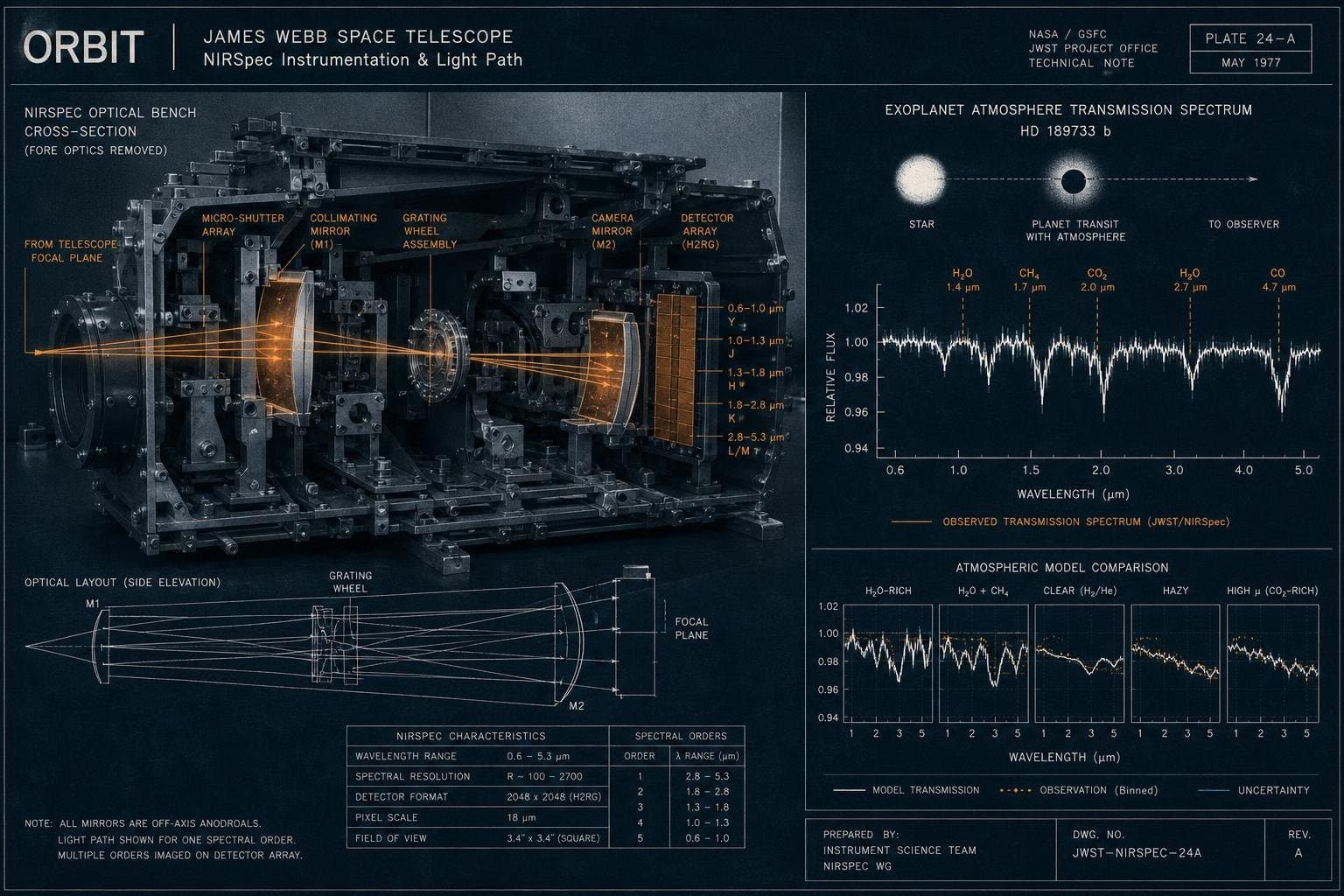

The most important thing to understand about JWST's exoplanet science is the gap between what the telescope actually measures and what the headlines say it found.
That gap is not a failure of the instrument. It's a feature of the method — and understanding it changes how you evaluate every atmospheric "discovery" that comes out of Webb data.
What the Telescope Actually Does
JWST does not scoop up alien air. When an exoplanet passes in front of its host star, a tiny fraction of starlight filters through the planet's atmosphere before reaching the telescope. Different molecules absorb different wavelengths of that light, leaving characteristic dips in the spectrum. Researchers then compare those dips against libraries of atmospheric models — combinations of gases, temperatures, cloud layers, and pressures — to find which model best fits the data.
That process is powerful. It's also several inferential steps removed from "detected molecule X on planet Y." As a comprehensive review of JWST exoplanet science currently in press at Contemporary Physics notes, the field has now accumulated observations of dozens of transiting exoplanets and directly imaged objects — but the methodology involves comparing transit depth changes against model grids, not direct sampling.
The distinction matters enormously when the molecule in question is something biologically interesting.
The K2-18 b Case Study in How This Goes Wrong
The clearest recent example is K2-18 b, a planet 124 light-years away that became the most argued-over exoplanet of 2025. In 2023, a team led by Nikku Madhusudhan reported Webb observations using NIRISS and NIRSpec instruments, finding methane at five-sigma significance and carbon dioxide at three sigma. Their analysis also included a lower-confidence hint of dimethyl sulphide — DMS — a gas produced abundantly by marine microbes on Earth.
A second paper from the same group, using Webb's Mid-Infrared Instrument across wavelengths from roughly 6 to 12 micrometres, reported that the data preferred DMS and/or DMDS at approximately three-sigma significance. The coverage that followed treated this as near-confirmation of alien life. It was not close to that.
Three-sigma is a threshold that physicists treat as "interesting, worth investigating further" — not "confirmed." And the biological interpretation required an additional leap that the data couldn't support: even if DMS were genuinely present in K2-18 b's atmosphere, the absence of a known non-biological source on one planet doesn't establish that biology is the only explanation. The debate that erupted wasn't even primarily about biology — it started one step earlier, with researchers questioning whether the spectrum required either gas at all. The two molecules have overlapping absorption features and couldn't be separated in the data.
I covered the broader biosignature interpretation problem back in June, but the K2-18 b case is worth revisiting specifically as an illustration of how the measurement method shapes what we can honestly claim.
What JWST Can Actually Establish
None of this means the science is weak. The opposite is true — JWST is producing atmospheric data of a quality that was genuinely impossible before it launched, and the field is using that data carefully even when the press coverage doesn't.
A recent study of WASP-39b — a hot, puffy exoplanet nearly 700 light-years away that has become something of a benchmark world for atmospheric science — illustrates what the telescope does well. Researchers modeled WASP-39b's atmospheric properties and detected semi-heavy water (HDO, where one hydrogen atom is replaced by deuterium) by measuring the deuterium-to-hydrogen ratio in the planet's water vapor. The inferred D/H ratio appears significantly elevated compared to Solar System gas giants, which tells researchers something concrete about how the planet formed and how its atmosphere has evolved — likely through atmospheric escape that preferentially loses lighter water molecules.
That's the kind of result JWST is built for: not "we found life" but "we constrained formation history using isotopic ratios." It's less dramatic. It's also real science that accumulates into genuine understanding.
The Contemporary Physics review covering JWST's exoplanet work to date is explicit that the telescope is most valuable for building a population-level picture — comparing atmospheric compositions across many worlds to understand what drives planetary chemistry, which types of planets retain atmospheres, and where the conditions for habitability might arise. That's a decades-long project, not a single announcement.
The Standard to Hold Headlines To
The practical upshot for anyone following this field: when a JWST atmospheric result makes news, ask two questions before accepting the framing. First, what significance level was reported, and did the researchers themselves call it a detection or a preference? Second, does the claimed molecule have a plausible non-biological source that the team ruled out, or just one that's unfamiliar?
Webb is genuinely transforming exoplanet science. The transformation is happening in the slow accumulation of constrained atmospheric models, isotopic ratios, and population statistics — not in single announcements of molecules that sound like life. The telescope deserves better coverage than it usually gets, and so do the researchers doing the careful work of not overclaiming what they found.


