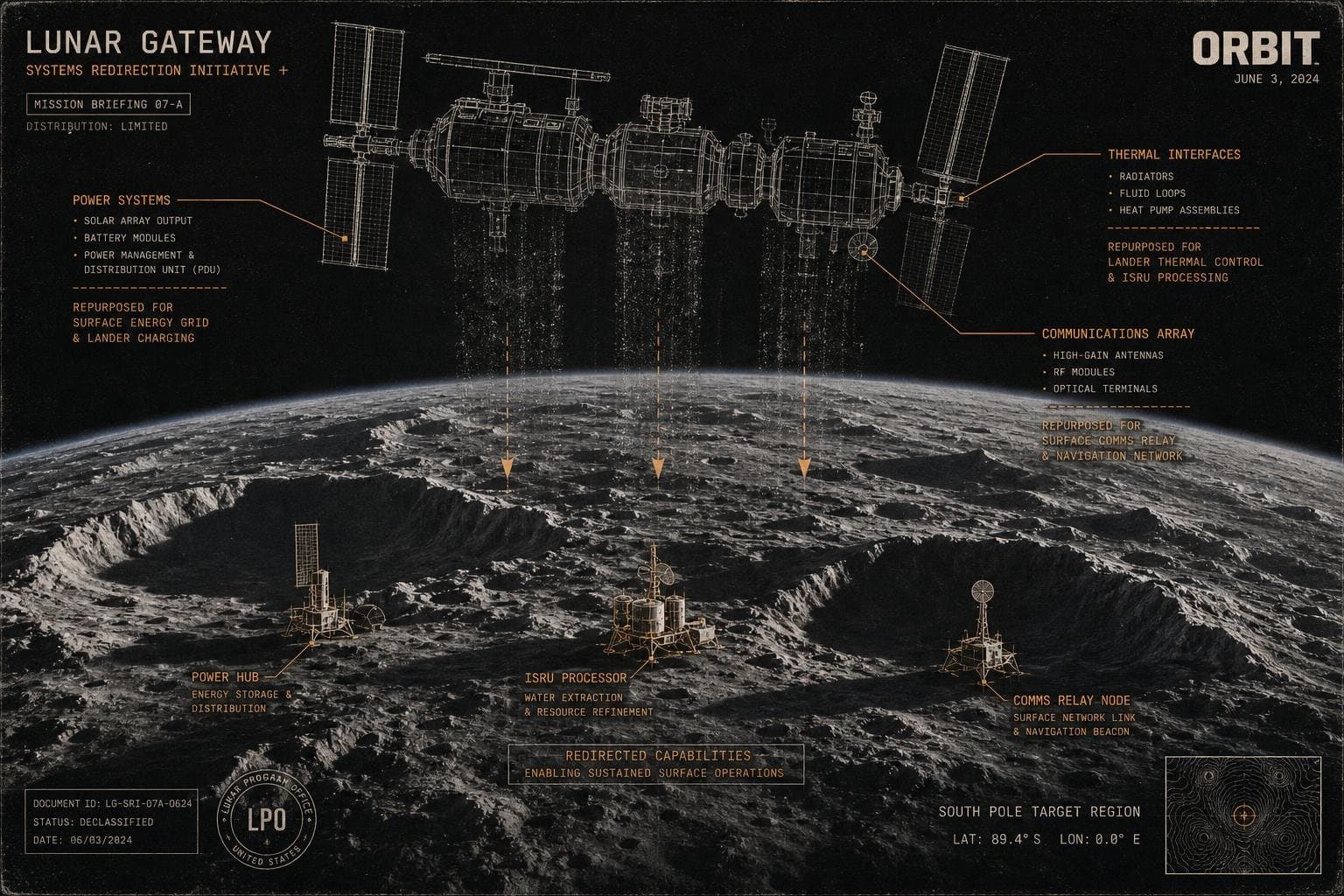

Last week, Northrop Grumman announced it would take the hardware it built for the lunar Gateway and land it on the Moon instead. The Canadian Space Agency made a similar pivot. Neither announcement came with firm launch dates or cost figures. What they did come with was an implicit admission: the argument for putting a station in lunar orbit, rather than on the surface, has quietly collapsed — and the industry is now scrambling to find new homes for hardware that was designed around a concept NASA has abandoned.
I wrote about Gateway's cancellation back in late June, when the program's formal end was becoming clear. What's new this week is the downstream consequence: we can now see what "repurposing" actually looks like, and it raises a sharper question than Gateway's cancellation did. Was the orbital approach ever the right one for this phase of lunar exploration — or did it just take a decade to admit that surface infrastructure is where the real work happens?
What Northrop Is Actually Doing With HALO
According to SpaceNews, Northrop Grumman announced on August 4 that it will reuse hardware and technologies from its Habitation and Logistics Outpost — the HALO module it had been building for Gateway — for a series of lander missions called Lunar Infrastructure Demos, or LIDs. Three missions are planned, each carrying power, data, and mechanical interfaces originally developed for an orbital station, now redirected toward demonstrating how surface assets can survive lunar night and shadow.
NASA confirmed it will fly these payloads through its Commercial Lunar Payload Services program. The agency described the HALO systems as "now being repurposed following NASA's shift from an orbital-focused lunar strategy to one centered on surface operations."
That's a candid sentence. Read it slowly: NASA is explicitly describing a strategic shift, not a minor program adjustment. The question worth sitting with is whether the orbital strategy was ever well-matched to what lunar exploration actually requires at this stage — or whether Gateway was solving a problem that didn't yet exist.
The Orbit-vs.-Surface Tradeoff Isn't Philosophical
There's a real engineering argument for orbital infrastructure, and it deserves a fair hearing before dismissing it. A station in lunar orbit — specifically the near-rectilinear halo orbit Gateway was designed for — offers a staging point that doesn't require landing and ascending every time you want to transfer crew or cargo. It provides a communications relay, a habitat that doesn't have to survive the lunar surface environment, and a platform for deep-space missions beyond the Moon.
The problem is sequencing. That argument makes sense when you already have frequent, reliable surface access and need to optimize the logistics of a mature operation. It makes much less sense when you're still figuring out how to keep power systems alive through a two-week lunar night, how to handle dust contamination of mechanical interfaces, and whether your landers can hit their target zones consistently. Those are surface problems. You learn them on the surface.
NASA's Moon Base planning frames the South Pole outpost as a step-by-step buildup through robotic and crewed missions — a sequenced approach that prioritizes learning how to operate in the actual environment before optimizing the logistics chain around it. That framing implicitly concedes that orbital infrastructure is a later-phase problem. The LID missions Northrop is now planning — testing power systems, thermal management, and communications through lunar night — are exactly the kind of foundational data you need before you can sensibly design what comes next.
The Honest Accounting
What the Gateway pivot reveals is that orbital infrastructure wasn't wrong in principle — it was premature in practice. A lunar Gateway makes more sense as the fifth or sixth major capability in a mature cislunar system than as the second or third. NASA spent years and significant resources building toward it before that sequencing problem became undeniable.
The Northrop repurposing is, in a narrow sense, good news: hardware that might have been written off is finding a new application, and the LID missions will generate real data about surface power and thermal systems that NASA explicitly says it needs to "shape Artemis surface campaigns and long-duration lunar operations." That's useful work. The announcement just didn't come with launch dates, funding mechanisms, or cost figures — which means the pivot is real, but the execution timeline remains an open question.
The sharper lesson isn't about Gateway specifically. It's about the tendency to design for the mature state of a program rather than its current one. Surface camps are unglamorous. They're dusty, thermally brutal, and operationally constrained in ways that an orbital station isn't. But they're where the actual unknowns live right now — and solving them is what makes the orbital infrastructure argument coherent later.
NASA's broader Moon Base framework describes the discoveries and lessons learned at the surface as the foundation that will "help shape the future of exploration, from the Moon to Mars." That's the honest sequencing: surface first, orbit later, when there's actually something in orbit worth supporting. Watch for whether the LID missions get firm launch assignments in NASA's Phase One Moon Base schedule, which runs through 2029. That's the real test of whether this pivot has teeth or is just hardware looking for a mission.


