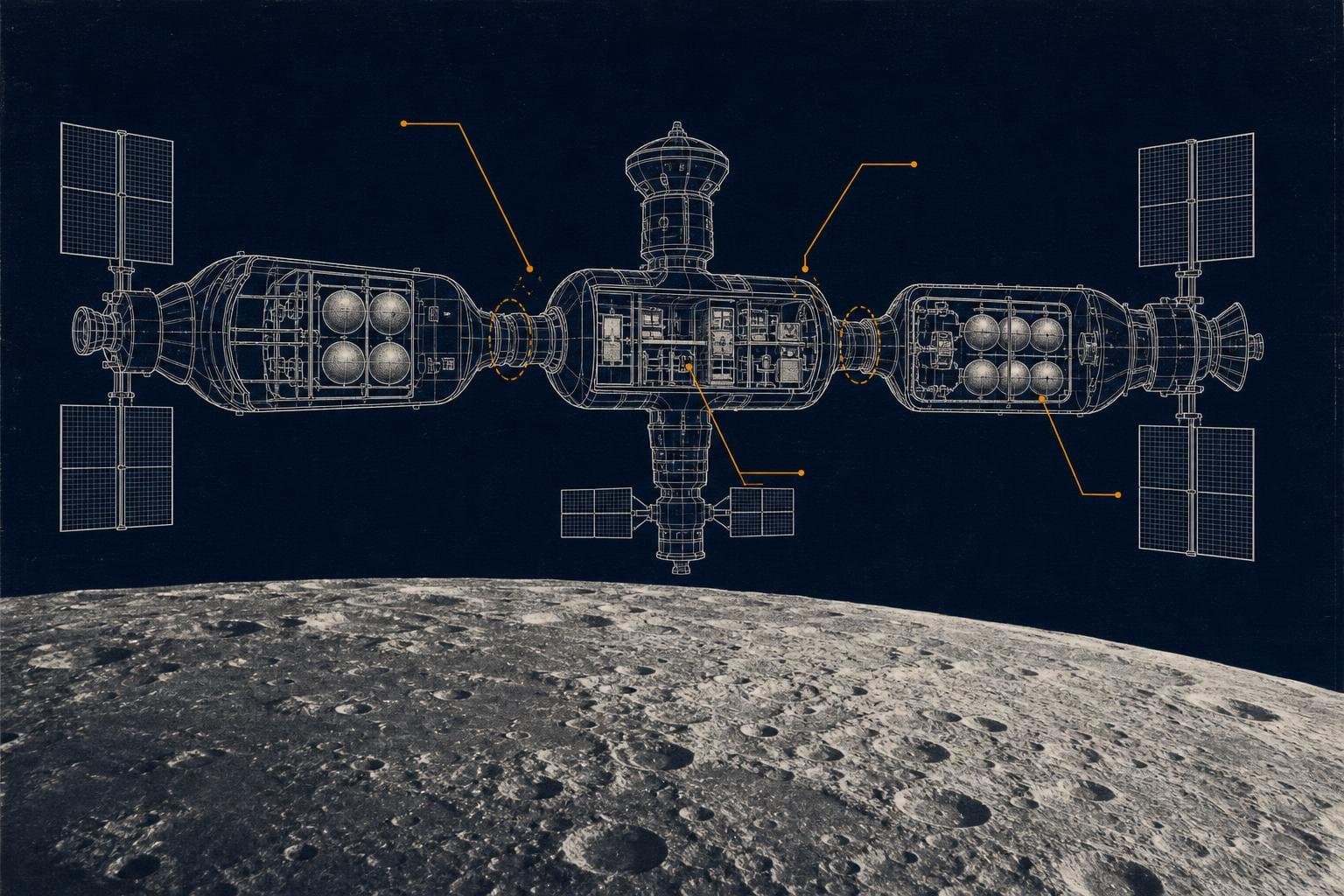

Three months ago, NASA Administrator Jared Isaacman stood at a podium and effectively canceled the Lunar Gateway. The "Ignition" event in March reoriented NASA's human spaceflight program away from a space station in lunar orbit and toward a base on the Moon's surface. The habitation module, the upgraded rocket stage, the larger launch tower — all gone, or going. NASA's inspector general subsequently confirmed what critics had long suspected: combined contract values for these programs had ballooned from roughly $2.8 billion to $5.9 billion, with delivery dates slipping by up to seven years.
So Gateway is finished as a near-term program. But the underlying question — why orbit a destination rather than just land on it — deserves a cleaner answer than "it cost too much." Because that answer is about execution, not concept. And the concept still matters for wherever human spaceflight goes next.
What Orbit Actually Buys You
The case for a lunar orbital station was never primarily about the Moon. It was about access architecture.
Landing on the Moon requires a descent, a surface stay, and an ascent back to whatever is waiting in orbit. If nothing is waiting in orbit, you need a vehicle capable of the entire round trip — or you need to launch everything from Earth on a single stack. That's the Apollo model, and it worked, but it required enormous rockets and left no margin for error or reuse.
A station in lunar orbit changes the math. It becomes a waypoint: a place to stage fuel, swap crews, park hardware between missions, and reduce the mass each individual vehicle needs to carry. NASA's Gateway overview describes it as a "multi-purpose outpost" — the kind of language that sounds like marketing but reflects a real engineering logic. Modularity and reuse are how you drive down per-mission cost over time.
The problem is that "over time" is doing enormous work in that sentence. The upfront cost of building and deploying the station has to be paid before any of those efficiencies materialize. And as the inspector general's report makes clear, NASA's execution on the enabling hardware was poor enough that the upfront cost kept growing while the timeline kept slipping — making the break-even point recede indefinitely.
The Cancellation Was About Management, Not Physics
Isaacman's critique at the Ignition event was pointed: "For too long we tried to satisfy every stakeholder. Billions of dollars wasted. Years lost. Hardware that never launched." That's a program management indictment, not a verdict on orbital infrastructure as a concept.
Northrop Grumman's HALO module — the habitation component that would have been Gateway's core — was described by the company as the "most mature technology for deep space habitation," drawing on Cygnus spacecraft heritage from over 20 ISS resupply missions. Whether that claim holds up is hard to assess from the outside. But the inspector general's report suggests that even the most mature elements of the broader program were still not ready, and that completing them would have cost more and taken longer than what was already on contract.
That's a damning finding. It's also a finding about this program, managed this way, by these contractors, under these oversight conditions. It doesn't tell us that orbital waypoints are a bad idea — it tells us that NASA's mid-2010s acquisition strategy for building one was.
Where the Logic Goes From Here
NASA's pivot to a lunar surface base raises its own version of the same question. A surface base is also expensive to build, also requires significant upfront investment before operational benefits materialize, and also depends on reliable heavy-lift access. The Artemis program's Congressional Research Service summary traces how the program's ambitions have repeatedly outpaced its budgets — a pattern that predates the current administration and will outlast it if the underlying incentive structures don't change.
Meanwhile, the physical infrastructure supporting any of these ambitions remains stressed. A recent inspector general report on Kennedy Space Center found that aging roads, gas lines, and electrical systems are already straining under demand from Starship and New Glenn — and that the system cannot simultaneously support launches from multiple pads without scheduling conflicts. SpaceX has told NASA it plans to launch Starship every eight days from Kennedy. The ground infrastructure was not built for that cadence.
The surface-versus-orbit debate is, in some ways, a false binary. Long-duration lunar operations probably need both eventually. The question is sequencing and cost — and right now, NASA has decided that a surface presence is the more direct path to demonstrating sustained human presence beyond Earth orbit. NASA's Lunar Surface Innovation Initiative reflects that bet, directing technology investment toward in-situ resource use, surface power, and mobility rather than orbital staging.
That may be right. But anyone watching this space should hold the cancellation of Gateway and the promise of a surface base in the same analytical frame. The orbital station failed because its costs ballooned and its schedule slipped. The surface base will face the same pressures. Watch the inspector general's office, not the press releases, for the early warning signs.
The physics of why orbit matters hasn't changed. What changed is NASA's confidence that it could build the hardware on budget and on time. That's worth keeping separate — because the next architecture, whatever it is, will eventually have to answer the same orbital access question again.


