
Look up tonight and you can find Europa yourself — a faint pinprick lined up with Jupiter's three other Galilean moons, as last week's NASA Astronomy Picture of the Day showed when Earth's own Moon briefly lined up in front of the group. That image is a nice reminder of scale: Europa is barely smaller than our Moon, visible from a backyard telescope, and yet almost nothing about what's happening under its ice is settled science.
The spacecraft meant to change that is still years from getting there. Europa Clipper launched in October 2024 and, per NASA's mission FAQ as summarized by iBuidl, won't arrive until 2030. It's currently in the long cruise phase that defines most outer-planet missions — more coasting than science. The European Space Agency's Juice probe, launched a year earlier in April 2023 and aimed at Ganymede and Callisto, is in the same position, having made Earth flybys on its own slow route out, as the Washington Post reported in September. Two flagship missions, two long waits. Worth being clear now about what they're actually built to measure, before the "could this find alien life" headlines start writing themselves in 2030.
It's Not Hunting for Life. It's Hunting for the Conditions Life Needs.
Every Europa Clipper explainer eventually has to correct the same assumption. The mission is not equipped, and was never designed, to detect life directly. As planetary scientist Murthy Gudipati put it before launch, "We are not a life-finding mission. Europa Clipper's goal is to understand Europa's ocean and the moon's habitability," as reported by The Conversation.
NASA breaks that goal into three connected objectives, laid out in the mission's own documentation and summarized by ScienceInsights: characterize the ice shell and the ocean beneath it, characterize the surface and atmospheric chemistry (especially carbon-bearing compounds), and characterize the geology that connects the two. None of those objectives is "find a microbe." All three are plumbing questions — is there water, is there energy, is there the right chemistry, and does material actually move between the ocean and the surface where a spacecraft can sample it.
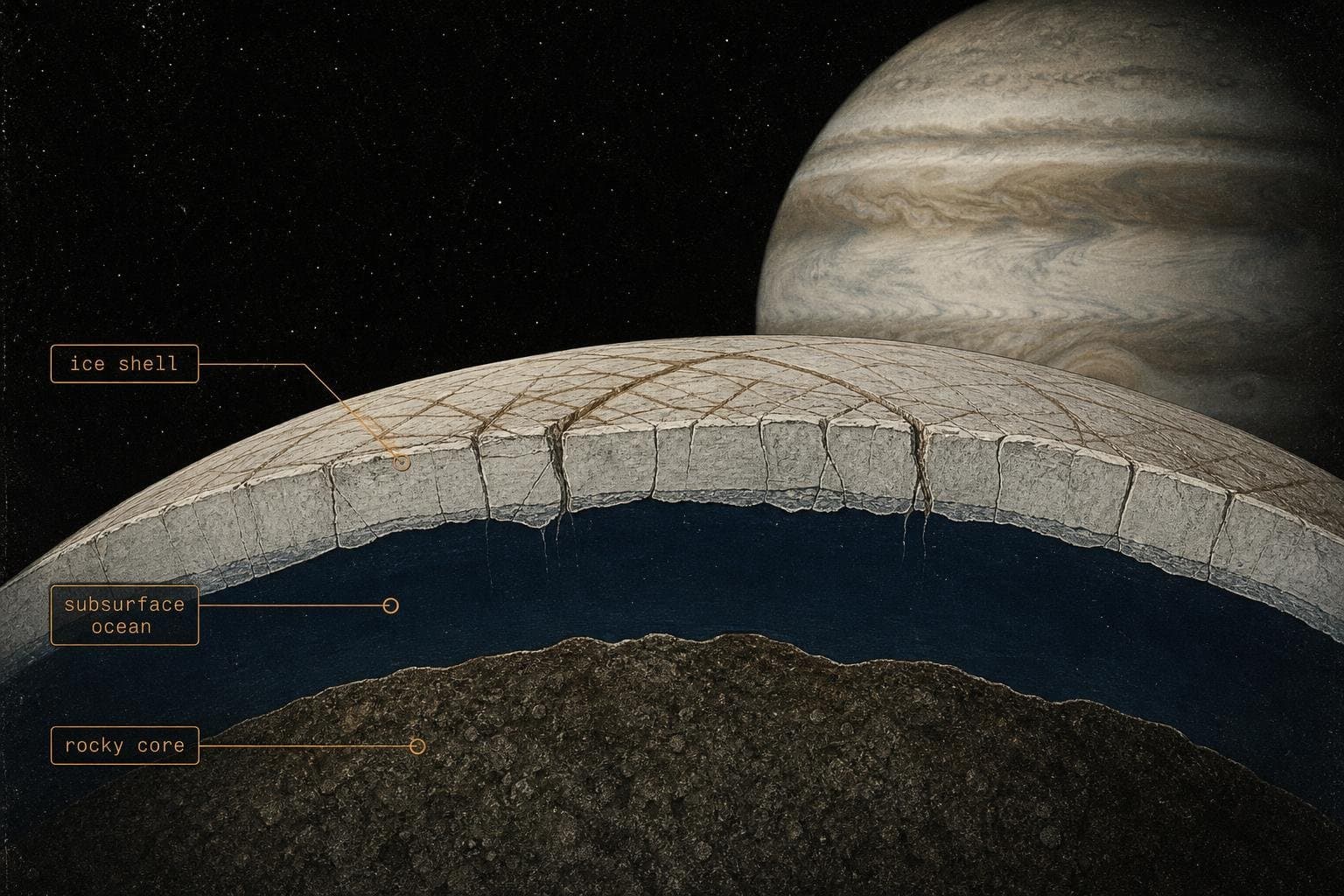
That last point matters more than it sounds. Europa's ocean is estimated to hold more than twice the volume of all of Earth's oceans combined, sitting under an ice shell scientists estimate at under 200 kilometers thick based on Galileo-era magnetic field data, per ScienceInsights. An ocean that size is scientifically useless to a flyby mission unless some of it reaches the surface. One of Clipper's nine instruments, the dust analyzer called SUDA, exists specifically to catch grains thrown up by surface plumes and trace their chemistry — and, as The Conversation reported, researchers recently found the instrument may be more capable of flagging biosignatures in that material than originally expected, should any exist. That's a notable sensitivity upgrade on paper. It's still a hypothesis about an instrument's reach, not a result — the plumes themselves haven't been confirmed to exist in a form Clipper will actually fly through.
Why It Won't Orbit the One Moon It's Named For
The engineering choice that shapes everything else: Europa Clipper will not orbit Europa. Jupiter's radiation belts are intense enough that parking a spacecraft there would fry its electronics quickly, so the mission instead orbits Jupiter itself and makes repeated close passes, descending as low as 25 kilometers above Europa's surface before retreating to safer distance, according to ScienceInsights. That's the real tradeoff baked into the mission design: shorter, repeated glimpses instead of sustained observation, stitched together across dozens of flybys rather than one continuous dataset.
That stitching is also where the mission will be easiest to oversell once results start arriving. As iBuidl's instrument atlas lays out, Clipper's cameras, radar, magnetometer, and chemical sensors each test a different physical question, and the strongest conclusions will come from several instruments agreeing on the same explanation — not from one striking image or one chemical signal. A single compelling photo of a crack in the ice will not, by itself, tell you what's happening in the ocean below it.
What to Actually Watch
Nothing from Clipper's science instruments is due for years. The milestones worth tracking between now and 2030 are the mundane ones — trajectory corrections, instrument checkouts during cruise, and whatever Juice turns up on its own slower path past Europa in the meantime. When Clipper's flyby campaign finally starts, the headlines that matter will be the ones that name which instruments agreed with each other, not the ones built around a single grainy frame.


