
The standard story of cosmic evolution goes something like this: the universe began in chaos, and order emerged slowly. Early galaxies were supposed to be messy, turbulent, still-assembling systems — raw material waiting to be shaped by billions of years of mergers, star formation, and gravitational settling. JWST keeps finding evidence that this story is wrong.
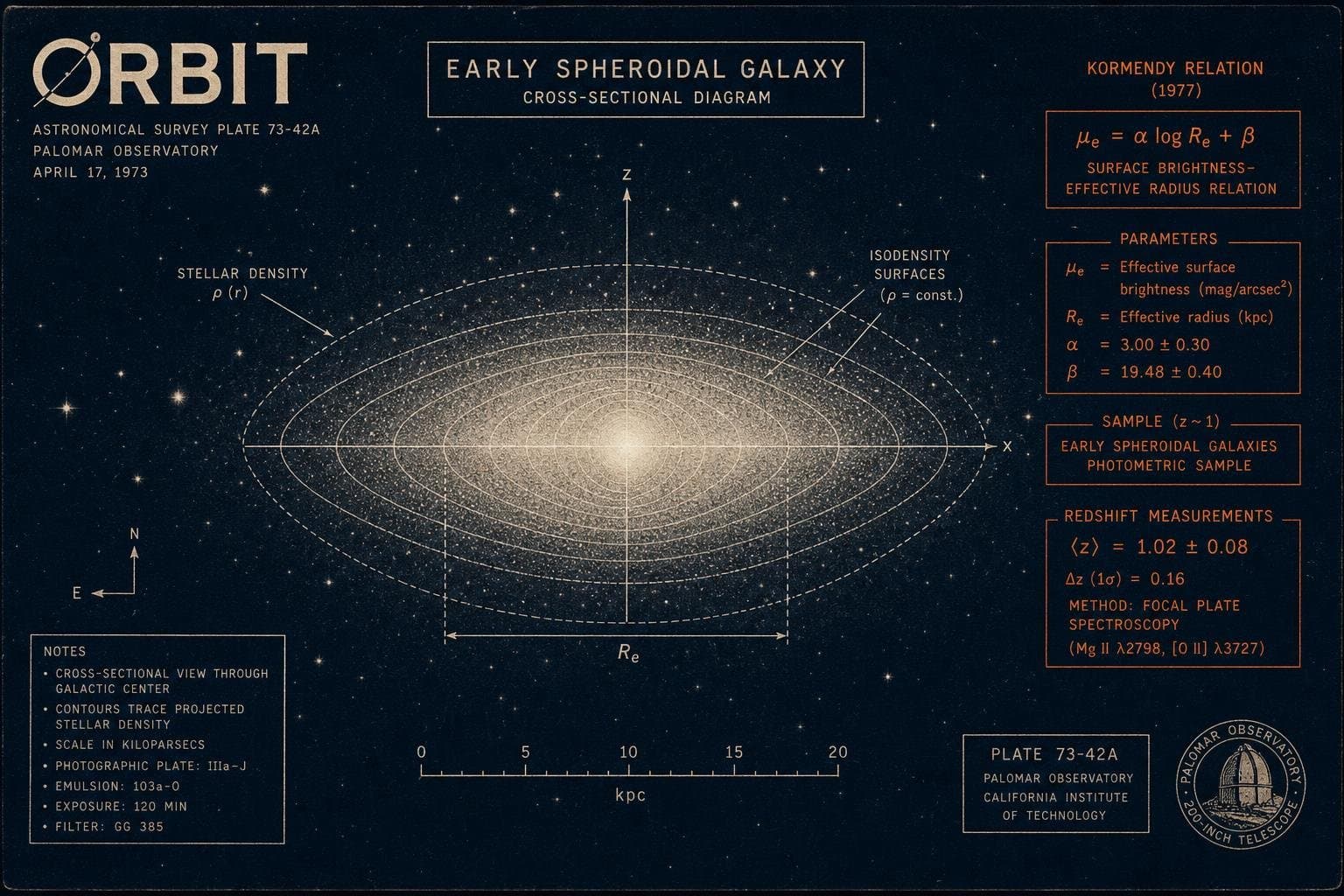
The latest challenge comes from researchers at the Inter-University Centre for Astronomy and Astrophysics (IUCAA) in Pune, who studied hundreds of very distant galaxies using publicly available JWST imaging. Their finding, published in The Astrophysical Journal Letters: the earliest spheroidal galaxies — those that existed when the universe was between roughly 400 and 900 million years old — already obeyed the Kormendy relation, one of the fundamental structural laws governing galaxy architecture.
That's not a minor footnote. It's a direct challenge to how we think galaxies form.
What the Kormendy Relation Actually Tells Us
The Kormendy relation links a spheroidal galaxy's size to its central surface brightness: brighter cores tend to be more compact. It's a scaling law that astronomers have used for decades as a diagnostic of how galaxies have been shaped by gravity, star formation, gas dynamics, and mergers over cosmic time. Until JWST, this relation had only been measured reliably for relatively nearby galaxies or those seen several billion years after the Big Bang — the first billion years of cosmic history were essentially off-limits because previous telescopes lacked the sensitivity and resolution to study them.
JWST changed that. And what the IUCAA team found in that newly accessible window is that the structural order we associate with mature, settled galaxies was already present less than a billion years after the Big Bang.
As Prof. Kanak Saha, who supervised the project, put it: these scaling relations encode how gravity, star formation, mergers, and gas dynamics shape galaxies over cosmic time. Finding them intact this early means either galaxies assembled far faster than our models predict, or the processes that produce this structural order operate differently in the early universe than we assumed. Neither answer is comfortable.
A Pattern, Not an Anomaly
This finding doesn't stand alone. It fits a pattern JWST has been building for the past few years.
NASA's early universe science program was designed precisely to probe this era — the cosmic dark ages and the period when the first stars and galaxies emerged from them. The telescope's infrared sensitivity allows it to detect light that left the earliest galaxies nearly 13.6 billion years ago, redshifted far beyond what optical telescopes can see. What it keeps finding in that light is structure where chaos was expected.
Separately, a study published July 13 in The Astrophysical Journal from the ASPIRE survey examined the environments and dark matter halos of luminous quasars during the Epoch of Reionization — the period when the first energetic sources began ionizing the neutral hydrogen that filled the early universe. Understanding how those massive structures clustered and grew is directly connected to the question of why early galaxies look so organized: if dark matter halos assembled quickly, they could have provided the gravitational scaffolding for rapid galaxy formation.
And a July 16 paper in The Astrophysical Journal Letters used JWST's NIRSpec instrument to study Lyman continuum leakers — galaxies that let ionizing radiation escape into the intergalactic medium — at redshift around 3. These objects are thought to be analogs for the galaxies that drove reionization itself. Confirming which ones actually leak, and which don't, helps constrain the physics of how early galaxies interacted with their surroundings.
Taken together, these papers are doing something cumulative: they're filling in the physics of a period that was almost entirely theoretical a decade ago.
What the Models Now Have to Explain
The IUCAA result sharpens the challenge for cosmological simulations. As lead author Dr. Anshuman Borgohain noted, future simulations must explain not only how the earliest massive galaxies formed so rapidly, but also why they already obeyed the same underlying structural laws that continue to govern galaxies nearly 13 billion years later.
That's a tighter constraint than it might sound. It's one thing to model rapid galaxy assembly. It's another to model rapid assembly that produces the right kind of structure — the kind that looks, in its proportions and organization, like the galaxies we see around us today. The universe apparently didn't need billions of years of trial and error to get there.
NASA's Cosmic Origins program frames its overarching goal as tracing how the elements forged in stars gave rise to planets and ultimately to life — connecting the cosmos to our own existence. That's a long chain of causation. JWST is now revealing that the first links in that chain snapped into place faster, and more cleanly, than anyone expected.
The specific milestone to watch: as JWST accumulates more deep-field observations and the ASPIRE survey expands its quasar sample, theorists will face increasing pressure to revise the timescales in their galaxy formation models. The question isn't whether the models need updating — they clearly do. The question is how deep the revision goes.


