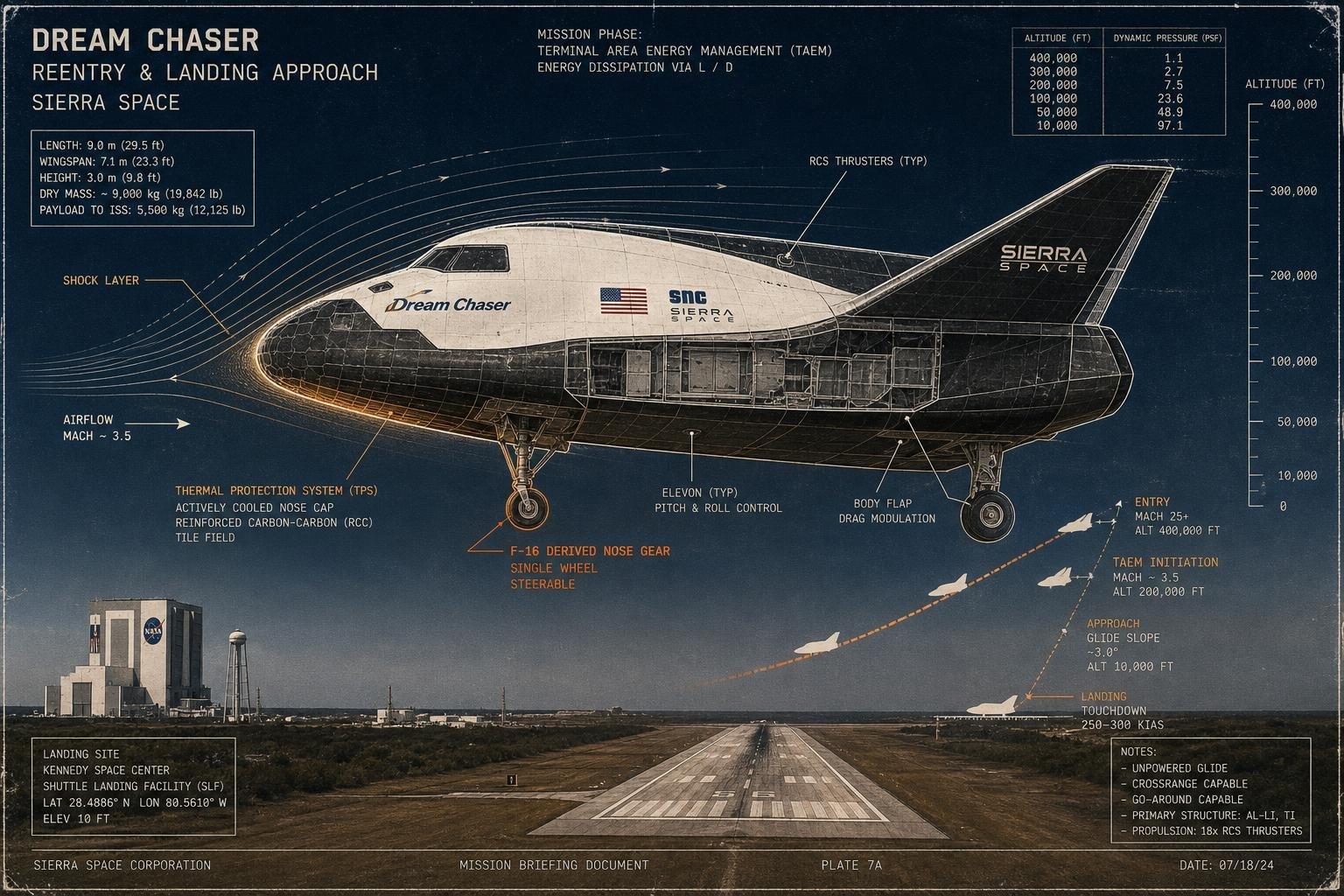

Sierra Space's Dream Chaser cleared a real regulatory hurdle this week: the FAA issued a reentry license letting the spaceplane land at either the former shuttle runway at NASA's Kennedy Space Center or at Vandenberg Space Force Base, with the agency flagging that sonic booms from reentry are expected but will be "temporary, short in duration, and limited" (Space.com). Dream Chaser is licensed for up to four landings a year at Vandenberg, and Sierra Space is now targeting a debut flight in spring 2027 (SpaceNews).
That's a genuine milestone — reentry licensing is not a rubber stamp, and it means the FAA has signed off on the trajectory, the noise footprint, and the public-safety case for a vehicle nobody has flown yet. But it's worth being precise about what just happened and what didn't. The license says Dream Chaser is cleared to land somewhere, someday. It says nothing about whether the hardware will be ready to launch on the date Sierra Space is now citing, which is itself a later date than the ones the company has cited in years past.
The Vehicle Is Interesting Enough to Explain Why People Keep Waiting
Dream Chaser's pedigree is unusual among cargo spacecraft, and it's worth understanding why Sierra Space thinks the wait is worth it. The vehicle is a lifting body — its fuselage shape generates lift the way a conventional aircraft's wings do, a concept NASA proved out in the 1960s with research aircraft like the M2-F2 and HL-10, vehicles so visually ungainly that test pilots called them flying bathtubs (Radio Hangar). That research fed into a NASA concept called the HL-20 in the late 1980s, a notional crew ferry that never got built, and Sierra Nevada Corporation — later restructured as Sierra Space — acquired the HL-20 design data and spent years turning a shelved engineering study into real hardware. The vehicle's nose gear is even derived from the F-16 Fighting Falcon, a detail that underscores how much of Dream Chaser's design DNA comes from aviation rather than capsule engineering (Radio Hangar).
That history also explains the delays, at least in outline. Sierra Nevada originally pitched a crewed, seven-passenger version of Dream Chaser in NASA's Commercial Crew competition and lost out, forcing a pivot to an uncrewed cargo variant for station resupply. Redesigning a vehicle mid-program, swapping its mission profile, and still trying to certify a brand-new reentry and landing architecture is a slower path than building a capsule that splashes in the ocean. Ocean recovery is forgiving. A runway landing that has to satisfy the FAA's public-safety rules, state range coordination, and sonic-boom tolerances at two separate sites is not (Space.com).
It's also worth placing this in the broader context of 2026's launch calendar. The year has already seen a crowded field of maiden flights — Starship Block 3, Soyuz-5, and several new Chinese and Japanese rockets among them — which is a reminder that "debut flight" timelines across the industry slip routinely, not just at Sierra Space (Wikipedia).
The Real Test Isn't the Paperwork, It's the Hardware
None of the sources here confirm a hard launch date commitment beyond "spring 2027," and that's the detail that matters most for judging this week's news. Regulatory approval tends to arrive in an orderly, almost bureaucratic sequence — safety review, environmental assessment, license — while flight hardware readiness is messier and less predictable, dependent on things like propulsion testing, thermal protection qualification, and integration schedules that companies don't always publicize until they slip. Sierra Space's own statement, posted on X and credited by Sierra Space representatives, thanked the FAA "for its collaboration and support of commercial space innovation" — language built around the regulatory win, not a hardware status update (Space.com). That's informative on its own. When a company has flight-ready hardware sitting on a pad, it shows you the hardware. When it has a license and a date, the license is what gets the press release.
This pattern of showing regulatory and programmatic wins ahead of hardware proof isn't unique to Dream Chaser. Commercial space companies generally operate under intense pressure to demonstrate forward momentum to NASA and investors well before vehicles are flight-ready — witness the current dispute between Axiom Space and Vast Space over NASA's private space station competition, where both companies are racing to show credibility to the agency ahead of a December 14 proposal deadline (Ars Technica). Milestones, licenses, and announcements are currency in this industry long before flight hardware is.
None of this is an argument that Dream Chaser is vaporware. The engineering lineage is real, the F-16-derived landing gear and lifting-body shape are not hype, and a vehicle that can return cargo to a runway instead of the ocean genuinely changes what's possible for time-sensitive science payloads and reusable hardware (Radio Hangar). But "debut mission in 2027" is a sentence Sierra Space has effectively been rewriting for years, and a reentry license doesn't resolve the variable that's actually been driving the slips: whether the spacecraft itself is done.
What to Watch
The next real signal won't be another regulatory filing — it'll be whether Sierra Space or NASA confirms a static fire, a completed thermal protection system, or an integrated vehicle shipped to the launch site ahead of that spring 2027 window (SpaceNews). Until one of those shows up, treat the date the way you'd treat any date this program has offered before: plausible, not binding.


