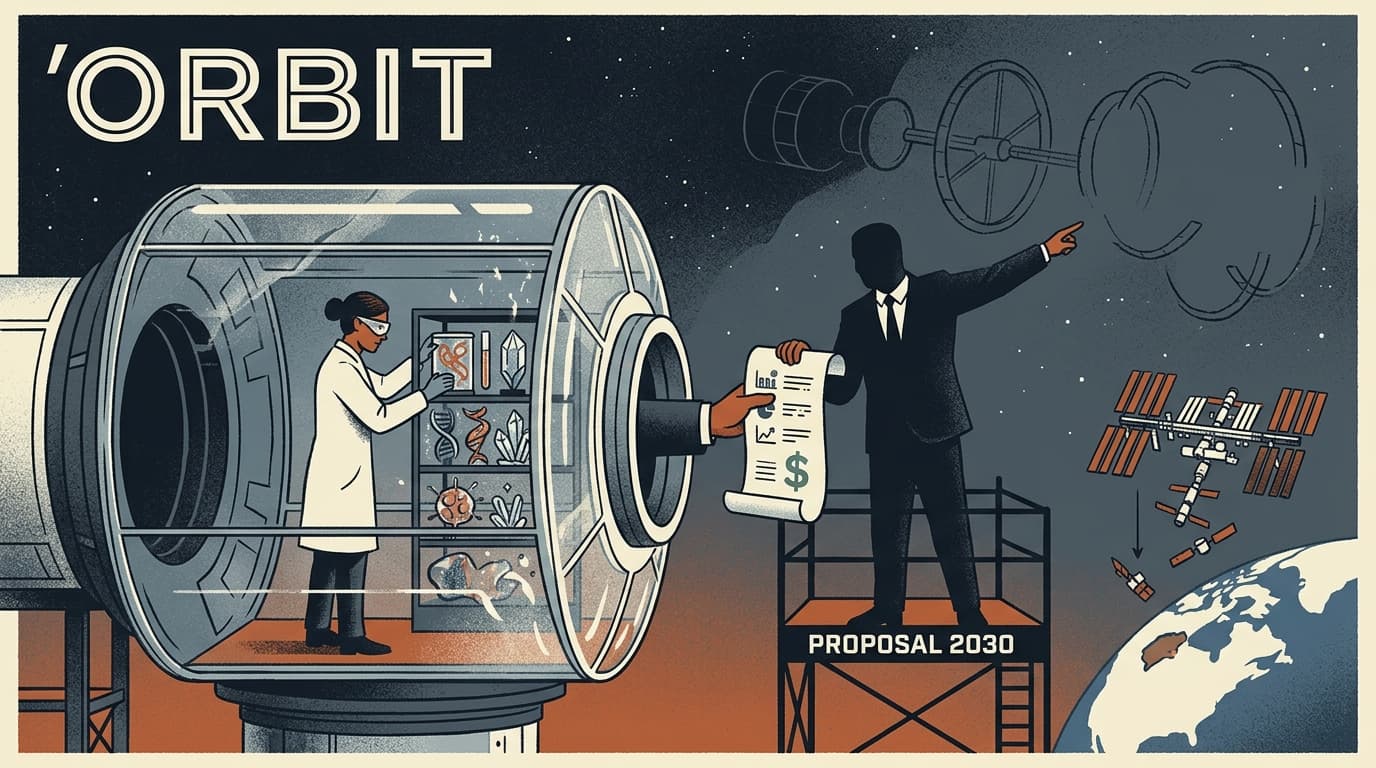

The International Space Station has roughly four years left. That's not a rumor or a pessimistic reading — NASA has committed to deorbiting it by 2030, and the agency is now actively accelerating the transition to whatever comes next. What "comes next" is, officially, a competitive commercial ecosystem. What it actually is, right now, is a collection of proposals at varying stages of credibility, each promising orbital research access that none of them can yet deliver.
That gap — between the pitch and the platform — is what researchers, pharmaceutical companies, and materials scientists should be thinking about before they start planning post-ISS experiments.
The Proposals Are Real. The Stations Aren't.
Three commercial concepts have gotten the most serious attention. Axiom Space is building modular segments that currently attach to the ISS, with plans to detach and operate independently after ISS retirement. Vast's Haven-1 is planned as a base module as early as 2027. Blue Origin, Sierra Space, and partners are developing Orbital Reef, described as a "multifunctional business park" — a phrase that tells you something about who's writing the marketing copy, if not about the engineering timeline.
Each of these is real in the sense that companies have funding, contracts, and engineering teams. None of them are real in the sense of being a place where you can run an experiment today, or book time with any confidence about what year that time will actually occur.
NASA has been threading a careful needle here. The agency's stated position, per its recent policy initiatives, is to "build a competitive commercial ecosystem rather than forcing a single outcome the market cannot support." That's a reasonable hedge. It's also an acknowledgment that the agency doesn't know which of these will actually make it to orbit on schedule — and doesn't want to bet the entire post-ISS research program on finding out.
Companies now expect NASA to issue its Request for Proposals in late March or early April, according to CNN's reporting. That RFP will shape how much NASA anchor funding flows to each concept — and anchor funding is probably the difference between "station that gets built" and "station that stays a rendering."
What Research Access Actually Requires
Here's the part that gets glossed over in the promotional materials: microgravity research isn't just about having a pressurized module in orbit. It requires continuous crew time, reliable power, thermal control, vibration isolation for sensitive experiments, and — critically — a logistics chain that can get samples back to Earth on a predictable schedule. The ISS took decades and roughly $150 billion across international partners to build that capability. Commercial stations are promising comparable access on a fraction of that investment and timeline.
Some of that is genuinely achievable. Launch costs have dropped dramatically, manufacturing has improved, and the ISS itself demonstrated what the requirements are, so nobody's starting from scratch on the engineering knowledge. Axiom's approach of building on ISS heritage is probably the most credible near-term path for continuity of research capability.
But "credible" and "on schedule" are different things. Planned activities for these stations include microgravity research, in-orbit manufacturing, Earth observation, and technology demonstrations — which is essentially everything the ISS does, promised by organizations that have never operated a standalone station. The ambition isn't the problem. The timeline compression is.
The Coverage Gap Nobody Wants to Name
If Haven-1 launches in 2027 and Orbital Reef follows a few years later, there's still a meaningful window where ISS is winding down and commercial capacity is ramping up. That window is where long-duration research programs — the kind that take years to design, approve, and execute — face real risk. You can't pause a pharmaceutical crystallization study for two years while a new station finishes construction.
NASA's language about "recognizing where the market is and where it isn't" suggests the agency is aware of this. The honest read is that the commercial market will probably serve some research needs well — shorter-duration experiments, technology demonstrations, commercial manufacturing pilots — while longer-duration fundamental science may face a harder transition. Whether NASA fills that gap with extended ISS operations, international partnerships, or something else isn't settled.
I'd argue the research community has been too passive in this conversation. The commercial station developers are optimizing for the customers who will pay the most: pharmaceutical companies, materials manufacturers, and eventually tourists. Basic science gets access when there's spare capacity, which is a different value proposition than what ISS offered.
Shorter Updates
NASA's RFP timing matters more than any station announcement. The late March/early April window for NASA's commercial LEO destinations RFP is the near-term milestone to watch. The terms of that solicitation — how much anchor funding, what performance requirements, what schedule commitments NASA demands — will reveal more about which concepts are viable than any company press release. Watch for it.
Haven-1's 2027 target is aggressive. Vast's timeline puts a crewed module in orbit within roughly two years. That would be a remarkable achievement for a company without prior station experience. SpaceX's involvement in launch logistics helps, but the station hardware itself is Vast's problem to solve. The 2027 date is worth tracking as a leading indicator of whether commercial timelines in this sector are realistic or aspirational.
The Space Force is building parallel infrastructure. Separately from the civilian research conversation, the U.S. Space Force is soliciting proposals for a potential 10-year, $981 million contract for the National Space Test and Training Complex. Military orbital test infrastructure and civilian research infrastructure aren't the same thing, but they're drawing from the same pool of commercial launch and operations capacity. Worth watching for whether defense priorities crowd out research access in the commercial station market.
The commercial station transition will probably work, eventually. The question is whether "eventually" aligns with the research programs that need continuity now. Four years sounds like a long runway until you're trying to design a multi-year experiment that needs to know where it's running.


