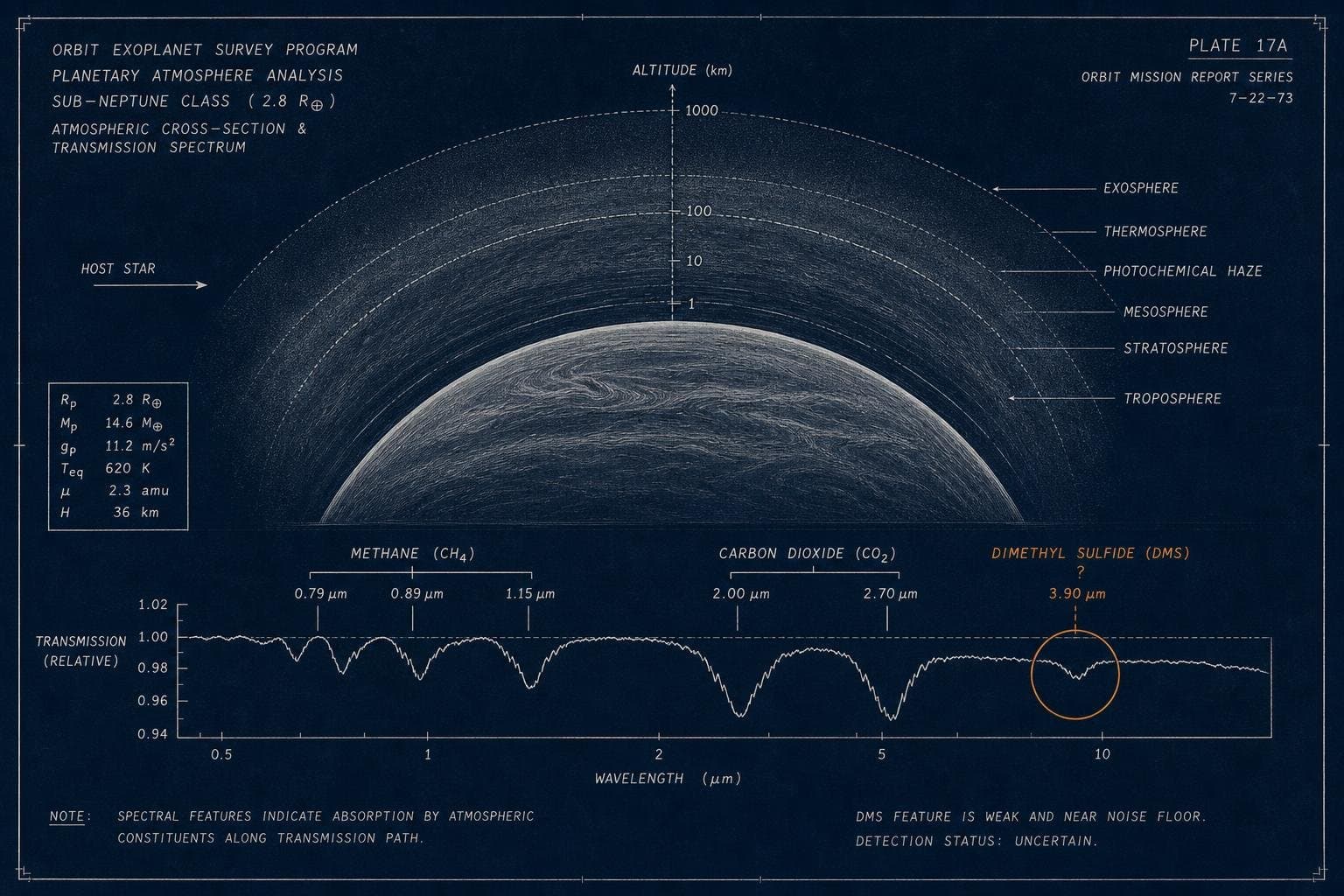

The molecule at the center of the most exciting exoplanet story of the past two years is called dimethyl sulfide. On Earth, it is produced almost exclusively by marine phytoplankton. If you detect it in the atmosphere of a planet 124 light-years away, you might be looking at the chemical exhaust of an alien ocean full of life.
Or you might be looking at a sulfur compound that mimics its spectral fingerprint. Or an ordinary mixture of gases that happens to produce a similar signal. Or an artifact of how the data was reduced.
That is the actual state of the K2-18b story, and it is a useful entry point into what biosignatures actually tell us — and what they structurally cannot.
The Signal Is Real. The Interpretation Is Not.
JWST has genuinely transformed exoplanet atmospheric science. The firmer part of the K2-18b story is the chemistry that isn't controversial: methane and carbon dioxide detected at high confidence in a hydrogen-rich atmosphere. Those are real measurements. The dimethyl sulfide signal is something else — tentative enough that independent teams reanalyzing the same observations have found it weakening or disappearing depending on how the data is processed, with ordinary molecules fitting the spectrum about as well.
This is not a failure of the telescope. It is a feature of the method. JWST characterizes exoplanet atmospheres through transit spectroscopy: it measures how starlight filters through a planet's atmosphere as the planet crosses in front of its star. The resulting spectrum is a statistical inference, not a photograph. Molecules leave overlapping fingerprints, and the signal-to-noise is low enough that different teams, making defensible choices about data reduction, can reach different conclusions from the same raw observations.
The arxiv preprint on K2-18b's hydrocarbon hazes illustrates this precisely. Researchers found that adding haze to their atmospheric models could explain the apparent mismatch between different instrument datasets — but doing so also systematically lowered the inferred molecular abundances, because haze opacity and atmospheric composition are deeply entangled. The planetary mass itself is poorly constrained, with uncertainties reaching roughly 71% at two sigma. That single unknown cascades through every other inference about the atmosphere.
The planet's basic nature remains contested. One interpretation, advanced by Nikku Madhusudhan and colleagues at Cambridge, casts K2-18b as a "Hycean world" — a deep liquid-water ocean beneath a thick hydrogen envelope, potentially habitable. Other groups model the same data as consistent with a gas-rich mini-Neptune or a magma ocean. These are not minor variations on a shared picture. They are fundamentally different planets.
The False Negative Problem Nobody Talks About
Most of the public conversation about biosignatures focuses on false positives — the risk of mistaking abiotic chemistry for life. That concern is legitimate. Ozone can accumulate through photolysis. Methane seeps from geological vents. No single gas, detected in isolation, constitutes evidence of biology.
But a 2026 paper in Nature Astronomy makes the less-discussed case for taking false negatives seriously. If life exists on a planet but its biosignatures are faint, patchy, seasonally variable, or chemically masked by abiotic processes, our current methods might simply miss it. The paper argues this risk is not currently high on research agendas precisely because false negatives don't produce embarrassing headlines — they just produce silence, which we interpret as absence.
A companion Nature Astronomy framework paper makes the same point from the ocean-worlds angle. Using Enceladus as a test case, the authors show that uncertainties in abiotic processes — geological methane production, hydrothermal chemistry — currently prevent any isotopic measurement from definitively inferring a biosphere, even in principle. The abiotic baseline has to be characterized rigorously before a biological signal can be distinguished from it. We are not close to that for most targets.
What Would Actually Change the Picture
JWST is doing real science, and the WASP-18b results published this month — detecting CO, water vapor, and OH in a hot Jupiter's atmosphere using a new direct-extraction method — show the telescope's capabilities still have room to grow. But the structural limitation is not one Webb can solve. Transit spectroscopy selects for planets orbiting close to small, cool stars. The temperate, rocky worlds orbiting Sun-like stars at habitable distances are geometrically inaccessible to this technique.
The LIFE mission concept — a five-spacecraft interferometer array proposed in a Keck Institute roadmap — is designed to address exactly this gap. By operating in the mid-infrared and using nulling interferometry to suppress stellar glare, it could characterize rocky planets around Sun-like stars directly, without requiring a transit. More importantly, it would observe the same planet across multiple wavelengths simultaneously, building a picture that can be tested for internal consistency against abiotic explanations.
That is the standard biosignatures actually need to meet. Not "we detected a molecule associated with life," but "we have assembled a chemical portrait so inconsistent with known abiotic processes that biology is the most parsimonious explanation." JWST is teaching us how hard that standard is to reach. The next generation of instruments will be designed specifically to reach it.
Watch for the LIFE mission's formal proposal timeline and whether NASA's Habitable Worlds Observatory planning process incorporates mid-infrared coordination with it — that pairing is where the real detection capability eventually lives.


