


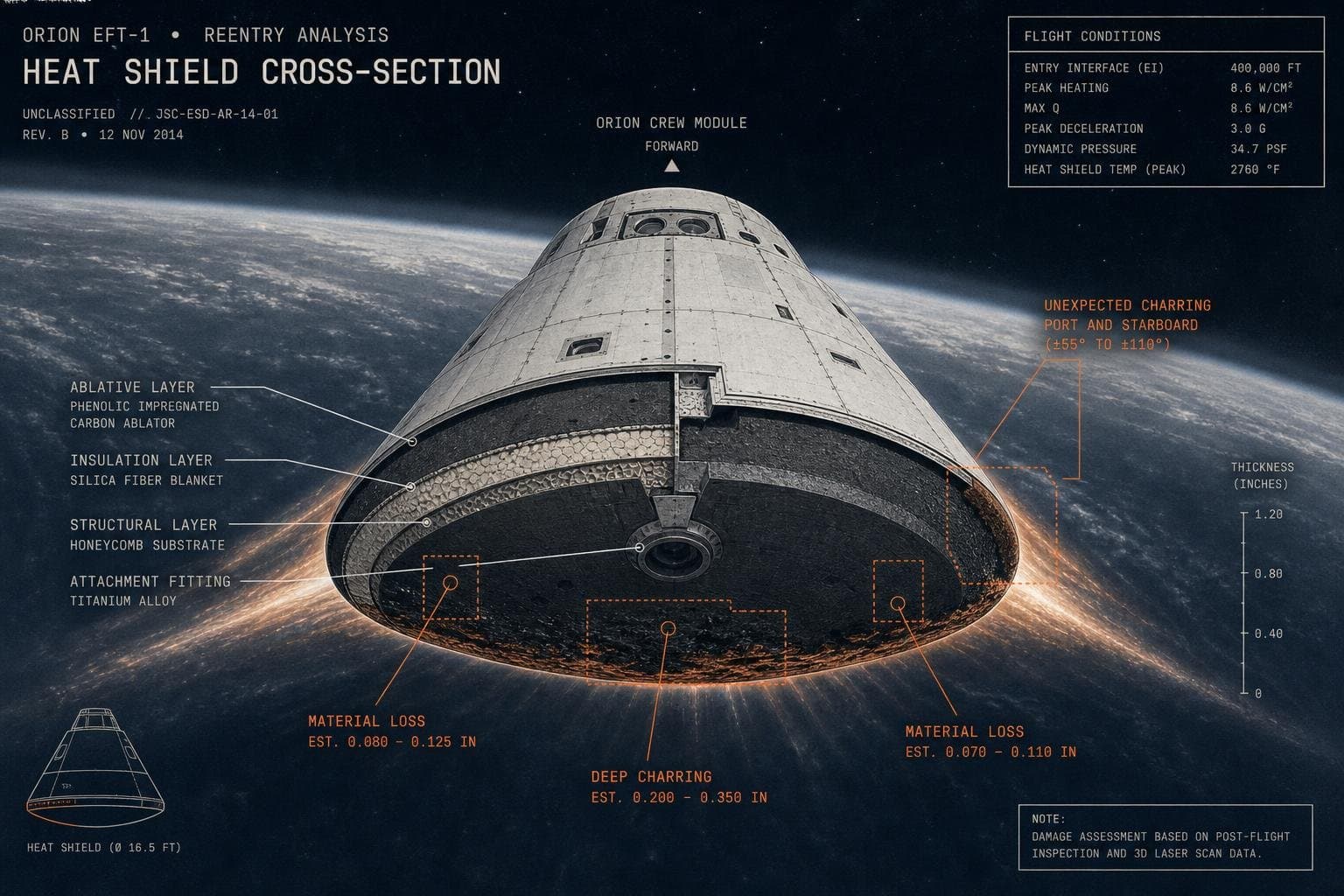

The Orion capsule carrying Reid Wiseman, Victor Glover, Christina Koch, and Jeremy Hansen hit Earth's atmosphere at close to 25,000 miles per hour. That's the number that gets quoted in the mission highlights — and it's genuinely impressive. What gets less attention is what happens to a capsule traveling that fast: the heat shield absorbs energy that would otherwise incinerate everything inside it, and on Artemis I, that shield didn't behave the way engineers expected.
The assigned topic here — "Artemis I heat shield failure" — is worth addressing carefully, because the framing requires some precision. Artemis I's Orion capsule did return safely in December 2022. But post-flight analysis revealed that the heat shield experienced unexpected charring and material loss during reentry, more than models had predicted. That finding became one of the engineering threads NASA had to resolve before putting crew aboard for Artemis II. The question worth asking now, with Artemis II back on Earth, is what the heat shield episode actually revealed about the program — and whether those lessons landed.
The Problem Was Never Just the Shield
Heat shield anomalies are not unusual in spacecraft development. What made the Artemis I finding significant was what it implied about the modeling. NASA's thermal protection systems are designed using computational predictions of how ablative material behaves under reentry heating. When the actual behavior diverges from the model — when more material is lost, or lost in unexpected patterns — it doesn't just mean the shield underperformed. It means the model was wrong, which means every future prediction built on that model is suspect until the discrepancy is understood.
This is the kind of problem that's harder to fix than a cracked tile or a failed sensor. You can replace hardware. Correcting a flawed simulation requires understanding why it was wrong, which means more data, more analysis, and more time. NASA spent the interval between Artemis I and Artemis II working through exactly that process — refining the thermal models, adjusting the reentry trajectory, and accepting some constraints on the flight profile as a result.
The Artemis II reentry, traveling at nearly 25,000 mph before atmospheric braking, was the first real-world test of those corrections with human lives depending on the outcome. That the crew splashed down safely is genuinely good news. Whether the heat shield performed within the revised model's predictions — and what post-flight inspection reveals — is the data point that will actually tell us whether the fix held.
What This Means for the Schedule Ahead
I've written before about Artemis 3's lander readiness and the launchpad constraints that have complicated the program's timeline. The heat shield issue adds a different kind of pressure — not a hardware procurement problem or a pad availability problem, but a certification problem. Before NASA can commit to a lunar landing with crew, it needs confidence that Orion's thermal protection system is fully understood and fully reliable.
That confidence comes from post-flight data, not from a successful splashdown alone. A capsule can return intact while still showing anomalies that need explanation. The Artemis I shield showed more erosion than predicted; Artemis II's post-flight inspection will either confirm the corrected models or open new questions. If it confirms them, the program moves forward with a stronger technical foundation. If it surfaces new discrepancies, the timeline pressure on Artemis 3 — already carrying significant schedule risk — gets worse.
The broader context matters here too. China's Chang'e 7 mission, aimed at the lunar south pole, was just delayed to 2027 after failing to meet launch conditions — a reminder that lunar programs on both sides of this competition are harder than their schedules suggest. SpaceNews reported that Typhoon Narra appears to have forced the delay, with the next viable window potentially not opening until early 2027. The race to the south pole is real, but both competitors keep finding that the Moon doesn't care about press release timelines.
The Honest Takeaway
Artemis II's success matters. Four people went around the Moon and came home — the first time humans have traveled to lunar distance since Apollo 17 in 1972. The Artemis program deserves credit for reaching that milestone.
But the heat shield episode is a useful reminder of what "success" means in this context. A crewed mission returning safely is the minimum bar, not the proof that everything worked as designed. The engineering work that happens after splashdown — the inspection, the model validation, the quiet comparison of predictions against measurements — is where programs actually learn. Watch for NASA's post-flight technical assessment of Orion's heat shield performance on Artemis II. That document will tell you more about the program's real trajectory than any mission highlight reel.