



Three months ago, NASA announced it was pulling Artemis 3 back from the Moon. No lunar landing on that mission — instead, a rendezvous test in low Earth orbit, modeled loosely on Apollo 9. The idea was to reduce risk before committing astronauts to an actual descent. Reasonable enough. But the details of how that test will actually work remain, as of this week, largely undefined.
That's the story worth tracking right now: not the headline pivot, but the engineering and schedule reality underneath it.
The Spacer Decision Tells You Something
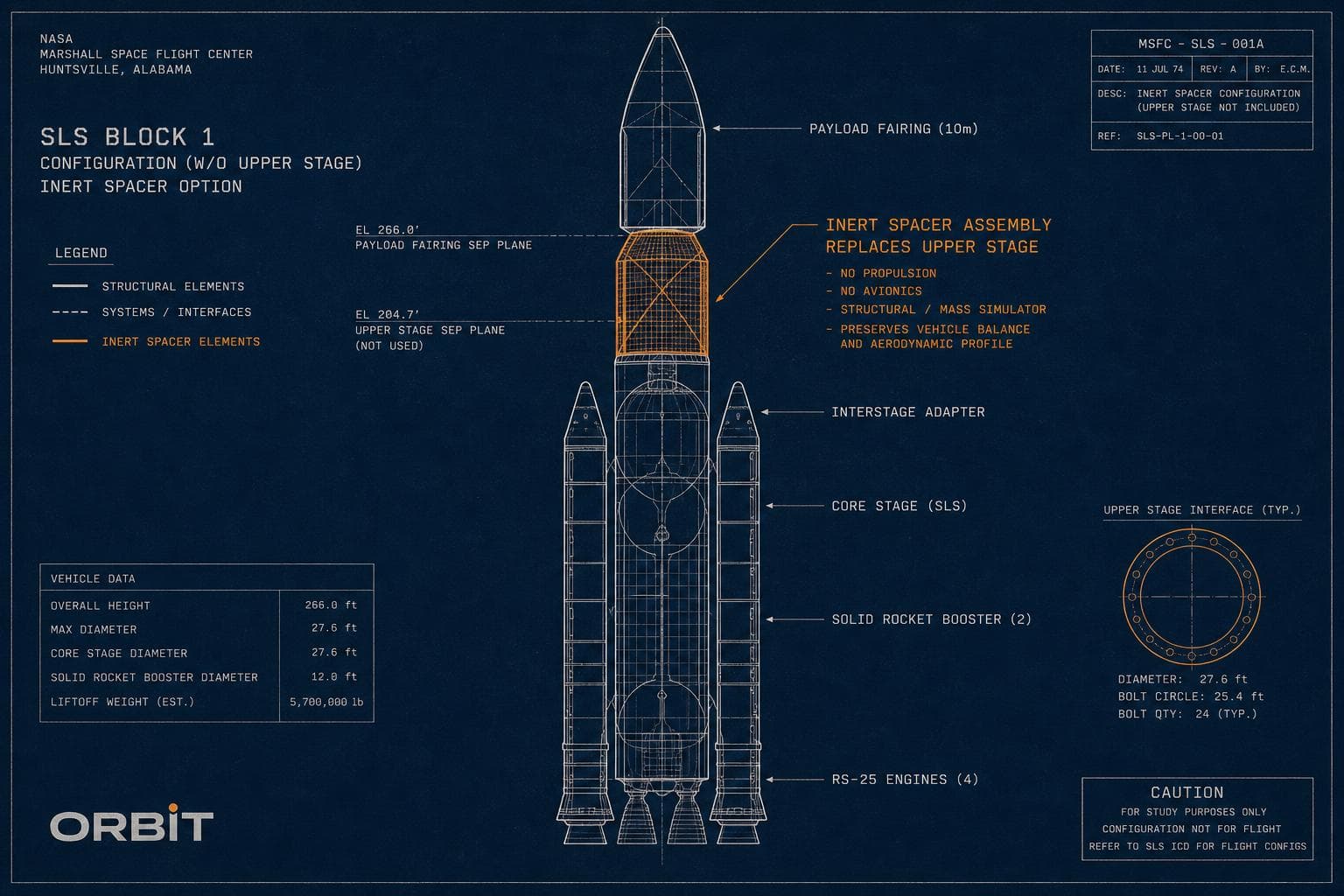
NASA's May 13 update on Artemis 3 confirmed that the Space Launch System will fly without its upper stage on this mission. In place of the Interim Cryogenic Propulsion Stage, engineers at Marshall Space Flight Center are building an inert "spacer" — same dimensions, same interfaces, no propulsion. The ICPS itself gets preserved for Artemis 4, the first actual landing attempt currently targeted for 2028.
This is a sensible piece of hardware triage. The ICPS is no longer in production, so every remaining unit is precious. Using a dummy on a LEO test flight to save a real upper stage for the Moon mission is exactly the kind of engineering pragmatism that makes sense on paper.
But read the decision sideways and it also tells you something about how constrained the program is. NASA isn't flying the spacer because it's the ideal configuration for Artemis 3 — it's flying it because the alternatives (the cancelled Block 1B upper stage, the not-yet-adapted Centaur) aren't available yet. The mission is being shaped as much by what hardware exists as by what the mission actually needs.
What NASA Still Hasn't Answered
Ars Technica's coverage of the May 13 update puts the situation plainly: NASA continues to put off key decisions. The agency says Artemis 3 will test "rendezvous and docking capabilities" between Orion and both the SpaceX Starship lander and Blue Origin's Blue Moon Mark 2. But it has not yet confirmed whether astronauts will actually enter either vehicle.
That's not a minor detail. The difference between a visual rendezvous and a crew transfer is the difference between a photo op and a genuine systems test. Apollo 9 — the explicit analog NASA is invoking — had two astronauts enter the Lunar Module, separate from the Command Module, fly independently, and redock. If Artemis 3 doesn't do something comparable, the "analog" framing starts to look more like marketing than mission design.
NASA's own statement acknowledges the gap: "Informed by Blue Origin and SpaceX capabilities, NASA also is defining the concept of operations for the mission." That sentence is doing a lot of work. It means the mission profile depends on how mature the landers are — and that maturity is still unknown.
The Hardware Is Moving, the Schedule Is Soft
To be fair, physical progress is real. SpaceNews reported in early May that the SLS core stage arrived at Kennedy Space Center and moved into the Vehicle Assembly Building on April 28. Solid rocket booster segments have been arriving from Northrop Grumman's Utah facility, with the remainder expected by summer. Orion's crew capsule and service module are set to be mated this summer as well.
So the rocket is coming together. The question is what it's launching toward — and whether SpaceX and Blue Origin will have landers ready to meet it. Both companies still have significant technical milestones ahead before their vehicles are ready for crew interaction, let alone a lunar descent. NASA has repeatedly cited late 2027 as the Artemis 3 target, with Artemis 4 following in 2028. That's an aggressive timeline given how much remains undefined.
What to Watch
The next meaningful signal will be whether NASA names the Artemis 3 crew — which Ars Technica notes could happen within months — and whether that announcement comes with any more specificity about mission operations. Crew selection tends to force mission definition; astronauts and their trainers need to know what they're actually practicing.
Watch also for any public updates from Blue Origin or SpaceX on Blue Moon Mark 2 and Starship's lunar variant readiness. The lander schedules are the real pacing item here. NASA can build the rocket on time and still find itself waiting at the dock.
The restructured Artemis 3 is a defensible plan. Whether it becomes a genuinely useful test — or a dressed-up orbital demonstration — depends on decisions that haven't been made yet.