


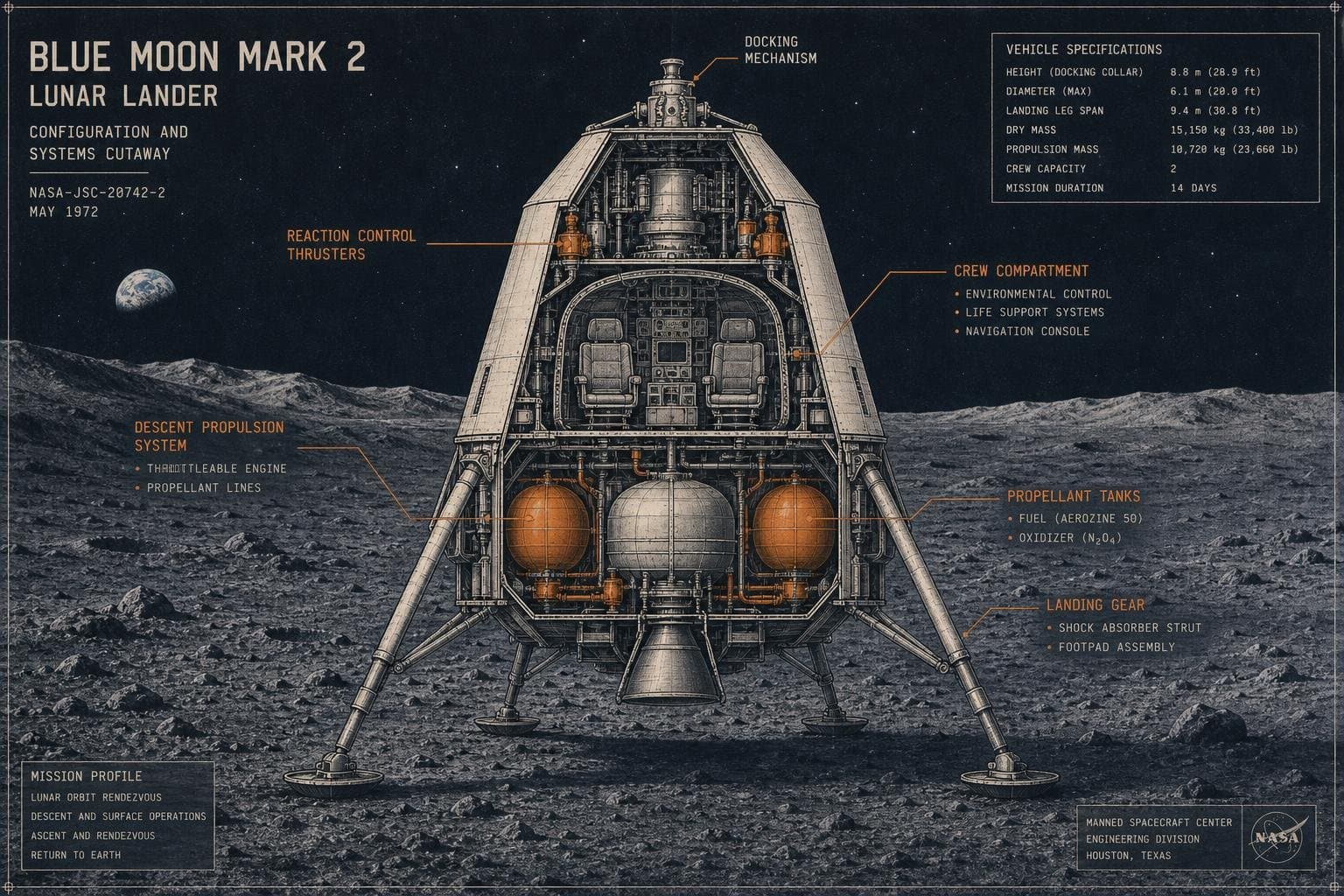

The headline version of Artemis 3 sounds almost normal now: NASA has a crew, a rocket, and a lander contractor. What the headline skips is that the lander itself exists in at least three distinct configurations, one of which won't have a full propulsion system, and the company building it is simultaneously recovering from an explosion that destroyed a rocket and key infrastructure at Cape Canaveral less than two months ago.
That's the actual state of the lunar return program as of this week.
I've covered the Artemis schedule's structural problems before, and before that, and the pattern holds: each new development doesn't so much resolve the timeline as add texture to why it keeps slipping. This week's texture comes from Blue Origin's John Couluris, who spoke at the Spacetide conference in Tokyo on July 6 and offered the clearest public accounting yet of where the lander program actually stands.
Seven Vehicles in Production, One Ready to Wait
According to SpaceNews, Blue Origin currently has seven Blue Moon vehicles in various stages of production — four Mark 1 uncrewed landers and three Mark 2 crewed landers. Couluris was explicit that the May 28 New Glenn pad explosion has not slowed lander development. "We have not slowed down," he said.
That's the good news. The more complicated news is what "on schedule" actually means for each vehicle.
The first Mark 1 lander — named Endurance — was originally slated to launch later this year. It's now expected to fly in the first quarter of 2027, after the New Glenn explosion pushed its launch window. Couluris said the vehicle has completed testing and is being placed into "quiescent operations" while it waits for a ride. A second Mark 1 is being built to carry NASA's VIPER rover, also targeting 2027. Two more Mark 1 landers, intended to carry lunar terrain vehicles under NASA awards, are scheduled for 2028.
The crewed Mark 2 program is where the Artemis 3 story gets genuinely unusual. Blue Origin is building a prototype Mark 2 that will launch to low Earth orbit as part of the revised Artemis 3 mission — but this vehicle will fly without a full propulsion system. It's essentially a crew module demonstrator that Orion will dock with in orbit rather than a functional lunar lander. The actual crewed landing hardware — what Blue Origin calls the Mark 2 Alpha — is a separate vehicle, with an uncrewed demonstration flight planned for 2028 followed by a crewed landing.
Couluris also noted that the Mark 2 Alpha's orbital parameters have been revised now that Gateway is no longer part of the plan. The lander is "optimized for the orbits that we've worked with NASA on," he said, without specifying what those orbits are. That's a meaningful engineering change — the near-rectilinear halo orbit Gateway would have used is quite different from a direct lunar orbit approach — and it's happening in parallel with active vehicle construction.
The Infrastructure Problem Doesn't Go Away
Even if Blue Origin hits every one of those production milestones, the program faces a constraint that no amount of lander progress resolves: the launchpad situation at Cape Canaveral is genuinely strained.
A SpaceNews analysis of spaceport capacity published this month notes that a June 22 NASA Inspector General report found Kennedy Space Center could reach launch capacity as soon as 2028. The power distribution system at Launch Complex 39 dates to the 1960s and lacks capacity for planned Starship launches. Gaseous nitrogen pipelines can't support simultaneous New Glenn and Vulcan Centaur operations. Blue Origin itself flagged concerns that future SLS flights would create blackout periods of one to two months on shared infrastructure.
That's the environment into which Artemis 3 — requiring SLS, Orion, and a Blue Moon lander launch — has to fit. The lander being ready and the launch infrastructure being ready are separate problems, and right now both are works in progress.
What to Watch
The Artemis 3 picture will sharpen considerably around a few specific milestones. Blue Origin's New Glenn return-to-flight timeline matters enormously — Endurance needs a rocket, and the investigation into the May 28 explosion is still ongoing. The Mark 2 Alpha's uncrewed demonstration in 2028 is the real technical gate for a crewed lunar landing; watch whether that date holds through the end of this year as vehicle production continues. And the NASA OIG's infrastructure findings deserve a congressional response — the agency has estimated Kennedy needs at least $1 billion in upgrades, and that number hasn't been funded.
The program has real hardware being built by people who are clearly working hard. What it still lacks is margin — schedule margin, infrastructure margin, and the kind of redundancy that makes a single explosion or a single delayed test something you absorb rather than something that reshapes the whole timeline. That gap between hardware progress and program resilience is where the Artemis story keeps living.