


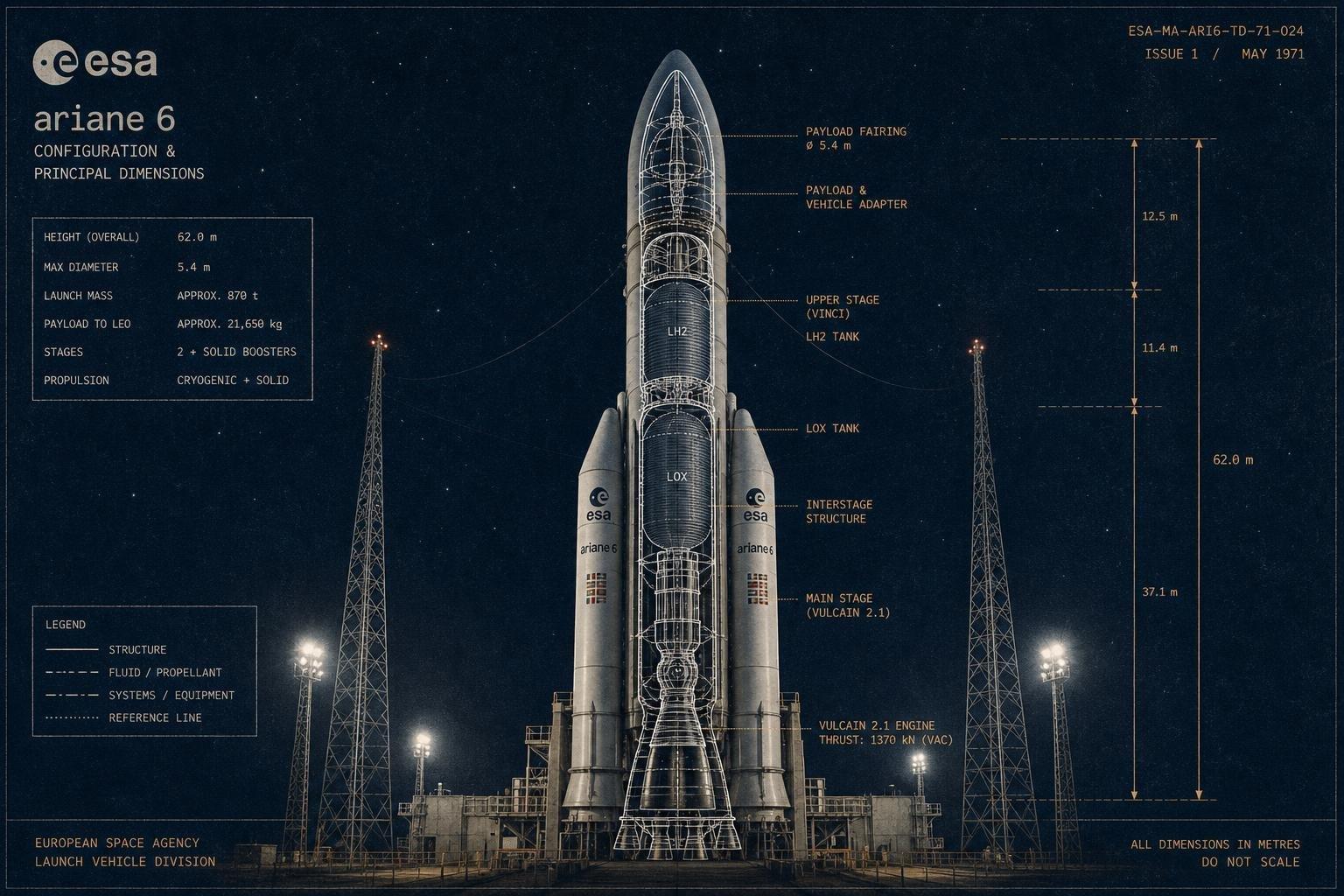

Here's the gap between the headline you'd expect and the one the sources actually support: this week's Ariane 6 news isn't about catching up to SpaceX's launch tempo. It's about waking up a single weather satellite.
MetOp-SG-B1 — the second of a new generation of European meteorological satellites — arrived at Europe's Spaceport in French Guiana last month aboard the sail-assisted cargo ship Canopée, spent a few weeks in climate-controlled storage, and has now been pulled out of its container and moved into a cleanroom for reactivation ahead of a launch "planned towards the end of the year" on Ariane 6, per ESA. It will join its sibling MetOp-SG-A1, already in orbit since August 2025, per the same ESA release. That's one launch, on one manifest, more than a decade in the making. It is not evidence of a cadence.
The Real Conversation Europe Is Having Is About the Next Rocket, Not This One
If you want to see how Europe's launch sector actually talks about closing the gap with SpaceX, the more revealing document isn't a launch-campaign update — it's a workshop recap. More than 70 people from across Europe's space transportation industry gathered at ESA headquarters in Paris in October for what the agency calls the Future Access to Space Club, and the subject wasn't Ariane 6's flight rate. It was reusability — specifically, first-stage reusability and high-thrust liquid propulsion, which ESA's Jean-Noel Caruana described as priority fields where the agency is "allocating more and more of our resources to hardware production and testing," according to ESA Space Transportation for Business. Companies in the room — ArianeGroup, Avio, Isar Aerospace, Maia Space, Rocket Factory Augsburg, The Exploration Company — were there to compare notes on a capability SpaceX has had operational for a decade, per the same ESA account. That's the honest framing: Europe isn't yet in a cadence race because it isn't yet flying the kind of reusable hardware that cadence races are run on. Ariane 6 is an expendable rocket competing, for now, on reliability and sovereign access rather than launch frequency.
The Crunch Ariane 6 Would Need to Solve Is Bigger Than SpaceX
What makes this gap matter is the shape of the global launch market Europe would actually be entering. The industry launched more rockets last year than ever, yet satellite operators are still short on rides — and increasingly, the shortage isn't about raw rocket count but about destination and timing, Exolaunch CEO Robert Sproles told SpaceNews. The FAA licensed 187 commercial launches in fiscal year 2026, up from under 100 a decade earlier, and the U.S. government is pushing spaceports toward more than 1,000 launches and reentries a year by 2030, per the same SpaceNews reporting. That demand is so acute that satellite operator AST SpaceMobile announced last week it's developing its own medium-lift rocket, Blacklift, rather than keep waiting for rides — a plan Ars Technica's Eric Berger flagged as wildly optimistic on timeline but symptomatic of a real supply problem, where companies "are now considering taking the extraordinary step of developing their own rockets" when they can't secure capacity on favorable terms, per Ars Technica. Meanwhile, the rocket Ariane 6 is implicitly measured against is reportedly being reconsidered by its own operator: discourse around SpaceX has shifted toward whether Falcon 9 might eventually wind down commercial sales and government launches altogether, as SpaceNews has reported, with the company's posture increasingly described by its own officials as that of an "infrastructure company" rather than a pure launch provider, per Ars Technica.
That's the actual competitive picture. The launch market isn't short on SpaceX flights — it's short on variety: destinations, schedules, and vehicle types that fit missions SpaceX isn't necessarily built to serve. Ariane 6 closing that gap wouldn't mean matching Falcon 9's flight count. It would mean becoming a second, reliable option for the kinds of missions currently queuing for a ride that doesn't exist yet. MetOp-SG-B1 getting off the pad before year's end is a fine milestone. It is not the metric that decides whether Europe closes anything.