
Six weeks ago, Polymarket was a crypto-native curiosity with a devoted but niche user base. Today, it's a $5 billion market — and that transformation is exactly why the cross-market gaps on this weekend's Round of 16 fixtures are worth watching closely.
The scale shift matters for arbitrage hunters because new liquidity doesn't arrive evenly. When a platform absorbs a wave of first-time users pricing soccer outcomes, the odds it produces reflect a different crowd than the sharp-money books. That's the seam. That's where the edge lives right now.
$6.4 Billion in Volume Creates New Inefficiencies, Not Fewer
The intuition runs backward: more liquidity should mean more efficient markets. And in mature, deep markets, that's true. But Polymarket's World Cup volume — estimated around $6.4 billion and climbing toward a projected $10 billion by the July 19 final — has been driven substantially by first-time users flooding in through the tournament. Bernstein analysts, cited in the same report, flagged that the surge also exposed structural problems: a "longshot problem" hiding $1.6 billion of questionable positioning.
That's the tell. When a platform's user base expands rapidly around a single event, the new participants tend to overprice underdogs and narratives. They're not wrong about the sport — they're just pricing sentiment, not probability. The sportsbooks, by contrast, are running sharp-money models with decades of soccer data behind them.
The result: Polymarket's implied probabilities on individual match outcomes have been diverging from traditional sportsbook lines in ways that weren't visible earlier in the group stage, when liquidity was thinner and the gaps were harder to act on.
This Weekend's Fixtures Are the Stress Test
DraftKings' current Round of 16 board shows Saturday's slate includes Canada vs. Morocco and Paraguay vs. France — exactly the kind of fixtures where the Polymarket-vs-sportsbook gap tends to widen. France, a heavy favorite, and Morocco, a team with genuine upset pedigree from 2022, are the type of matchup where narrative-driven prediction market users push the underdog price down (making them look more likely to win than the books believe).
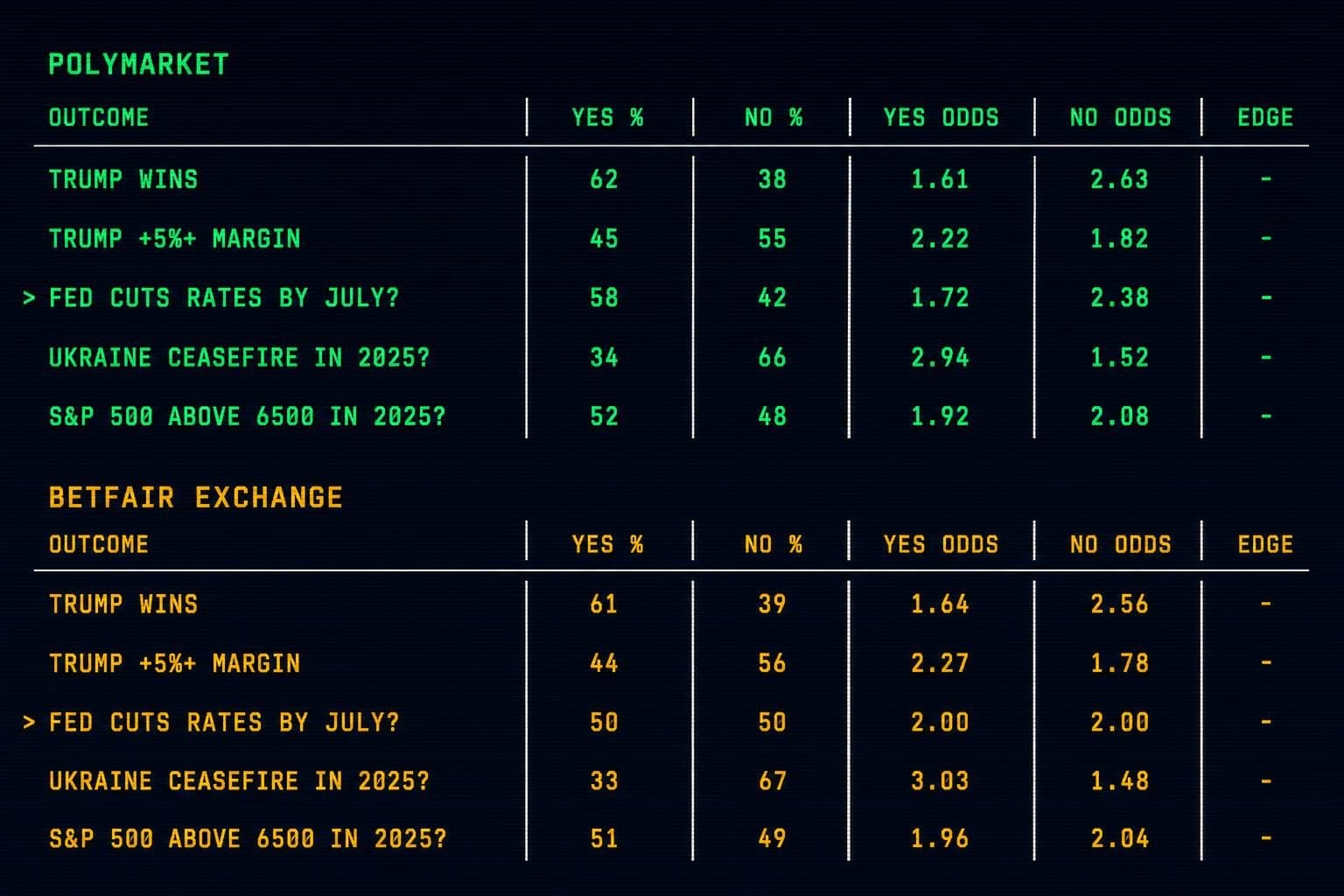
Polymarket's live World Cup board shows Argentina at 86¢ to advance against Cabo Verde — that's an implied probability of roughly 86%. The Betfair tipsheet from July 2-3 had Cape Verde trading at 15.0 on the exchange to qualify — implying roughly a 6-7% chance. That's a meaningful spread from Polymarket's 14¢ (14%) on the same outcome. The Betfair exchange, populated by European sharp money, is pricing Cape Verde's chances at less than half what Polymarket's market implies.
That's not a rounding error. That's a 7-8 point gap between two liquid markets on the same binary outcome, and it's the kind of discrepancy this publication exists to track.
Why the Gap Exists — and How Long It Lasts
The Betfair exchange and traditional sportsbooks have a structural advantage in soccer: years of sharp European money calibrating odds on exactly these kinds of mismatch fixtures. Polymarket's user base, now operating at mainstream scale for the first time, skews toward crypto-native traders who are sophisticated about market mechanics but less specialized in soccer probability. They know how to read a contract. They may be less precise about what a 0-0 draw against Spain in the group stage actually tells you about a team's knockout-round ceiling.
The gap also has a shelf life. As the knockout rounds progress and the field narrows, Polymarket's markets tend to tighten toward the exchange — the arbitrage window compresses as more information arrives and sharper participants correct the pricing. The Round of 16 is the widest the gaps will be for the rest of the tournament.
There's also the regulatory overhang to note: the same volume surge that made Polymarket a $5B platform has drawn CFTC scrutiny, arriving "right on schedule" according to the crypto.news report. That's a background risk for anyone with significant positioning on the platform — not a reason to avoid it, but a reason to be aware that the platform's operating environment is shifting in real time.
The actionable read for this weekend: check the Polymarket implied probability on each Round of 16 match against the Betfair exchange price on the same outcome. Any gap above 8 points on a binary advance/eliminate market is worth sizing. The Argentina-Cape Verde line is the most visible example right now, but the France and Morocco fixtures on Saturday deserve the same treatment before kickoff.
The platform just got a lot bigger. The pricing hasn't caught up yet.


