
The 2026 World Cup final ran July 19. Six weeks of the most liquid prediction market event in Polymarket's history, and now that volume has to go somewhere. Where it's landing this weekend is MLB — and the pricing gaps are real.
The shift matters because soccer and baseball attract different bettor profiles. World Cup markets on Polymarket skewed heavily toward casual and international traders, which inflated liquidity and compressed spreads on tournament contracts. MLB markets on Polymarket have historically been thinner and less efficient, as I wrote back in May. The question now is whether that World Cup liquidity migrates into baseball prediction markets — and whether the sportsbooks have already adjusted for it or not.
Based on what's visible in the market data this weekend, the answer is: not fully.
The Nationals-Diamondbacks Total Is the Cleanest Signal Right Now
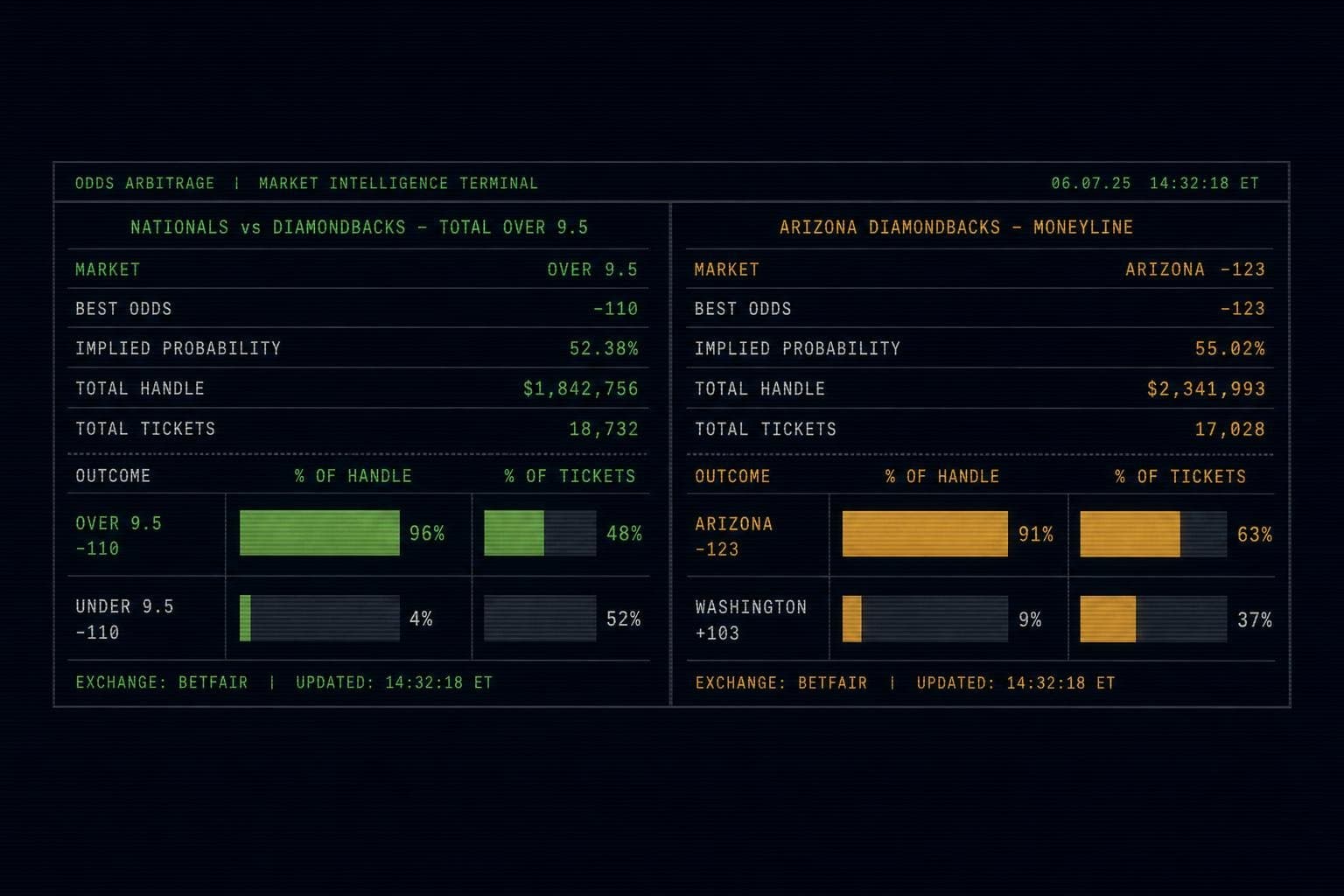
Friday's Nationals-Diamondbacks game at Nationals Park produced one of the more striking bet-to-handle splits you'll see on an MLB total. According to DraftKings betting splits, the Over 9.5 drew just 48% of tickets — essentially a coin flip in public ticket count — but captured 96% of the handle. That's a 48-point gap between bet count and dollar volume on the same side of the same market.
That kind of divergence has a specific meaning: the public is roughly split, but large accounts are hammering the Over. The structural reason is visible in the pitching matchup. DraftKings data shows Washington starter Carson Palmquist carrying an 8.74 ERA and a 1.677 WHIP — numbers that make a 9.5 total look like a gift to anyone with a spreadsheet. Arizona's Eduardo Rodriguez is at 2.62 ERA on the other side, but sharp money appears to be pricing the Washington half of the equation heavily.
The moneyline tells the same story. Arizona opened at -123 (implying roughly 55% win probability), with 63% of tickets and 91% of handle on the Diamondbacks. The run line splits mirror it: only 36% of bets on Arizona -1.5, but 91% of the handle. Public bettors are taking the safety of Washington +1.5; bigger accounts are laying the runs.
This is a textbook sharp-vs.-public divergence. The total handle split is the more actionable signal — a 96% handle concentration on one side of an even-juice market is unusual enough to treat as information.
BetMGM's HR Props Are Pricing Differently Than the Handle Suggests
Separate from the game lines, BetMGM's home run prop market for Saturday shows Ben Rice and Byron Buxton both listed at +210 (32.26% implied probability), with Matt Olson and Hunter Goodman at +220 (31.25%). Yordan Alvarez sits at +230 (30.3%) — the same line as Junior Caminero, which is the number that stands out.
Alvarez at +230 is a price that deserves scrutiny against whatever Polymarket or Betfair is showing on related player performance markets. The Betfair exchange data available this weekend is too limited to extract specific lay prices, so a direct cross-market comparison on individual player props isn't possible from current sources. But the BetMGM implied probabilities are the baseline: if a prediction market is pricing Alvarez's home run probability materially above 30%, that's a gap worth tracking.
The broader prop table from BetMGM shows Shohei Ohtani at +280 (26.32%) — lower implied probability than Alvarez, Rice, or Buxton. Whether that reflects current form, park factors, or lineup positioning isn't extractable from the odds alone, but the ordering is notable for a player of Ohtani's historical power profile.
What the Post-World Cup Shift Means for the Next Few Weeks
Polymarket's World Cup page confirms the tournament ran through July 19, with MetLife Stadium hosting the final. The volume that built up across 104 matches and six weeks of knockout-round trading doesn't evaporate — it reallocates. Some of it moves to NFL futures (Week 1 prediction markets opened in May, as I covered then). Some moves to political markets. And some moves to MLB, which is currently in its highest-volume stretch of the regular season.
The structural opportunity in that reallocation is timing. Polymarket's MLB markets have historically lagged sportsbook line movement — thinner liquidity means slower price discovery. If World Cup traders are now rotating into baseball contracts without deep knowledge of the sport, the mispricing window on game totals and series outcomes widens temporarily before the market corrects.
The Nationals-Diamondbacks handle split is one data point. Watch for similar bet-to-handle divergences on Sunday's slate — FanDuel's MLB research page tracks game lines across the full card. When sharp handle concentration shows up on a total with even juice, that's the signal. The World Cup crowd is learning baseball pricing in real time, and that's where the edge lives right now.


