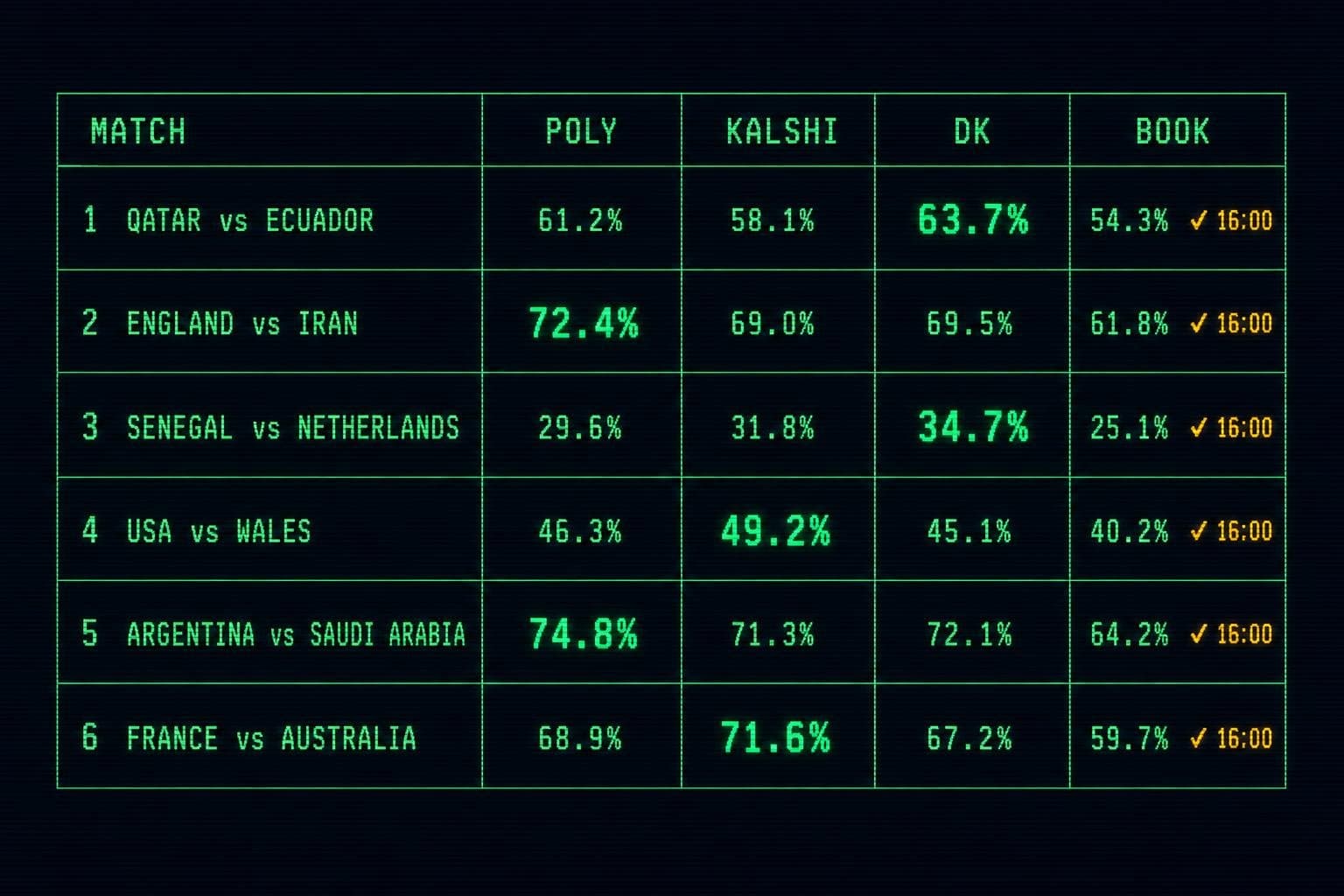

Six games today. One structural signal worth tracking across all of them.
The final day of the 2026 World Cup group stage is the most information-dense betting environment of the tournament — teams with nothing to lose, teams playing for seeding, and simultaneous kickoffs that prevent late-breaking lineup news from moving all markets at once. That last point is where the pricing gaps live right now.
Lineups.com's match breakdown for Saturday, June 27 confirms the full slate: Croatia/Ghana and Panama/England at 5 p.m. ET, Colombia/Portugal and Congo DR/Uzbekistan at 7:30 p.m. ET, Argentina/New Jordan and Algeria/Austria at 10 p.m. ET. Six games across three windows, with multiple markets pricing each one independently.
The Structural Gap That's Been Building All Tournament
This isn't a new observation for this publication — three weeks ago I flagged France at +410 as the clearest Polymarket/FanDuel divergence point. But the group stage closer creates a different kind of opportunity: the simultaneous-kickoff problem.
When two games in the same group kick off at the same time, a result in one game immediately changes the optimal strategy for teams in the other. Sportsbooks and prediction markets handle this differently. Books typically freeze live lines or move them reactively; prediction markets with active order books can see traders repositioning in real time as news breaks. That asymmetry has been measurable throughout this tournament.
SCCG Management's analysis of the first four games documented the pattern directly: prediction-market prices sat above the de-vigged sportsbook consensus on the favorite leg in three of four opening games, with the USA market producing the first genuine cross-platform split — a 2.5-point spread between Kalshi (most confident on the favorite) and the de-vigged sportsbook consensus (least confident). That piece also flags the single most common error in this kind of analysis: comparing raw prediction-market prices to raw sportsbook lines without stripping the vig. The books carried 4.7% to 5.3% overround on that opening slate. Skip the de-vig and you're measuring the house's margin, not the actual disagreement.
Where the Vig Gap Matters Most Today
The vig question is especially relevant for today's simultaneous windows. FrenFlow's breakdown of Polymarket's fee structure puts the math plainly: a standard -110/-110 sportsbook line carries a 4.76% overround baked into the price. Polymarket caps its taker fee at roughly 0.75% of notional on a 50/50 line, drops toward zero as prices move away from even money, and charges nothing on maker orders or sells. On heavily traded World Cup markets — which qualify as liquid by any measure — that's a structural cost difference of three to six times in favor of the prediction market.
The catch, as always, is liquidity. On thin books, the bid-ask spread can erase the fee advantage entirely. Today's six-game slate, with multiple high-profile matchups running simultaneously, should keep order books deep enough that the fee gap is real. The 10 p.m. ET window — Argentina and the Algeria/Austria game — will draw the most volume and likely the tightest spreads.
DraftKings and FanDuel Are Now in the Mix
One thing that has changed since earlier in this tournament: the sportsbook-adjacent prediction platforms are more active. PolyPunter reported on June 11 that DraftKings Predictions reached a $3.1 billion annualized total trading volume in May, up 34% month-over-month, with executives crediting the NBA Finals and the upcoming World Cup as the timing drivers. FanDuel Predicts has deepened its exchange partnerships over the same period.
More volume across more platforms means more potential for divergence — but also faster convergence once a gap is spotted. The actionable window on any cross-platform discrepancy today will be shorter than it was in the tournament's opening week, when these platforms were still ramping. Check the simultaneous-kickoff windows first; those are where reactive repricing lags most.
The CME's move into prediction markets — documented by IASG — is the longer-term signal here. When institutional infrastructure starts treating event contracts as a legitimate asset class, the arbitrage windows that exist today between Polymarket, Kalshi, DraftKings Predictions, and traditional books will compress. The group stage closer on June 27 is one of the last high-volume, multi-game windows before the knockout rounds tighten everything up. The Round of 16 will have deeper liquidity and more sophisticated pricing on both sides. Today's gaps, where they exist, are wider than what's coming.
Watch the 7:30 p.m. ET window specifically — Colombia/Portugal runs alongside Congo DR/Uzbekistan, and Portugal's incentive structure in that game (rest key players vs. push for group position) is exactly the kind of ambiguous team-motivation scenario that prediction markets and sportsbooks have historically priced differently.


