


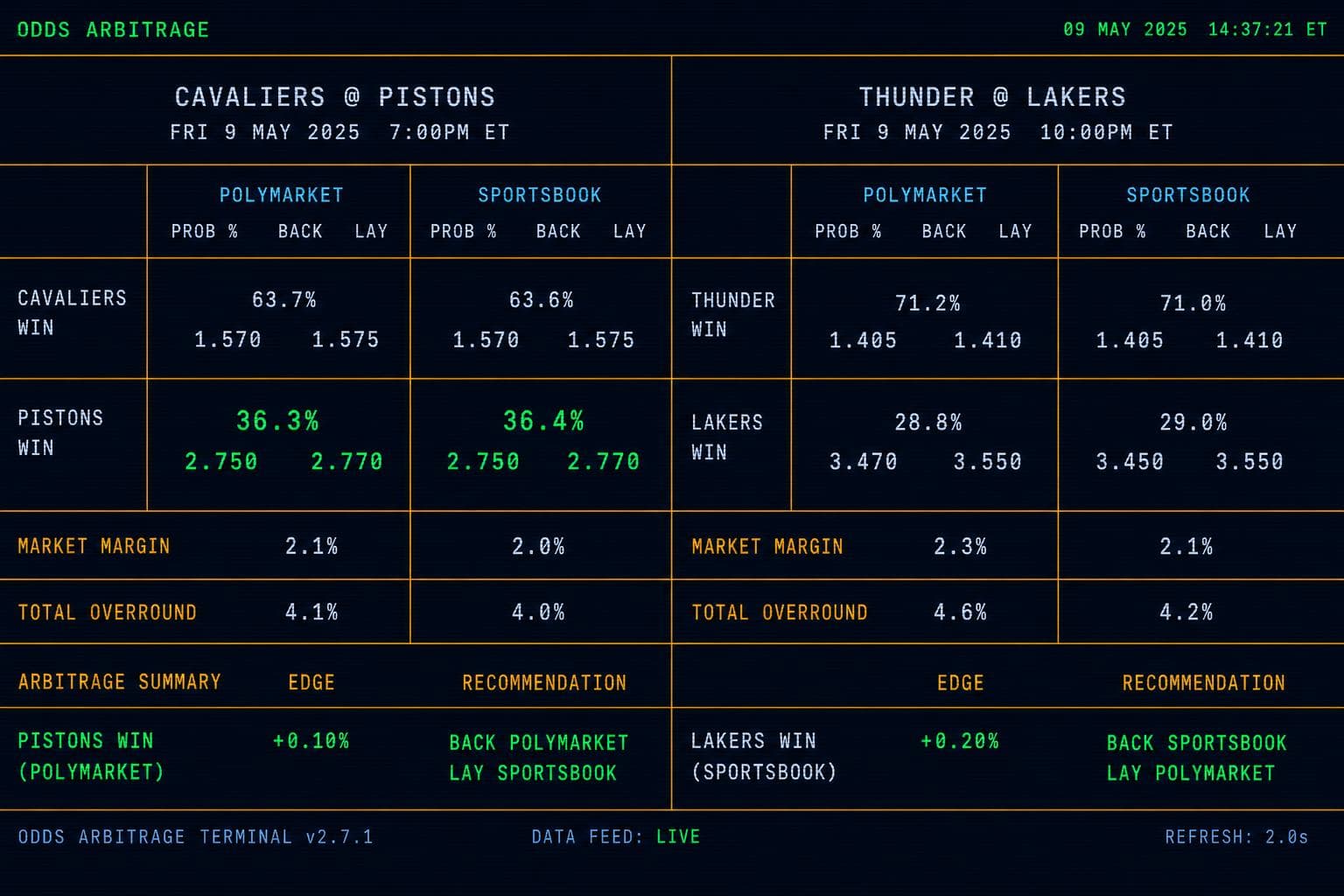

The Thunder-Lakers series looks like the obvious story. OKC at -1050 on DraftKings, Polymarket sitting at 86.5% for Game 1, series market at 93% Thunder — both ecosystems saying the same thing in slightly different dialects. When Polymarket and sportsbooks agree that closely, there's no edge. Move on.
The interesting number this weekend is Detroit.
Cavaliers-Pistons Is Where the Markets Actually Align — Which Is the Story
Bettors Insider's cross-market analysis from May 5 puts Polymarket at 58.5% Detroit, with sportsbook moneylines ranging from -149 to -155 for the Pistons — roughly 59.8-60.8% implied before vig removal. Strip the juice and you're looking at fair-value Pistons probability in the 57-59% range. That's essentially identical to Polymarket's figure.
So where's the edge? It's not in the direction of the bet — it's in what the consensus means.
When two structurally different markets price the same event within 1-2 points of each other, that's a signal the market has genuinely processed the available information. The Pistons are a mild favorite, both ecosystems agree on that, and neither is offering a meaningful discount on the other side. This is what efficient pricing looks like. The absence of a gap here is itself data.
Contrast that with the Thunder-Lakers situation, where the sportsbook implied probability (roughly 87-89% after vig removal) sits just inside Polymarket's 86.5% — again, near-perfect alignment. OddsShark's current championship odds have OKC at -185 to win the title outright, with the Spurs as the second-round surprise story after evening their series with Minnesota. The market has priced OKC's dominance across every time horizon: game, series, championship. There's no seam between platforms to exploit.
The Structural Reason Prediction Markets and Sportsbooks Are Converging
This convergence isn't accidental. A WSJ analysis (via Covers) found that 67% of Polymarket profits flow to just 0.1% of accounts — meaning the sharp money on prediction markets is increasingly concentrated in the same hands that move sportsbook lines. When the same sophisticated traders operate across both ecosystems, they arbitrage away the gaps. The inefficiencies that made cross-market plays obvious two years ago are narrowing.
DraftKings has noticed. The same Covers piece covers their interest in building prediction market infrastructure "the right way" — which is corporate language for: we see where the liquidity is going and we want a piece of it. As these platforms integrate, expect the pricing gaps to compress further.
That's the meta-trend underneath this weekend's numbers. The arbitrage window between Polymarket and traditional sportsbooks is real but shrinking, and it's shrinking fastest on high-volume, high-visibility events — exactly the NBA playoff games that dominate this weekend's slate.
Where to Actually Look
The remaining edges tend to live in lower-liquidity corners: Game 4 of Flyers-Hurricanes tonight, per CBS Sports, is the kind of market where Polymarket contract depth is thin and sportsbook lines haven't been hammered by sharp volume. NHL second-round games draw a fraction of the NBA's betting handle. Thinner markets mean slower information propagation — which means gaps persist longer before closing.
The pattern to watch going into next week: as the NBA second round advances and series prices shift on game results, check whether Polymarket updates faster or slower than the books on series markets after each game. That lag — whichever direction it runs — is where the actionable spread lives. A series that shifts 8-10 points on Polymarket before DraftKings moves its series price is a clean signal. Right now, on this weekend's slate, the two biggest NBA matchups are priced too efficiently to offer that.
The Pistons-Cavaliers series market is worth watching through Game 2. If Detroit wins Game 1 and the series price on Polymarket jumps before sportsbooks adjust, that's the tell.