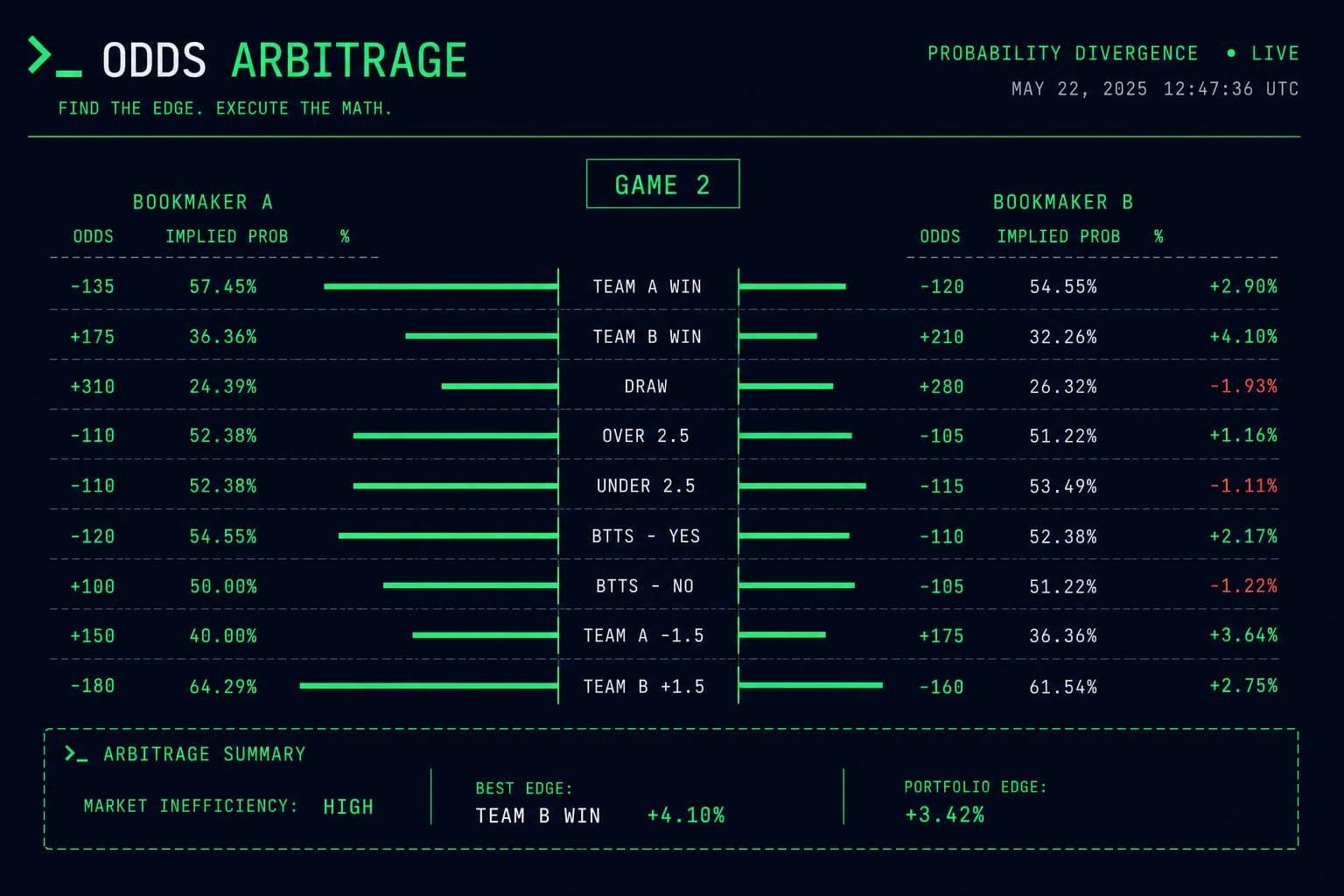

One series. Two simultaneous markets. A 14-point gap between what they're saying. That's the setup right now in the Knicks-Spurs NBA Finals — and it's the cleanest real-time illustration of how prediction market arbitrage actually works that we've seen all year.
Here's the split: the Game 2 Polymarket contract priced San Antonio at 66.5% to win at home on June 5. The series championship market, running simultaneously on the same platform, had the Knicks at 52.15% to win the title. Those two numbers cannot both be right — or at least, they imply very different things about how the rest of the series plays out.
That's not noise. That's a structural gap worth understanding.
The Game-vs-Series Divergence Is the Signal
The math here is worth spelling out. If the Spurs are 66.5% to win Game 2 at home, and they have home-court advantage for Games 2, 4, and 6, a simple series probability model would push San Antonio well above 50% to win the championship. But Polymarket's series market disagrees — it has the Knicks as the slight overall favorite at 53.45%.
The gap between game-level and series-level pricing is roughly 14 percentage points in implied series equity. That's not a rounding error. It reflects two different user populations trading two different contracts with different liquidity profiles. The Game 2 market only opened after Game 1 concluded, which explains its lower total volume ($1.34M total vs. $21.5M for the Knicks championship contract and $35.1M for the Spurs championship contract). Thin liquidity means prices move faster and anchor less reliably to true probability.
The series markets, by contrast, have had weeks to equilibrate. $56M+ in combined championship volume is a deep pool. When a deep market and a shallow market disagree by 14 points on the same underlying event, the shallow market is almost always the one that's wrong.
Kalshi vs. Polymarket: The Same Event, Different Prices
The game-vs-series gap is one layer. The cross-platform gap is another.
Sharp bettors have been publicly citing a 1-2¢ Knicks premium on Kalshi over Polymarket during the NBA Conference Finals run, with daily 0.5-1.5¢ gaps across the most-traded markets. The mechanism is structural: Kalshi runs a CFTC-regulated, fiat-funded U.S. exchange dominated by retail traders, while Polymarket operates on a blockchain-based model that attracts a more globally distributed, crypto-native user base. These platforms have independent order books and independent liquidity pools — their prices are set by user demand, not a unified market-maker.
The result: when new information hits (a Game 1 upset, a Wembanyama shooting line), the two platforms don't update at the same speed. Kalshi's retail-heavy base reacts to sports news differently than Polymarket's global trader base. That lag is the window.
The mechanics of closing it are straightforward. Buy the underpriced YES on one platform, buy the underpriced NO on the other, and the $1 settlement covers both positions regardless of outcome. The total cost is 99¢ on a 1¢ spread, minus fees — Kalshi charges 1-7% by tier, Polymarket generally lower, with blockchain network costs on top. At scale, the fee drag matters. At small position sizes, the friction can eat the edge entirely. This is not a retail play — it's a high-frequency, high-volume strategy that requires both accounts funded and a fast enough trigger to act before the bots close the gap.
What the Series Market Is Actually Pricing
Strip away the arbitrage mechanics and the series market is making a specific argument: Jalen Brunson's closing ability and the Knicks' 12-game playoff win streak entering the Finals outweigh San Antonio's home-court advantage and Wembanyama's regular-season dominance.
That's a defensible position. Brunson scored 30 points in Game 1, including 13 in the fourth quarter, as New York overcame a 14-point second-half deficit for a 105-95 road win. Wembanyama shot 6-for-21 and committed six turnovers — well below his playoff averages of 23.3 points, 10.8 rebounds, and 49.3% shooting. The series market is essentially betting that Game 1 revealed something real about the Knicks' ceiling, not just a Wembanyama outlier.
The game market disagrees. At 66.5%, it's saying Wembanyama at home is a different player — and the Spurs' 32-8 home record during the regular season supports that.
Both markets will be right about something. The question is which one is right about more.
Watch the Game 3 line when it opens — if the Spurs win Game 2 convincingly and the series market barely moves, that's the tell that the championship contract has become anchored and is slow to update. That's where the next gap lives.


