


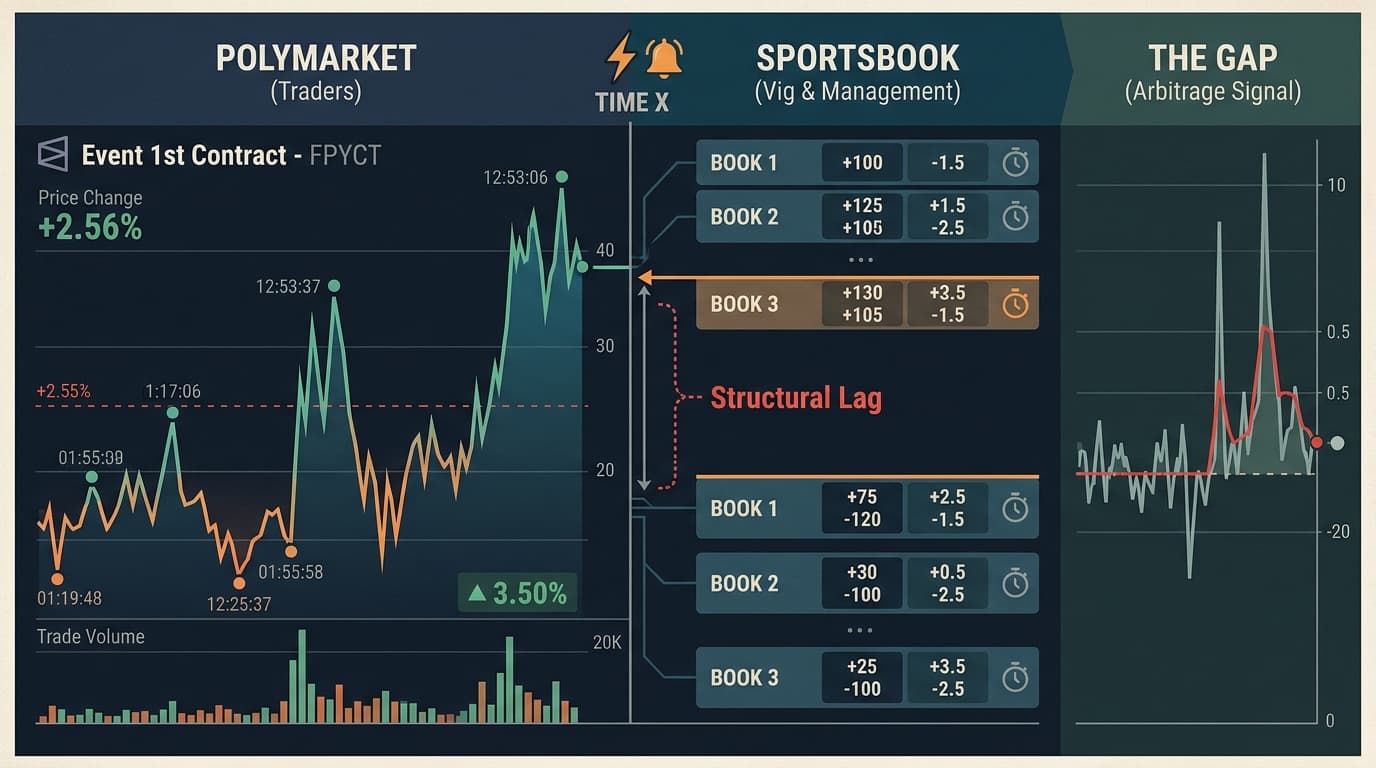

The most reliable edge in cross-market arbitrage isn't finding a mispriced line. It's finding a line that hasn't moved yet on one platform while another has already adjusted.
That structural lag is the whole game. And right now, the architecture of how prediction markets and traditional sportsbooks process information makes it persistent.
Polymarket and Sportsbooks Are Pricing Different Questions
Here's the friction point that creates recurring opportunity: Polymarket and sportsbooks aren't technically pricing the same thing, even when the surface question looks identical.
A sportsbook moneyline is priced to generate balanced action and protect margin. The vig is baked in, the line moves based on ticket volume as much as sharp money, and the book's goal is exposure management. Polymarket operates as a pure prediction market — prices reflect the aggregate probability estimate of traders, updated in near real-time based on actual capital at risk.
That's a meaningful structural difference. When injury news breaks, a sharp Polymarket trader can move a contract within minutes. A sportsbook line might lag by 20-30 minutes, especially for lower-profile games where the trading desk isn't watching every wire. That lag window is where the spread opens.
The Polymarket Analytics platform updates market data every five minutes — fast enough to catch meaningful divergences before sportsbooks close the gap. The methodology for finding those divergences is straightforward: convert both markets to implied probability, subtract, and look for spreads above 8 points. Anything under that is likely noise or vig differential.
Where the Gaps Actually Appear
Three recurring conditions generate actionable spreads:
Injury and lineup news. This is the most reliable source. Sportsbooks are slower to move on late-breaking news, particularly for mid-week NBA games or early-week NFL injury reports. Prediction markets, with their open participation model, often reprice faster because any informed trader can move the market immediately. If a starting point guard is listed as doubtful at 6 PM and Polymarket has already moved the win probability 7 points, check whether DraftKings or FanDuel has adjusted the spread yet. Often they haven't.
Different user bases, different priors. Polymarket's user base skews toward crypto-native traders who are comfortable with probability-based thinking and tend to be well-calibrated on certain event types — particularly anything with a clear binary resolution. Traditional sportsbooks attract a broader population that includes recreational bettors who anchor on narratives (home team, recent form, brand recognition). That behavioral difference creates systematic biases. Recreational money on sportsbooks tends to inflate favorites and popular teams; Polymarket prices are less susceptible to that distortion.
Liquidity gaps on smaller markets. A low-liquidity Polymarket contract can be moved significantly by a single large position. When that happens, the resulting price may not reflect genuine consensus — it reflects one trader's conviction. Cross-referencing against a sportsbook line in that scenario tells you whether the move was informed or just large. A 12-point Polymarket divergence on a market with thin volume is a different signal than the same divergence on a deep, heavily-traded contract.
How to Use This Framework This Week
The Polymarket Analytics search tool lets you compare markets across Polymarket and Kalshi simultaneously — useful for confirming whether a divergence is platform-specific or reflects genuine cross-market disagreement. A spread that shows up on both prediction markets but not in sportsbook lines is a stronger signal than one that only appears on Polymarket.
For sportsbook comparison, the major books — DraftKings, FanDuel, BetMGM — don't move in lockstep. VegasInsider's comparison data shows that DraftKings and BetMGM differ in their line-setting approaches, with DraftKings leaning on its DFS-derived user data and BetMGM drawing from MGM's broader market intelligence. That means the same event can carry meaningfully different implied probabilities across books before the market converges.
The practical workflow: identify a Polymarket contract where the implied probability has moved more than 8 points in the last hour, check the corresponding sportsbook moneyline, convert both to probability, and assess whether the gap is explained by vig alone. If it isn't, you have a candidate.
The window on these opportunities is usually measured in hours, not days. Sportsbooks have gotten faster. But the structural difference between how prediction markets and books process information hasn't closed — and until it does, the seam between them is where the edge lives.