


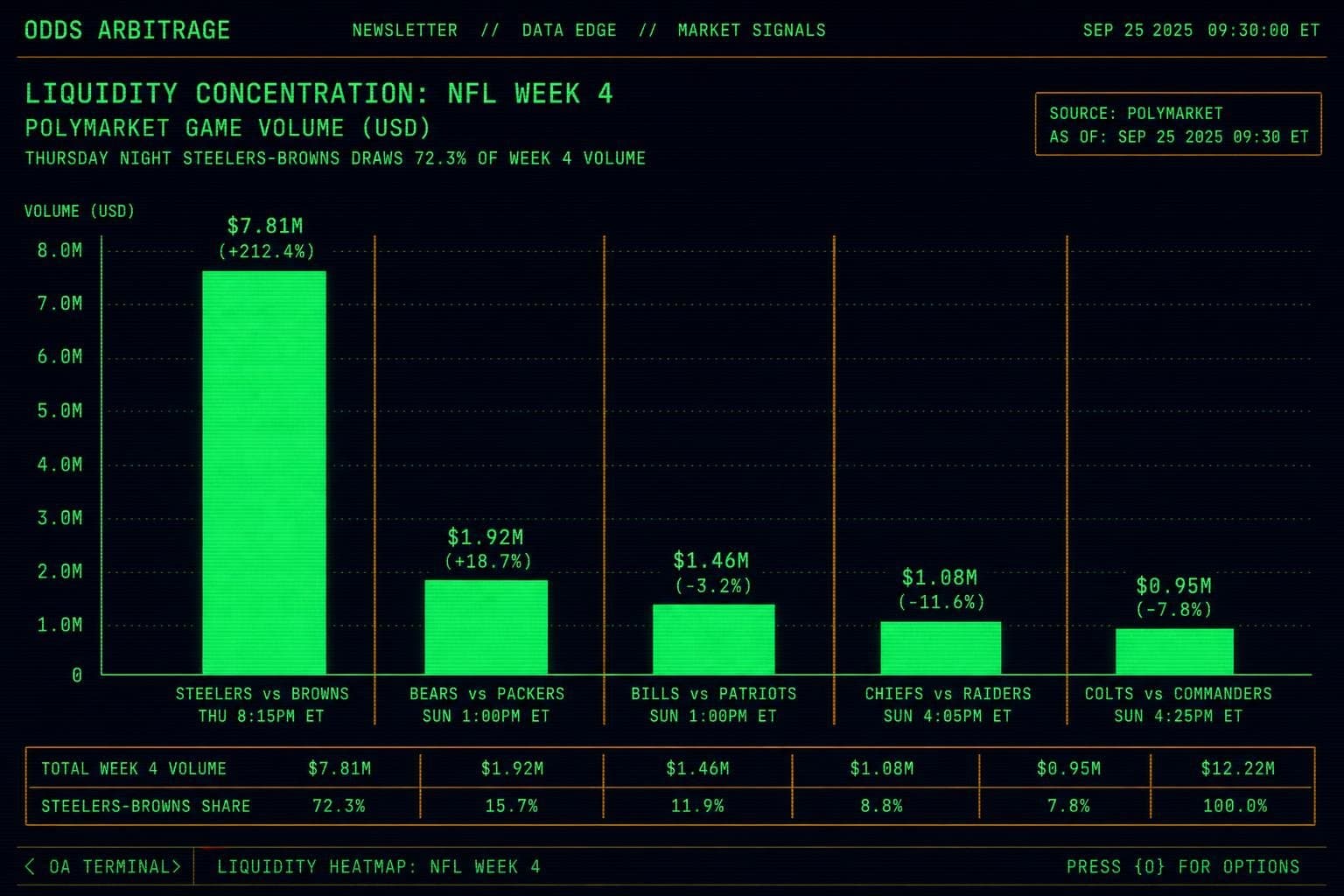

Look at where the money on Polymarket is actually sitting this week and the picture gets lopsided fast. The Steelers-Browns Thursday night market has pulled in $7.81 million in volume, while the Bears-Packers market for the following week — still a division game, still a name brand — sits at $819.72. That's not a rounding difference. That's a market with real depth sitting next to one that barely has a pulse yet.
The lesson isn't that Steelers-Browns is somehow more interesting football. It's that Polymarket liquidity in the NFL still concentrates hard around primetime windows close to kickoff, and everything further out on the calendar is effectively unpriced. If you're hunting for a Polymarket-vs-sportsbook gap on a game two weeks out, you're not finding an inefficiency — you're finding an empty order book. The arbitrage thesis only works where both sides have enough volume to mean something, and right now that's a short list.
Where the Real Divergence Is Living: Inside the Books, Not Between Them
With Polymarket thin everywhere except one marquee game, this week's actionable signal is happening entirely within the sportsbooks — specifically the gap between where the number sits and where the public is piling in.
BetMGM flags that 87% of straight against-the-spread tickets and 91% of straight moneyline tickets on Bills-Patriots are backing Buffalo, even with the Patriots priced at +260 on the moneyline and Buffalo coming off a performance where their underlying efficiency numbers didn't match the scoreboard. A team can win three straight games and still get bet against by the house's own analysts specifically because the ticket count is this one-sided. That's a textbook sharp-vs-public split, and it's happening on a single sportsbook's board, no cross-platform comparison required. When nine in ten moneyline bettors pick the favorite, the sportsbook's line has already baked in a public tax — the number isn't just measuring team strength, it's measuring where the square money wants to be.
Compare that to the pricing on two separate FanDuel games this week. Chiefs-Raiders has Kansas City at -225 on the moneyline against a +188 underdog, with a 4.5-point spread priced at -112/-108. Colts-Commanders has Indianapolis at the same -225, Washington at the same +188, on a 3.5-point spread priced at -122/+100. Two completely unrelated divisional and interconference matchups, and the moneyline odds come out identical to the cent. That's not a coincidence of team quality — it's a function of FanDuel's pricing model defaulting to a standard vig structure around a similarly-sized implied favorite, regardless of the actual matchup underneath it. When two unrelated games get the exact same number, the information content of that number drops. It's telling you more about the book's margin structure than about either team.
The Takeaway: Watch the Liquidity Before You Watch the Price
None of this means cross-market arbitrage is dead this week — it means the hunting ground has shifted. DraftKings' Week 4 board is already up with the full slate, including the Colts-Commanders London game and the Steelers-Browns Thursday opener, and Betfair's exchange is running its own promotional pricing around the same Steelers-Browns matchup. All of that liquidity is converging on the same handful of games Polymarket is also concentrating in. If a genuine Polymarket-vs-sportsbook gap is going to show up anywhere this week, Steelers-Browns is the one game with enough volume on both sides to make the comparison mean something. Everything else — Bears-Packers two weeks out, any game not yet carrying real Polymarket depth — is a trap for anyone pattern-matching last month's playbook onto an empty book.
For next week, the thing to track isn't another spread table. It's whether Polymarket volume on Bears-Packers climbs out of four figures before kickoff. If it does, that's the first real test of whether the liquidity gap closes as games approach, or whether Polymarket's NFL market structure is permanently going to favor primetime and ignore the rest of the slate. Either answer changes where the next few weeks of edge-hunting should point.