


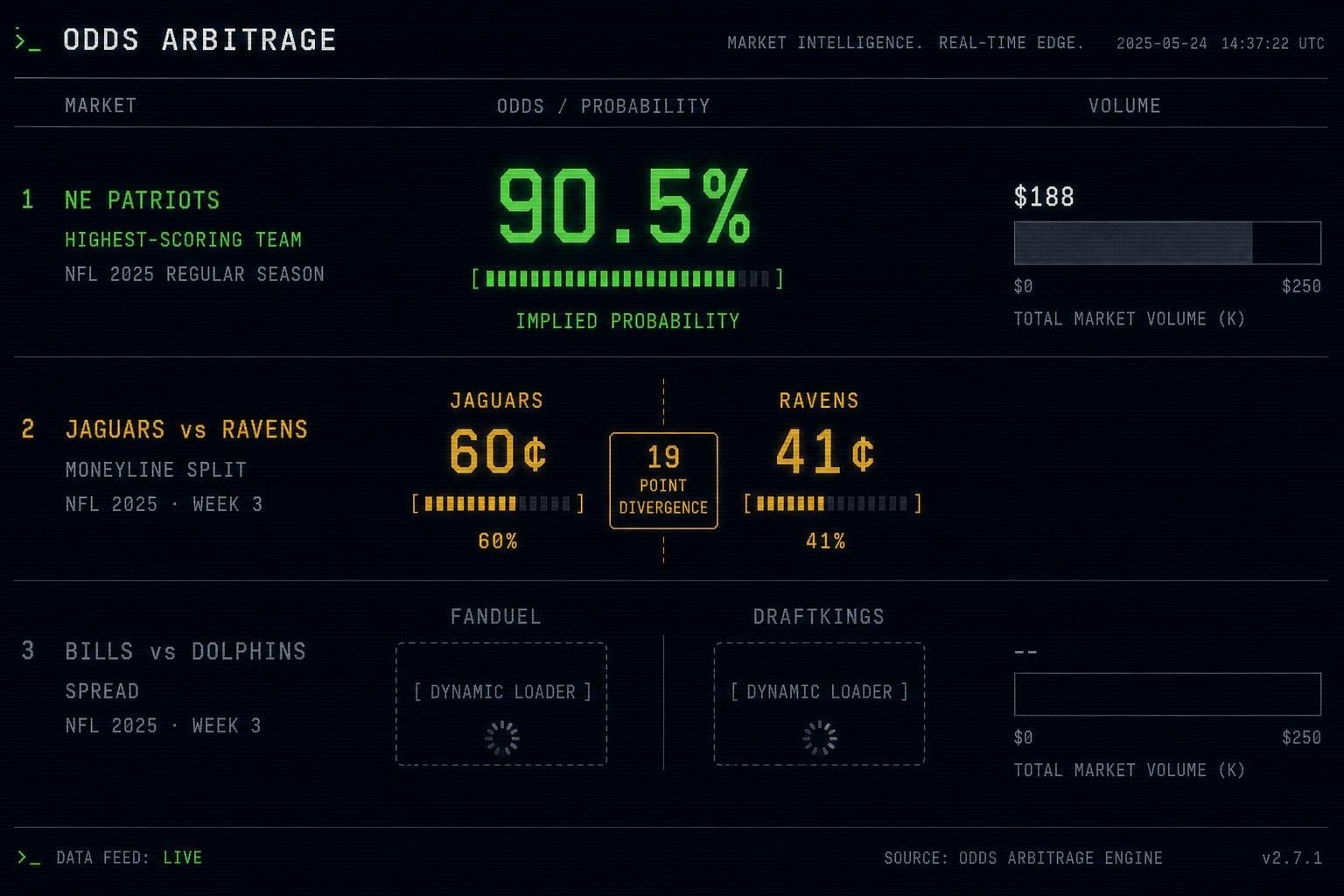

A market pricing the New England Patriots at 90.5% to be the NFL's highest-scoring team in Week 5 sounds like a strong signal — until you see it traded on $188 in total volume, with the next two outcomes stuck under 1% and most other teams sitting at literal zero volume (Polymarket). That's not a market disagreeing with sportsbooks. That's a market that barely exists.
This is the recurring problem I keep running into on the NFL side of Polymarket this fall, and it's worth naming plainly rather than forcing a cross-market comparison that the numbers can't support.
A 19-point moneyline spread with no volume behind it
The clearest example sitting live right now is the Jaguars-Ravens moneyline for the November 5 game, where Polymarket has Jacksonville priced at 60¢ and Baltimore at 41¢ — a 19-point implied-probability gap in Jacksonville's favor (Polymarket). On paper, that's the kind of number I'd normally stack straight against a DraftKings or FanDuel moneyline to look for a mispricing. The catch: the market's own volume reads as effectively nonexistent at the time of writing, meaning that 60/41 split reflects almost no real capital taking a position. A price with no depth behind it isn't an edge. It's noise that happens to look like a price.
This matters because the gap could easily evaporate or invert the moment real money shows up — and because trading against it now means trading against a number nobody else has actually tested. The lesson from the Patriots market and the Jaguars-Ravens market together is the same one: check volume before you check price. A 19-point gap on a $200 pool tells you less than a 3-point gap on a $2 million pool.
Why the books aren't giving us anything to triangulate against this week
Normally this is the point where I'd lay sportsbook lines next to Polymarket's prices and hunt for the 8-10 point divergence that makes a trade worth placing. This week, that comparison doesn't hold up on the sourcing I have. FanDuel's Week 6 schedule page lists every game from Thursday's Seahawks-Broncos opener through Monday's Commanders-49ers finale, but the specific spreads and totals are gated behind a live odds widget that updates outside the static page (FanDuel). DraftKings' betting-splits tool shows which games are getting attention — Eagles-Jaguars, Raiders-Patriots, Bengals-Dolphins among them — but the bet and handle percentages that actually tell you where the public and the sharp money diverge sit behind the same kind of dynamic loader (DraftKings). I'd rather say that plainly than invent a spread number to fill the gap.
The regulatory backdrop is doing more than the odds are
One underappreciated reason liquidity stays thin on event-specific NFL markets: prediction markets are still operating inside a patchwork of jurisdictional rules that sportsbooks settled years ago. Polymarket's U.S. product runs through QCEX, a CFTC-registered exchange, and is live in 49 states plus D.C. but excluded from Nevada (USA Today). Compare that to Brazil, where sports betting and online casinos were banned outright starting September 25, 2026, forcing platforms to process withdrawals on a fixed government timeline before shutting down entirely (BetMGM). Different countries, different exchanges, different user bases walking in the door — all of it adds up to prediction markets that are structurally younger and shallower than the sportsbook pools they're supposed to be arbitraged against.
That's the actual state of play this week: not a clean mispricing to act on, but a reminder that liquidity gaps are themselves the signal. Watch whether volume on the Jaguars-Ravens market builds meaningfully before November 5 — if it does and the 60/41 split holds, that's worth revisiting with real conviction. If it stays thin, the price isn't information. It's just a placeholder waiting for someone to show up.