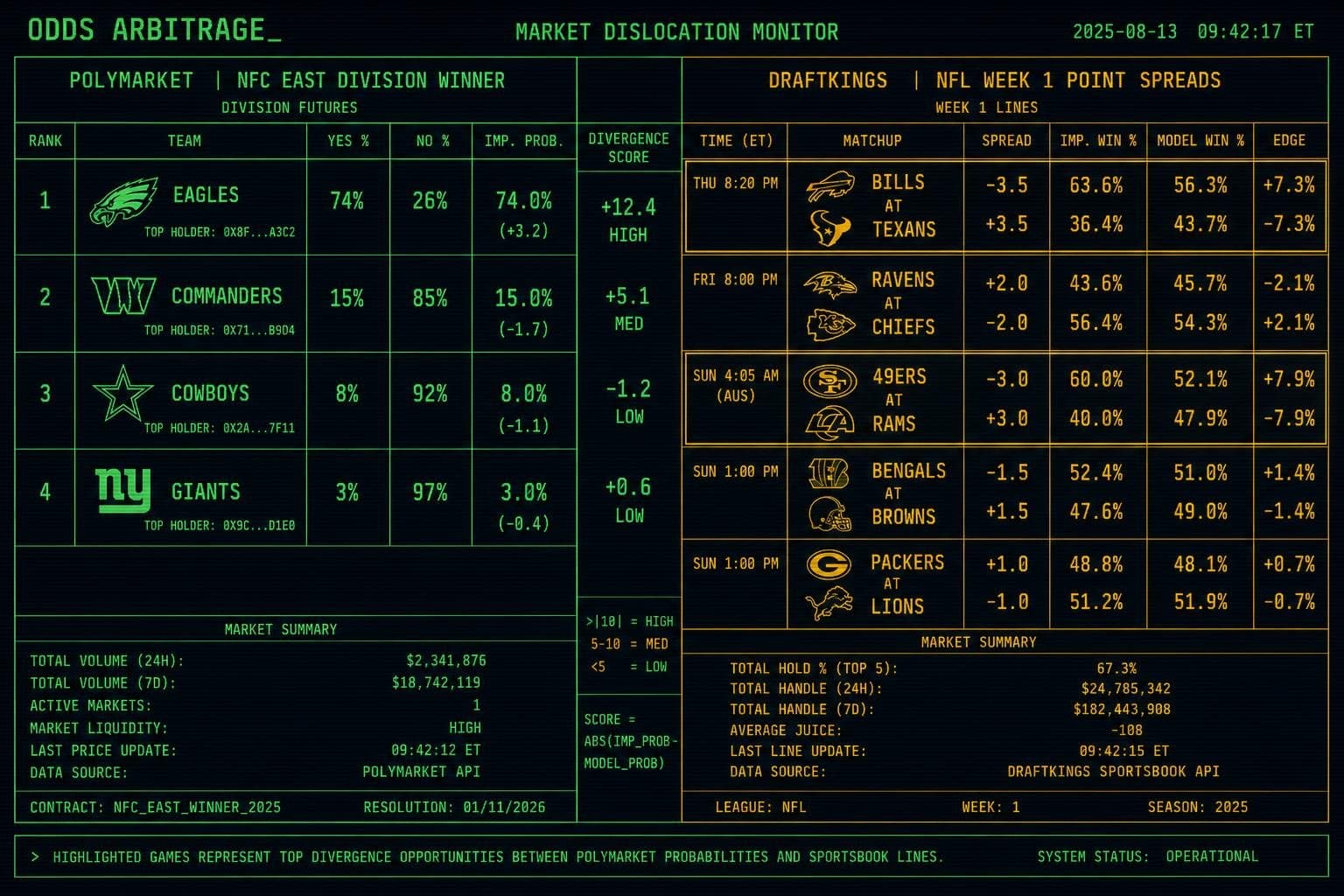

NFL Week 1 is here, and the markets are already disagreeing.
The opening weekend of the 2026 season features some genuinely unusual matchups — a Wednesday night opener, the league's first regular-season game in Australia — and the structural novelty of those games is creating exactly the kind of liquidity imbalance that produces cross-market pricing gaps. Prediction markets and traditional sportsbooks don't always process new information at the same speed, and Week 1 is historically the moment when those seams show most clearly.
Here's where the divergence is worth watching right now.
The NFC East Division Market Has a Structural Mismatch
The clearest cross-market signal this weekend sits in the NFC East division futures. Polymarket's NFC East champion market currently prices the Philadelphia Eagles at 41% and the Washington Commanders at 14%, with the Cowboys and Giants filling out the remainder. That's a prediction market built on aggregate trader sentiment — a user base that skews toward macro-level probability reasoning rather than game-by-game line movement.
The problem: those division probabilities are derived from season-long expectations, but they're not updating in real time with Week 1 game lines. DraftKings' Week 1 board shows the Cowboys opening Sunday Night Football against the Giants at MetLife Stadium — a direct NFC East head-to-head that should be repricing both teams' division odds simultaneously. When a divisional game is live on the board, the sportsbook is implicitly making a statement about relative team quality that the prediction market may not have absorbed yet.
The gap to watch: if Dallas is priced as a meaningful favorite in that SNF game (the line hasn't been confirmed in the available data, so I won't assign a number), but Polymarket still has them trailing Philadelphia by a wide margin in the division market, that's a structural lag — the kind of seam between different betting ecosystems that this column exists to identify.
The Bills-Texans Line Is the Weekend's Most Interesting Spread
Betfair's Week 1 preview lists the Bills as 1.5-point favorites over Houston, with match odds of 4/5 (Bills) and 1/2 (Texans) — implying roughly 56% for Buffalo and 67% for Houston on the moneyline, which already signals a discrepancy in how the exchange is pricing the two outcomes relative to the spread. FanDuel's Week 1 schedule coverage lists this game as a featured matchup, though specific moneyline numbers weren't extractable from the available excerpt.
The Betfair framing is notable: the exchange is treating this as a near-coin-flip despite Buffalo being the road favorite. Josh Allen's documented 0-4 record in Houston, combined with a Texans defense that Betfair describes as second only to Seattle's last season, is apparently being priced into the exchange more aggressively than a 1.5-point spread would suggest. If traditional sportsbooks are holding Buffalo closer to -3 or -3.5 while Betfair sits at -1.5, that's an 8-10 point implied probability gap — exactly the threshold where cross-market action becomes worth sizing.
The under 44.5 total on this game is the secondary signal. A defensive game with two run-heavy teams (Betfair notes David Montgomery arriving in Houston specifically to generate a ground game against Buffalo's strong run defense) tends to be underpriced on totals markets early in the season, when books are still calibrating to new rosters.
The Australia Game Is a Liquidity Anomaly
The 49ers-Rams game at the Melbourne Cricket Ground is the weekend's structural wildcard. DraftKings notes this as the NFL's first-ever regular season game in Australia — which means it's drawing liquidity from a market that has never priced this specific event type before.
Novel events are where prediction markets and sportsbooks diverge most reliably. Polymarket traders tend to anchor on team quality and season-long narratives; sportsbooks adjust for venue, travel, and scheduling factors. A game played at an unusual time in an unusual location creates asymmetric information: sharp bettors who've modeled the travel impact will move the sportsbook line, but that signal may not propagate to Polymarket's NFC West champion market (where the Rams are separately priced) for hours or days.
I don't have Polymarket's current NFC West pricing to compare against the sportsbook line on this specific game — the source pool doesn't surface it. But the structural argument holds: any time a sportsbook is processing genuinely novel scheduling information, check whether the corresponding season-long prediction market has moved in parallel. Usually it hasn't.
The pattern across all three of these markets is the same: sportsbooks are processing Week 1 game-specific information faster than prediction markets are updating their season-long contracts. That lag is the edge. Watch the Bills-Texans spread movement through Sunday morning — if it shifts more than a point in either direction, the implied probability gap with Betfair's current exchange pricing becomes the most actionable number on the board.


