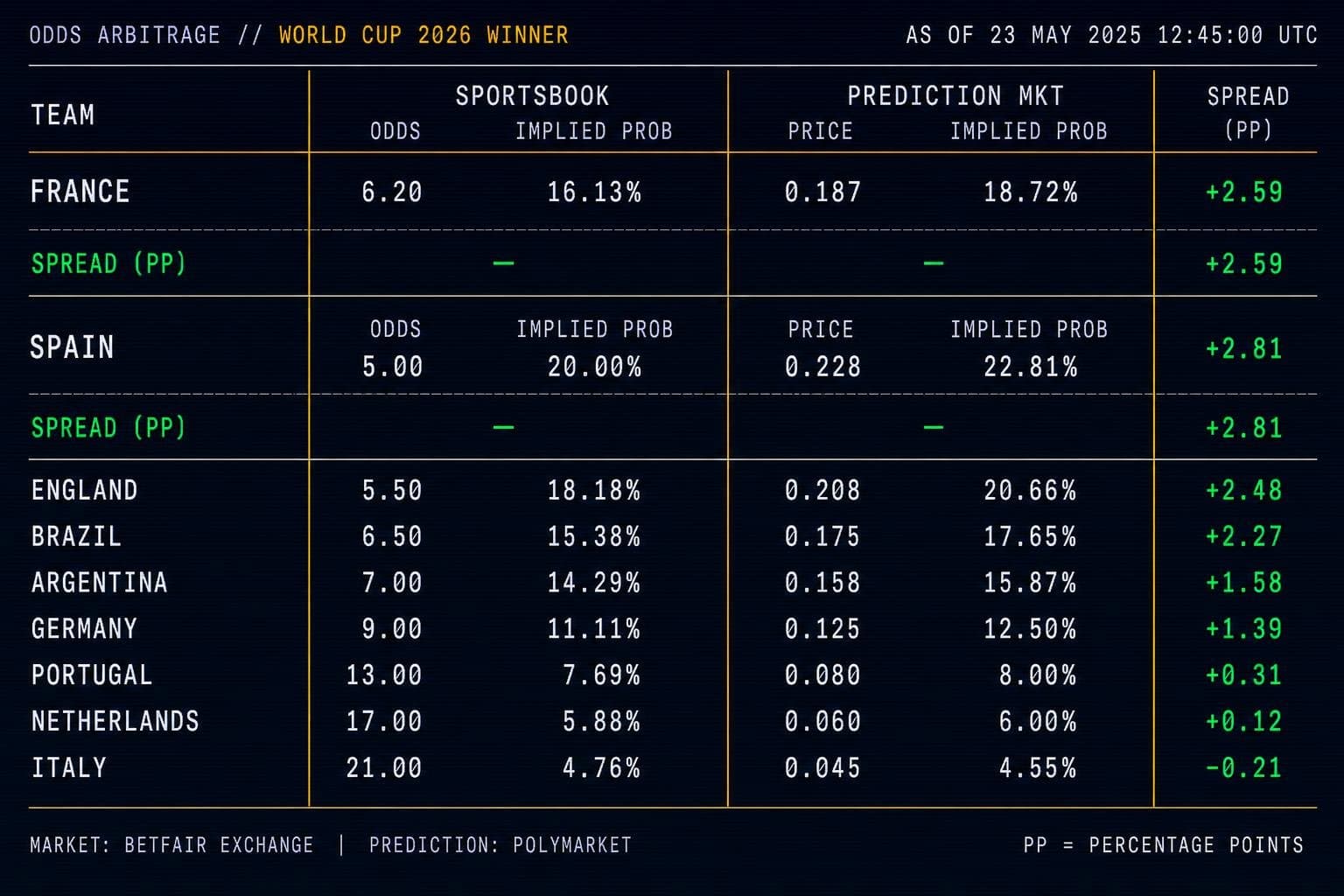

The 2026 World Cup is two weeks old, and the tournament favorite has already been reshuffled. France's 3-1 demolition of Senegal on Tuesday — Mbappé scoring twice, Barcola adding a third minutes after coming on — pushed Les Bleus to the top of the oddsboard. FanDuel Sportsbook now lists France at +410, its lowest price since the tournament odds opened in December. Spain sits at +480 after a shocking opening draw against Cape Verde. England climbed to +650 following a 4-2 win over Croatia.
Those are the sportsbook numbers. The more interesting question is whether Polymarket is pricing the same tournament.
Polymarket's World Cup Volume Is Real, But the Spread Is the Story
Polymarket's World Cup markets are running live, with the top individual game markets showing volumes in the $1M–$7M range. That's meaningful liquidity for a prediction market — enough that the bid-ask spread on the major contracts should be tight, and the implied probabilities should be comparable to what sportsbooks are offering.
The structural reason to care about this comparison is cost. A standard -110/-110 sportsbook line carries a 4.76% overround — the house's margin baked into every wager. Polymarket charges no vig, with taker fees capping around 0.75% of notional on a balanced market and dropping toward zero at the extremes. On a World Cup winner market, the gap widens further: futures books at traditional sportsbooks typically carry a 15–30% hold across the full field, per the same source. That's not a rounding error. It's the difference between a market that's priced to inform and one that's priced to extract.
So when Polymarket's implied probability on France diverges from FanDuel's, the default assumption should be that Polymarket is closer to fair value — not because it's smarter, but because it's cheaper to trade and therefore attracts sharper positioning.
The France-Spain Spread Is the Actionable Signal
FanDuel's current board has France at +410 and Spain at +480. Converting to implied probabilities: France sits at roughly 19.6% and Spain at roughly 17.2%. That's a gap of about 2.4 percentage points between the top two favorites.
The question is whether Polymarket's live contracts reflect the same spread or have moved differently. Spain's opening draw against Cape Verde is the kind of result that moves sportsbooks quickly — books respond to public sentiment, and a shock result generates immediate handle on the other side. Prediction markets, by contrast, move on the same information but through a different mechanism: traders updating positions based on their own probability assessments rather than a line-setter adjusting to balance action.
If Spain's draw caused sportsbooks to widen the gap between France and Spain faster than Polymarket traders repriced, there's a structural opportunity: Spain is relatively cheaper on Polymarket than on FanDuel. The reverse is also possible — if Polymarket's user base is more soccer-literate and already discounted Spain's defensive vulnerabilities before the tournament started, the draw may have moved Polymarket more aggressively, making Spain relatively expensive there.
Without a timestamped snapshot of both markets at the same moment, the exact spread delta isn't extractable from current sources. What is clear is that the conditions for divergence are present: a major result (Spain's draw), different user bases pricing the same event, and a structural vig gap that means the two markets don't have to agree.
Why DraftKings and FanDuel's Own Prediction Arms Complicate This
There's a third market in play that didn't exist a year ago. DraftKings Predictions reached a $3.1B annualized total trading volume in May, up 34% month-over-month, with executives crediting the NBA Finals and World Cup timing for the surge. FanDuel Predicts, meanwhile, added Crypto.com's OG Prediction Markets as a second exchange partner, expanding its contract offerings.
This matters for cross-market arbitrage because DraftKings and FanDuel now operate both a traditional sportsbook and a prediction market product. Their sportsbook lines and their prediction contracts are priced by different mechanisms — one by a line-setter managing liability, the other by an order book. When those two products from the same company diverge on the same event, that's a cleaner signal than comparing across platforms, because you can rule out user-base differences as the explanation.
As of June 11, DraftKings Predictions was still building liquidity — consumer volume at $1.3B annualized is real but not deep enough to guarantee tight spreads on every World Cup contract. Thin books on the prediction side mean the spread can swallow the vig savings, as the structural analysis makes clear. The edge lives in the liquid markets.
The specific contracts to watch over the next week: France's group stage completion odds and Spain's path to the knockout round. Both teams play again before the end of June, and each result will stress-test whether sportsbook lines and prediction market contracts reprice at the same speed — or whether one consistently lags the other.


