


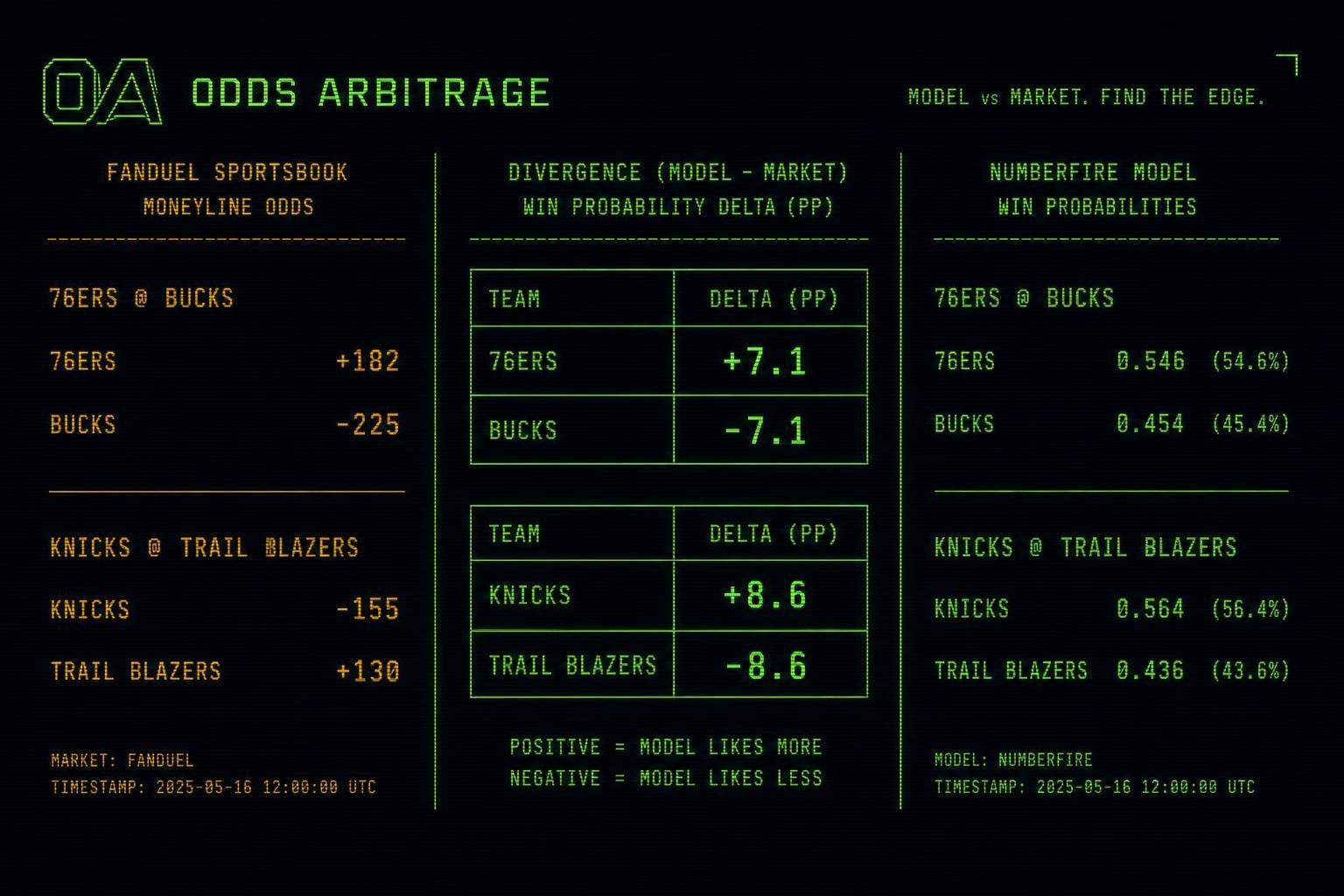

Here's a strange one: on Saturday's NBA slate, FanDuel's sportsbook and FanDuel's own predictive model can't agree on how lopsided two games actually are. Not a cross-platform gap. A cross-department gap, inside the same company.
Start with 76ers-Bucks. Philadelphia is priced at -649 on the moneyline, Milwaukee at +480. Strip the vig and that line implies roughly 83% for the 76ers. FanDuel Research's own numberFire model, sitting right next to the betting line on the same page, pegs Philadelphia's win probability at 74.2%. That's close to a 9-point gap between what the book is charging and what the house's own projection system thinks is fair.
The Knicks-Trail Blazers board shows the same pattern, smaller but still real. New York is -210 on the moneyline against Portland's +176, which normalizes to about 65% implied win probability for the Knicks. numberFire has New York at 71.2% — the model is more confident in the favorite than the actual market price. In both cases the sportsbook is pricing closer to the chalk than its own analytics shop believes is justified, which is the opposite of what you'd expect if public money were piling onto the favorite and pushing the line past fair value. It suggests the house number here is doing something other than pure probability — baking in margin asymmetrically, or just lagging the model's read on current form.
Where the Real NFL Market Actually Agrees
Compare that to Cardinals-Chiefs, which looked like a candidate for a clean gap and turned out to be the opposite. DraftKings has Kansas City at -1800 on the moneyline against Arizona's +1000, a line that moved enough during the week that the game total slid from an opened 44.5 down to 40.5 — a four-point drop that usually signals the book pricing in a blowout script rather than a competitive game. Normalize DraftKings' moneyline for vig and Kansas City lands around 91%. Polymarket's own FAQ copy for the contract states a current KC price of 92¢ — effectively the same number. Spread markets and prediction markets rarely converge this tightly on a 16.5-point favorite; when they do, there's nothing to trade. The two ecosystems have reached the same conclusion through completely different pricing mechanisms, which is itself informative: when sharp spread movement and a liquid prediction contract both land in the same place, that's about as close to consensus truth as these markets get.
The flip side is Raiders-Broncos, where Polymarket's three linked contracts are showing combined volume in the low five figures — $1.1K, $8.3K, and $1.3K across the different resolution markets. That's too thin to treat as a price signal against anything. A contract that thin can be moved by a single mid-five-figure order, so any "gap" you'd compute against DraftKings' line here is really just measuring whoever traded last, not a market view. The lesson isn't new — I've flagged Polymarket's NFL liquidity problem more than once this season — but it's worth restating every time a game like this shows up on the board with a tempting-looking divergence that evaporates the second you check volume.
The Actual Edge This Week Sits in the NBA, Not the NFL
Put it together and the signal for this slate inverts the usual pattern. The NFL cross-market comparison — Polymarket against DraftKings on a marquee Sunday game — is clean and boring, which means it's not where the money is. The interesting divergence is inside a single sportsbook's own product stack on two Saturday NBA games, where the posted line and the in-house model disagree by six to nine points of implied probability. That's not something you can arbitrage directly, since you can't bet against FanDuel's model, but it's a useful tell: when a book's own projection system is more bullish on the favorite than the number it's actually offering, the number has room to move before tip-off. Worth checking where the 76ers and Knicks lines sit an hour before game time against where they opened — if the book nudges toward its own model's number as liquidity firms up, that's the signal confirming itself in real time.