



There's a design question that haunts every roguelike developer: once you've accepted the genre's core loop — run, die, upgrade, repeat — what's actually left to innovate? Most answers involve adding more cards, more biomes, more synergies. The interesting answer, the one two very different games are exploring right now, is to steal the core mechanic from somewhere else entirely.
The Arcade Cabinet as Roguelike Engine
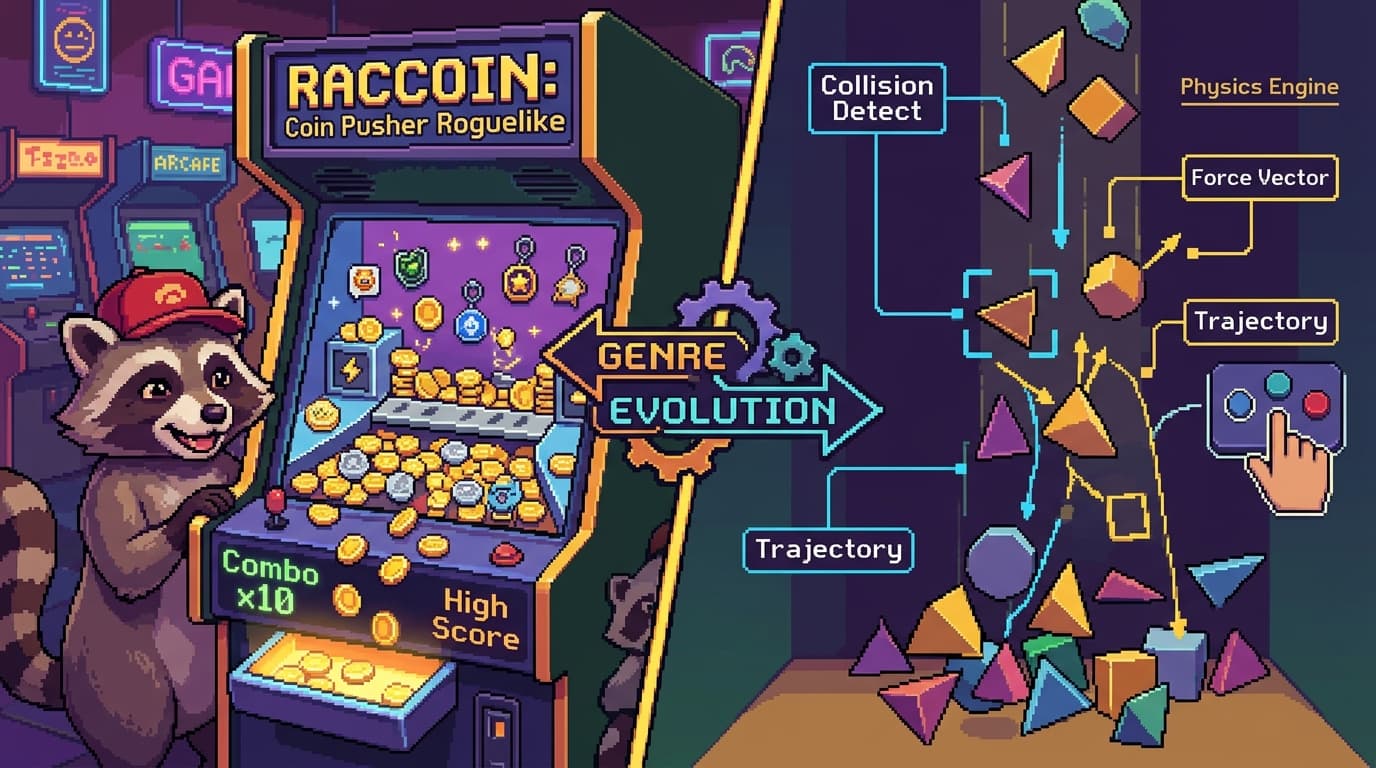
RACCOIN: Coin Pusher Roguelike should not work. The coin pusher is arguably the most cynical machine in arcade history — a device engineered to look like it's about to pay out while never actually doing so. Translating that into a roguelike feels like a joke setup waiting for a punchline.
Instead, it's one of the more genuinely clever design moves in recent memory. TechRaptor's review describes a game where over 150 coin types, 18 coin modifiers, chips, prizes, and keychains all interact through the physics of a coin pusher — and where a combo meter that rewards consistent scoring creates exactly the kind of mounting tension that makes roguelikes addictive. The comparison to Balatro isn't accidental; both games are published by Playstack, and both ask you to find exponential score growth inside a mechanic that looks trivially simple on the surface.
What RACCOIN understands is that the coin pusher's fundamental appeal — the sense that you're almost in control of physics — maps perfectly onto the roguelike's fundamental appeal: the sense that you're almost in control of chaos. The house doesn't always win here. That's the twist.
Stopping Time as a Strategic Turn
Ascend to Zero comes at the formula from the opposite direction. Where RACCOIN borrows a physical object, Ascend to Zero borrows a feeling — that split-second in a survival roguelike when enemies swarm from every direction and you desperately wish you could pause and think.
According to Xbox Wire, the game from Flyway Games was built around exactly that moment. The developer's insight was structural: freezing time and releasing it creates a strategic turn inside a real-time action game. You're not playing a turn-based game. You're not playing a pure action game. You're playing something that collapses the distinction between them, and the roguelike's upgrade loop — over 200 items, equipment sets beyond the mythic tier, three enhancement systems — exists to give you more interesting decisions to make in those frozen moments.
The design lineage here is worth noting. The developer cites Inflation RPG's structure of "explosive growth packed within limited opportunities" as a direct influence. That's a specific and unusual reference point, and it shows: Ascend to Zero isn't trying to be Hades with a time-stop button. It's trying to make each run feel like a compressed arc of power accumulation, where the time-bending mechanic is the delivery mechanism for that arc.
What Both Games Are Actually Doing
The pattern here isn't coincidence. Both RACCOIN and Ascend to Zero are solving the same problem: how do you make a player feel like they've discovered something, not just optimized something?
The standard roguelike answer is build diversity — give players enough cards or items that each run feels like a different puzzle. That works, and Slay the Spire 2's early access launch demonstrates there's still enormous appetite for it. Alinea Analytics estimates the sequel sold roughly 4.6 million copies in its first two weeks on Steam, generating over $92M — numbers that confirm the deck-builder formula has plenty of runway left.
But the more interesting design space is the one RACCOIN and Ascend to Zero are working in: find a mechanic that creates genuine surprise through its physics or feel, not just its numbers. A coin that bounces unexpectedly. A moment of frozen time that opens up a move you didn't see coming. These aren't just new skins on the same loop. They're new reasons to lean forward.
The roguelike genre has always rewarded developers willing to ask "what if the core mechanic were completely different?" Balatro asked it with poker hands. These two are asking it with arcade machines and time itself. Worth watching which answer sticks.