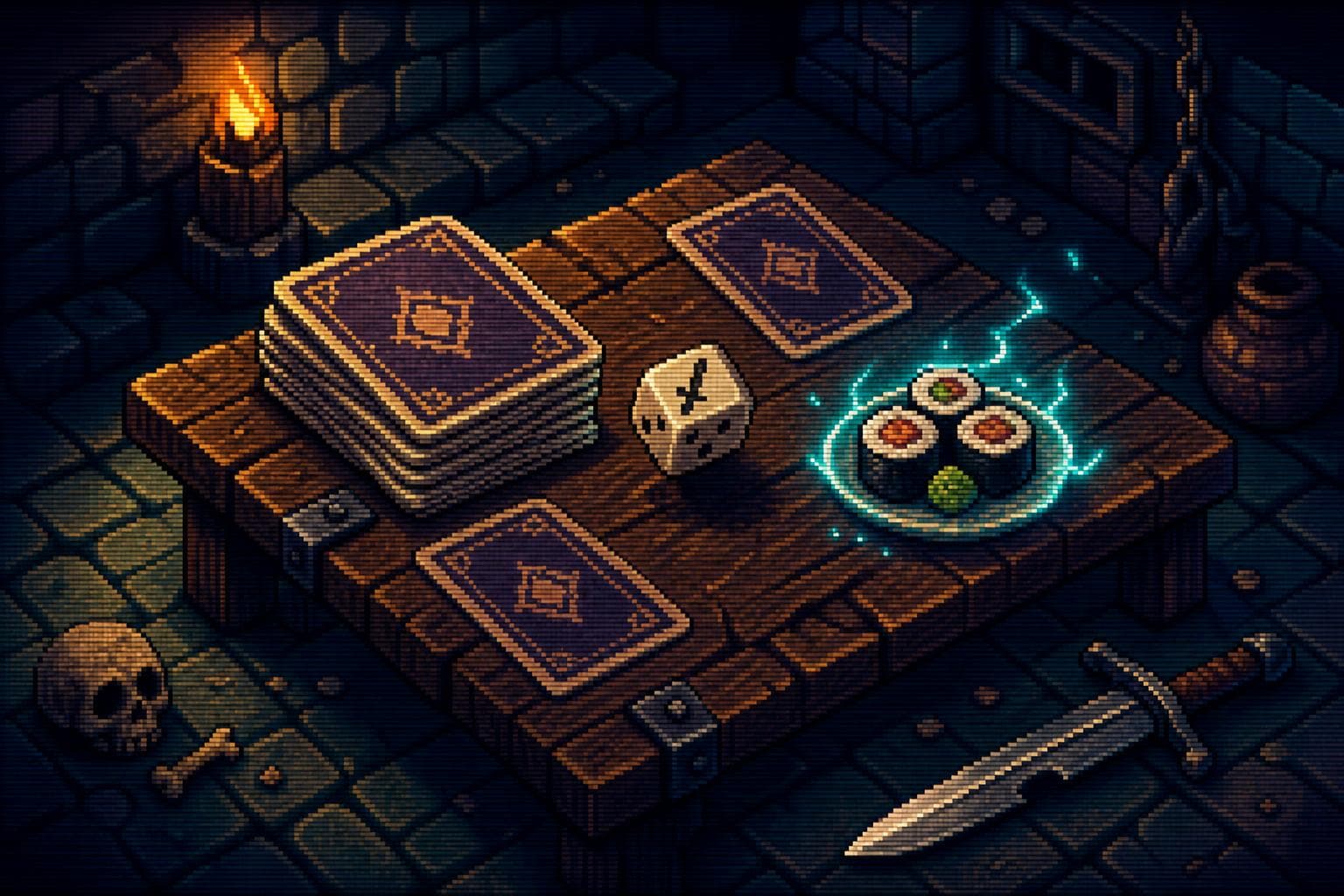

There's a moment in almost every deck-builder where you realize the game has a ceiling. You've found the broken combo, you know which cards to draft, and the rest is execution. The genre has a repetition problem — and the most interesting games coming out right now are solving it by questioning the premise itself.
What if your deck was made of dice? What if it was 44 cards and nothing else, ever? What if it wasn't cards at all, but sushi?
These aren't gimmicks. They're design arguments.
The Smallest Possible Deck Is Still a Complete Game
Scoundrel, which launched on Steam in May 2026 for $2.99, makes its thesis explicit in the developer's own framing: "Now go lose to the deck. The dungeon wants a story." The entire dungeon is 44 shuffled cards. No meta-progression, no persistent unlocks, no branching paths — just a deck that reshuffles and kills you differently each time.
The design logic is almost confrontational. Four cards flip face-up per turn. You must engage three. The fourth can be skipped, but skipping accumulates consequences, and every fight you take wears down your blade. As GameBrief notes, "excessive greed becomes more dangerous than combat threats." That's the whole game. Two to five minutes per run, then a new shuffle begins instantly.
What Scoundrel demonstrates is that constraint is the mechanic. Most deck-builders give you more — more cards, more synergies, more unlocks — and call that depth. Scoundrel gives you less and forces every decision to matter at a granular level that sprawling card pools rarely achieve. At $2.99, it's less than a coffee and more replayable than most games at ten times the price.
When the "Cards" Aren't Cards
Die in the Dungeon, which hit 1.0 in May 2026, takes the deck-builder skeleton and replaces every card with a die. Each die represents an action — attack, heal, boost, copy — and you can modify individual faces, add properties, and reshape each die's role in your build. The deck is still there conceptually, but the tactile randomness of rolling changes how you read your hand on every turn.
Rogueliker's coverage notes that the game was praised in Early Access for being accessible to newcomers while still offering a stern challenge — which is exactly the balance this subgenre struggles with. Deck-builders tend to front-load complexity; Die in the Dungeon apparently earns its depth gradually, letting the dice system teach you its logic through play rather than tutorials.
The design insight here is that randomness feels different depending on its source. Drawing a bad hand is frustrating. Rolling a bad result on a die you built yourself feels like a different kind of problem — one that implicates your choices rather than your luck.
The Balatro Effect, and What Comes After It
Both of these games exist in the shadow of Balatro, which demonstrated that you could take a familiar card structure (poker hands) and make it feel completely alien through modifier stacking and score multiplication. The game's influence is visible everywhere right now.
Sushiamo, from solo developer Panellino Games, launched a free demo in May 2026 and describes itself explicitly as Balatro-inspired — but the translation is interesting. Instead of poker hands, you're building high-scoring sushi combinations. Ingredients have distinct bonuses and synergize with each other; special tools and sauces modify those synergies further. The studio lists 80 special tools and 40 unique sauces as part of the build space, which suggests the combo depth is genuine rather than cosmetic.
The Balatro comparison is useful precisely because Sushiamo isn't trying to hide it. The question isn't whether it's derivative — it's whether the thematic translation creates new decision spaces. From the demo materials, the ingredient-tool-sauce triangle looks like it might: each layer modifies the others in ways that aren't just additive, which is where Balatro's real genius lived.
Meanwhile, Rogueliker's June 2026 roundup notes that Slay the Spire 2 ranked among the biggest launches in all of gaming in the first half of 2026 — which tells you the genre has genuine mainstream momentum, not just niche appeal.
What to Watch
The pattern across all of these games is the same: the interesting work isn't happening at the card level, it's happening at the system level. What counts as a card? What counts as a hand? What counts as a run? Scoundrel answers those questions with radical minimalism. Die in the Dungeon answers them with physical metaphor. Sushiamo answers them with thematic translation.
If you've been sleeping on this corner of the genre because it all started to blur together, these are the games worth waking up for. Scoundrel in particular — $2.99, two-minute runs — has no excuse not to be in your library by the end of the week.


