


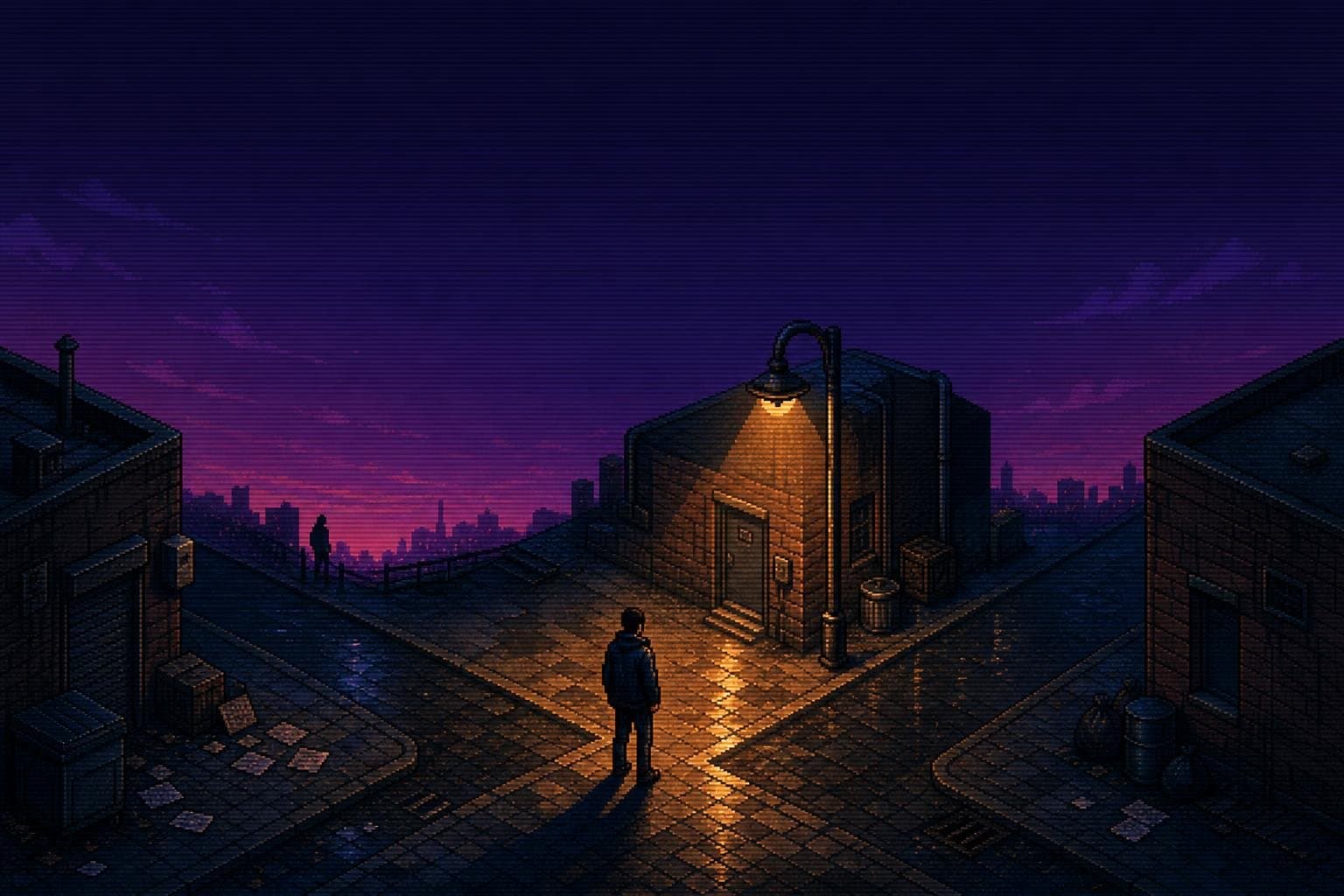

There's a specific kind of dread that only branching narrative games can produce. Not jump-scare dread, not combat-difficulty dread — the dread of realizing, three hours in, that a decision you made casually in chapter one has quietly reshaped everything around you. The story didn't announce it. It just... changed. That's the craft that separates a genuinely emotional narrative adventure from one that merely has a dialogue wheel.
The source pool this week is thin on newly released narrative adventures under $20 with confirmed branching mechanics — so rather than invent specifics to fill the gap, I want to use what's actually here to make a case about where the best examples of this genre are living right now, and why one title in particular keeps coming up as a benchmark.
Until Then Is Still the Standard
Until Then from developer Polychroma Games sits at 97% positive across over 9,000 Steam user reviews — "Overwhelmingly Positive" in Steam's own rating, with 96% of the most recent 480 reviews still landing there. That's not a honeymoon number. That's a game that has held its reputation over time.
The tags players have attached to it tell you everything about what the genre can do when it's working: Emotional, Story Rich, Psychological, Mystery, Multiple Endings, LGBTQ+, Psychological Horror. That's a wide emotional register for a pixel-art adventure game. The premise — a fateful meeting sets off a chain reaction, people disappear, memories prove unreliable — is the kind of setup that sounds like a dozen other visual novels until you're actually inside it and realize the unreliable memory mechanic isn't just flavor. It's structural. The game is doing something with the form, not just filling it.
I wrote about narrative constraints as a design virtue back in May, and Until Then is the clearest example of that argument in practice. Polychroma Games didn't have the budget to render a photorealistic world, so they built an emotional one instead — pixel art that communicates feeling through color and composition rather than fidelity. The "Multiple Endings" tag suggests the branching is real, not cosmetic. When a game with this review profile tags itself that way, players are usually confirming it in the discussion threads, not just hoping.
Currently on sale at 60% off on Steam, it's well under the $20 ceiling this newsletter operates in — and at that price, the value proposition is almost unfair.
The Itch.io Tier: Emotional Risk at No Cost
The other place narrative adventures with genuine branching and emotional depth are thriving is itch.io, where the economics of distribution let developers take swings that Steam's storefront pressure sometimes discourages.
Two visual novels from developer superbiasedcat — com__et and Bite the Hand — were recently available free on itch.io (the freebie window has likely closed, but both are normally priced at $4 and $6.99 respectively, well within scope). What's interesting about them as a pair is the design philosophy they share: both games actively reward replaying. com__et is described as a queer romance horror where deviating from the expected path unlocks "challenging narrative encounters, some touching, some terrifying," with a True Ending the game is "trying to keep from you." That's not a branching system bolted onto a linear story — that's a game whose structure is the argument.
Bite the Hand takes a different angle: a character in the middle of self-discovery encounters a mysterious figure, and the transformation that follows comes with a cost the player has to reckon with. Both games carry content warnings for sensitive material, which is worth flagging — but it's also worth noting that the best emotional narrative games usually do. Dread and discomfort handled with craft are different from gratuitous darkness.
What Makes Branching Actually Work
The pattern across these games points to something consistent: the choices that land aren't the ones with the most options. They're the ones where the game has thought carefully about what each path costs the player emotionally, not just narratively. A branch that leads to a different ending is a feature. A branch that makes you question whether you made the right call three sessions later is a design achievement.
That's the bar worth holding the genre to. Not "does this game have multiple endings?" but "does this game make you feel the weight of the path you didn't take?"
The narrative adventure space under $20 is producing work that answers that question seriously. Until Then is the clearest current proof. The itch.io tier is where the next proof is probably being built right now, by a developer who can't afford to play it safe — which, as this newsletter has argued before, is often exactly the condition that produces something worth remembering.