


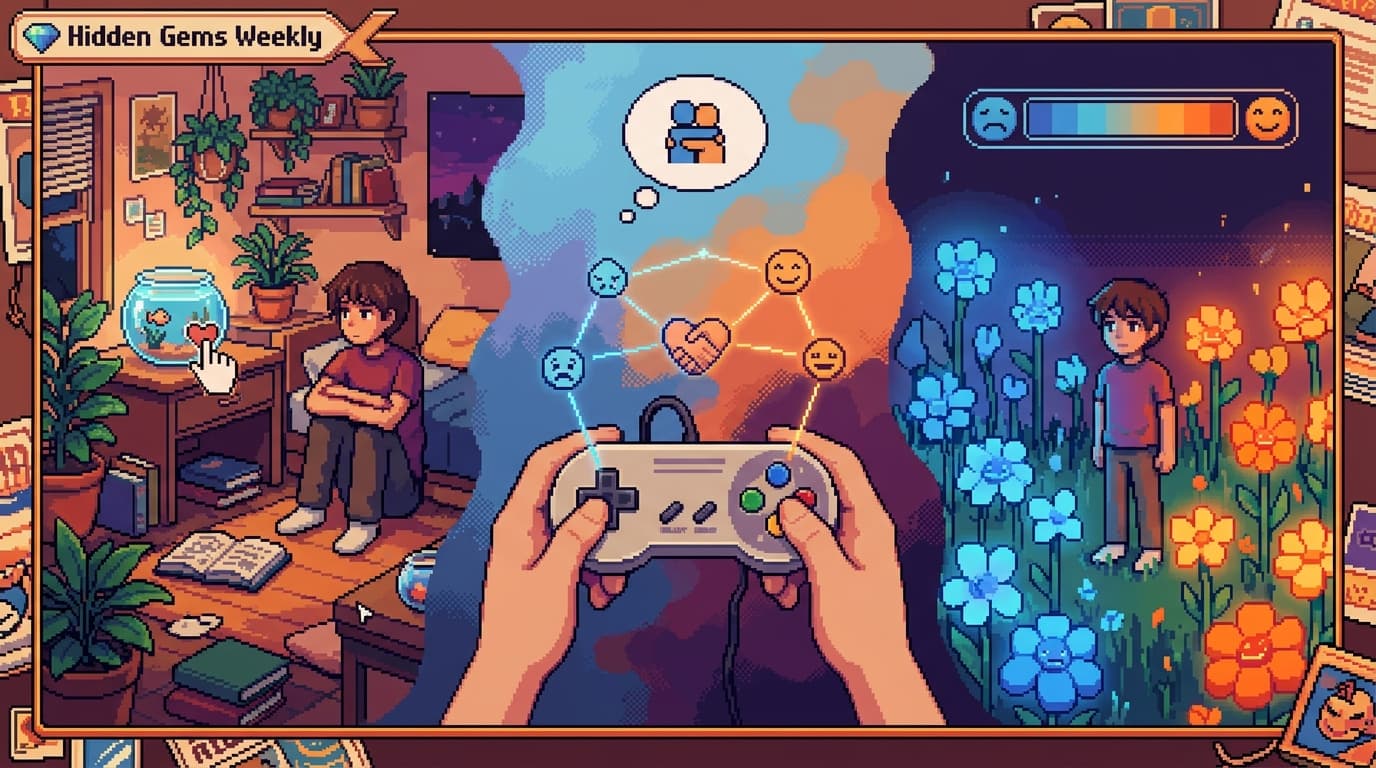

There's a moment in Fishbowl — a game Polygon recently highlighted — where the mechanics stop mattering and something else takes over. You're not trying to beat a level. You're just sitting with a feeling the game has carefully constructed around you. That's the line these games are walking: not "is this fun?" but "is this true?"
Experimental art games have always existed at the edge of what the medium can do. But lately, a particular kind of small-studio game keeps surfacing — one that uses game mechanics not as a challenge system but as an emotional delivery mechanism. The controller isn't a tool for winning. It's a tool for paying attention.
The Mechanic Is the Message
What separates these games from walking simulators or interactive fiction isn't the absence of systems — it's that the systems mean something. Polygon's coverage of Fishbowl frames it as a game that "mines heartfelt life lessons out of the social isolation," which is a useful description of how this genre works at its best. The interaction loop isn't there to create challenge. It's there to create implication.
This is the design move worth paying attention to: when a mechanic is chosen because of what it says rather than what it does, the game stops being a game in the traditional sense and becomes something harder to categorize. You're not playing through a story. You're enacting one. The distinction sounds subtle until you're actually inside it, and then it feels enormous.
I'd argue this is where the most interesting creative risk-taking in games is happening right now — not in procedural generation or AI-driven narrative, but in this quieter question: what does it feel like to do this thing, and what does that feeling teach you?
Small Teams, Stranger Visions
The experimental end of itch.io is where this gets genuinely weird, and I mean that as a compliment. Solo developers and tiny teams operate without the pressure to justify a design choice to a committee, which means they can follow an idea somewhere strange and just... see what happens.
Vena, a hex-tile strategy game on itch.io by solo developer Leonhard Kohl-Lörting, is a useful example of how aesthetic vision can transform a familiar genre. Built entirely by one person — design, art, music, code — it uses what the developer describes as a "bleached red-and-green palette, blending gore, nature, and postmodern structures" to make a resource management game feel genuinely alien. The mechanics are legible. The world is not. That gap between comprehensible systems and incomprehensible atmosphere is exactly where experimental games live. It won Godot Wild Jam #85 and currently holds a 4.6/5 on itch.io across its early ratings.
That's the thing about solo development at this scale: the creative vision is undiluted. When the art direction is strange, it's strange on purpose. When the tone is unsettling, someone made a deliberate choice to make you feel that way.
What "Respecting Your Time" Means Here
I usually evaluate games on whether they respect your time — but experimental art games require a different frame. A 45-minute experience that leaves you thinking for three days respects your time more than a 20-hour game that respects none of it. The value proposition isn't hours-per-dollar. It's weight-per-hour.
The games in this space tend to be short. Some are free. Most are under $10. That's not a limitation — it's a feature. A focused 40-minute experience can sustain a single emotional idea in a way that a longer game can't without diluting it. Fishbowl isn't short because the developer ran out of ideas. It's short because the idea is complete.
This is also why the under-$20 price range is where experimental games thrive. There's no commercial pressure to pad runtime or add systems that don't serve the vision. The game can be exactly as long as it needs to be, which is often not very long at all.
The games worth watching in this space aren't the ones trying to be the next Journey — that's a known destination now, and chasing it produces imitation. The interesting ones are the developers asking a stranger question: what if the mechanic itself was the argument? What if playing the game was the point it was making?
Keep an eye on itch.io's new releases over the next few weeks. The experimental stuff rarely announces itself loudly. It just shows up, does something you've never seen before, and leaves you slightly changed.