
There's a moment in INSIDE where the ambient drone shifts — barely perceptibly — and you realize the world has been watching you far longer than you knew. No cutscene. No dialogue. Just a change in the air, and suddenly everything feels different. That's the trick these games pull: they use absence as a design tool, and the best of them are ruthlessly good at it.
Atmospheric puzzle games with minimalist design have carved out a distinct corner of the indie space, and the formula keeps proving itself. Strip away the UI clutter, the tutorial pop-ups, the voiced exposition — and what's left either collapses into emptiness or becomes something genuinely unsettling. The games that succeed understand that a haunting soundscape isn't decoration. It's load-bearing.
Minimalism as Pressure, Not Aesthetic
The mistake people make about minimalist design is assuming it's about doing less. It's about doing precisely. Every visual element that survives the cut carries more weight. Every sound that makes it into the mix gets heard.
INSIDE is the clearest example of this principle executed at a high level. Playdead's game strips its world down to silhouette, shadow, and a muted palette — and then uses that restraint to make every anomaly feel significant. The Steam page describes it as combining "intense action with challenging puzzles" through a "moody art style, ambient soundtrack and unsettling atmosphere," which undersells how deliberately those three elements are braided together. The soundtrack isn't ambient in the background-music sense. It's reactive, breathing with the game's pacing, and the moments it goes quiet are often the most frightening.
That's the design insight worth stealing: silence is a sound. When a game's audio drops out completely, it signals something. Players trained by years of constant background music feel the absence physically. Atmospheric puzzle games weaponize this — and it's a reason PC Gamer's best indie games list consistently returns to titles defined by mood and restraint rather than mechanical complexity.
The Itch.io End of the Spectrum
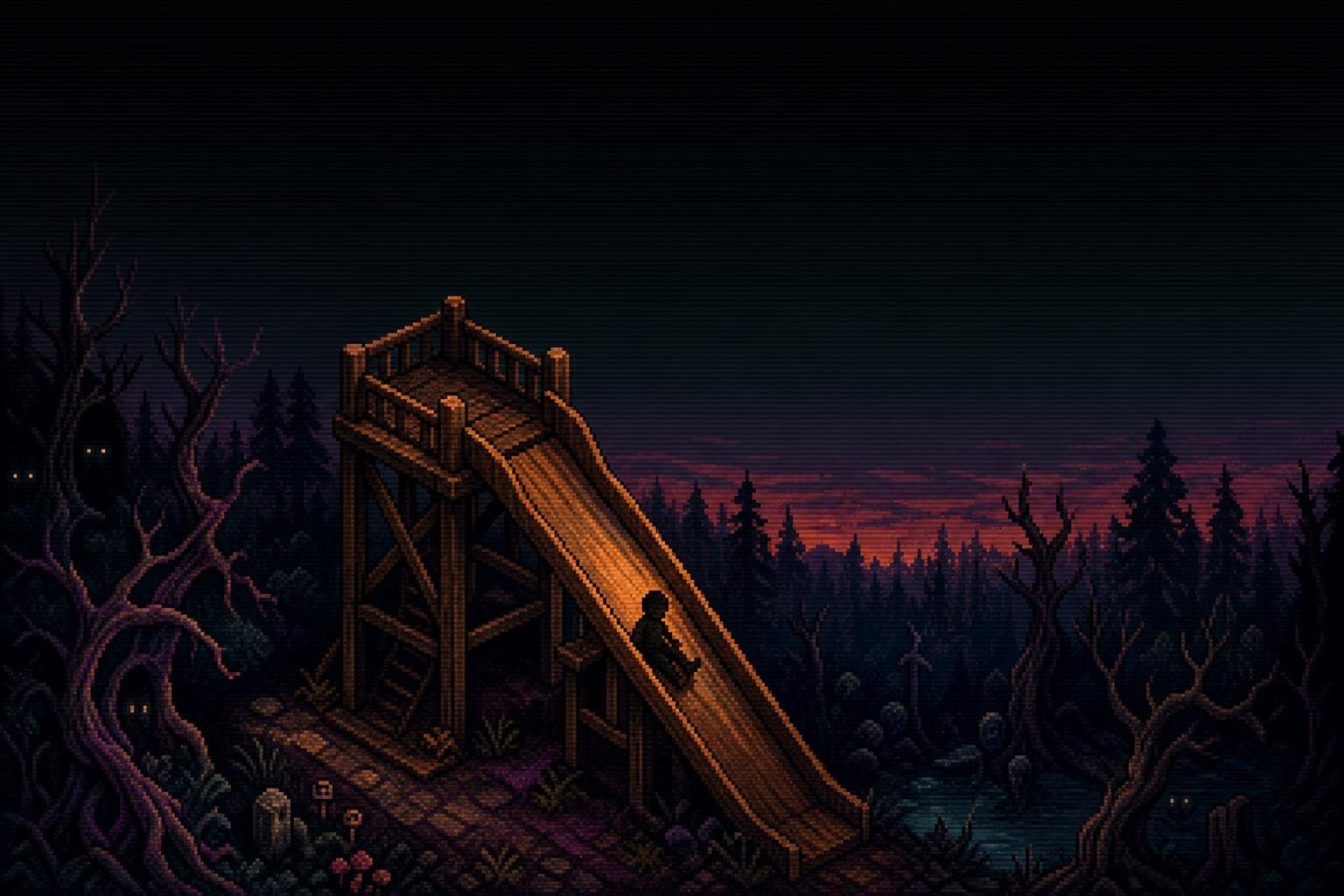
At the other end of the budget scale, Slide in the Woods by Jonny's Games demonstrates how far this approach can travel on almost nothing. It's a short horror game — name-your-own-price, a few minutes long — built around a single repeated action: going down a slide. Each descent changes something. The world shifts incrementally, and the PSX-style low-poly aesthetic makes those shifts feel wrong in ways that high-fidelity graphics often can't achieve. Uncanny valley works differently when the baseline is already abstracted.
The player comments on itch.io are instructive. Players consistently describe the same experience: "I loved how such a simple idea slowly became so unsettling." The game holds a 4.5-star rating across over 1,400 ratings, which for a free, minutes-long game represents genuine word-of-mouth momentum. People finish it and immediately want to tell someone about it.
That's the value proposition of minimalist atmospheric design at the budget end: when a game costs nothing and takes ten minutes, the barrier to recommendation drops to zero. The discovery loop accelerates. And because the game commits fully to its single idea — a slide, a woods, a growing wrongness — it doesn't overstay its welcome or dilute the effect.
What "Haunting" Actually Requires
The word gets overused in game descriptions, but a soundscape earns the label "haunting" through specific choices, not general spookiness. Drone tones that sit just below comfortable frequencies. Sound design that mimics natural ambience closely enough to feel real, then introduces one element that shouldn't be there. Silence deployed at the exact moment a player expects resolution.
INSIDE has been tagged by its own Steam player community with "Atmospheric," "Minimalist," and "Soundtrack" as defining characteristics — which is notable because players don't usually tag games for their audio unless it genuinely shaped the experience. The tags are a form of collective critical consensus, and when "Soundtrack" appears alongside "Minimalist," it suggests the two qualities are perceived as inseparable.
That's the through-line connecting games at every price point in this space: the sound design isn't compensating for the visual restraint, it's completing it. The minimalism creates the negative space; the audio fills it with something that feels alive. It's also why itch.io's horror and atmospheric categories keep surfacing games built on this template — the approach is reproducible at any scale, which makes it a natural fit for solo developers and tiny teams.
The Case for Playing in the Dark
If you haven't spent time with this genre, the entry point is easier than it's ever been. INSIDE sits at the established end — critically validated, widely available, a game that holds up as a reference point for what atmospheric puzzle design can achieve. Slide in the Woods is the ten-minute free version of the same argument, rougher and rawer and worth your time precisely because it proves the approach doesn't require a team or a budget.
The games that do this well share one quality: they trust you to feel the discomfort without being told to. That trust, extended to the player, is rarer than it should be. When you find a game that has it, you notice immediately — usually because something in the audio just shifted, and you can't quite say what changed. Rock Paper Shotgun's weekly coverage keeps returning to exactly this kind of discovery: small games that do one thing with complete conviction, and leave you thinking about them long after the screen goes dark.


