


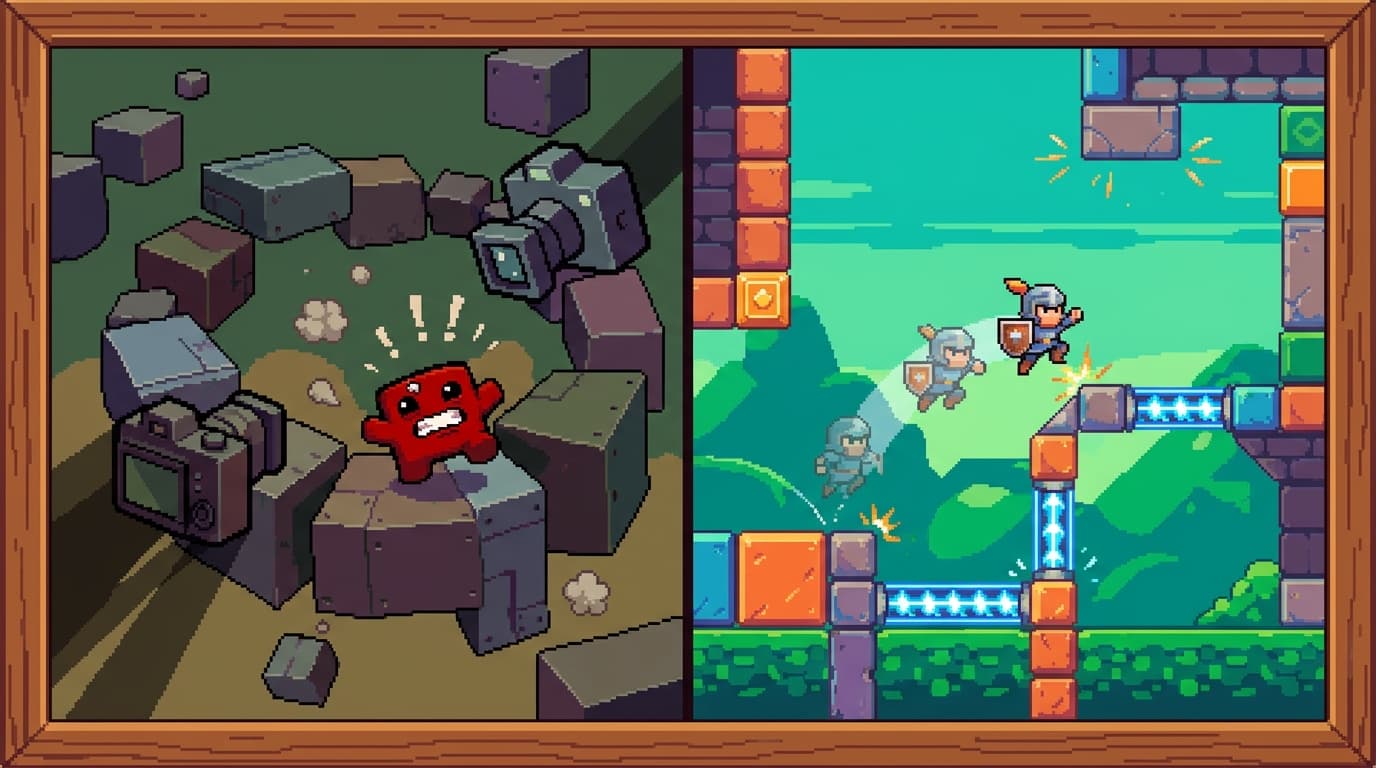

There's a version of "retro-inspired platformer" that's basically a mood board: chunky pixels, chiptune soundtrack, wall-jumps. It checks the nostalgia boxes and coasts. Then there's the version that actually interrogates what made those old games work — and asks whether the rules themselves are worth keeping.
Two recent releases sit at opposite ends of that question, and the gap between them is instructive.
When 3D Is the Wrong Answer
Polygon's review of Super Meat Boy 3D lands like a useful cautionary tale. The original Super Meat Boy was a masterclass in 2D precision — every death instant, every retry frictionless, the whole thing tuned to a razor's edge. The 3D version keeps the punishment but loses the precision. Loose movement and a restrictive camera add a layer of difficulty that wasn't designed, just... present. As Polygon puts it, the game "confidently jumps head-first into the same meat grinder."
That's the trap. Adding a dimension isn't the same as adding an idea. The series' core design insight — that dying fast and retrying faster creates a specific kind of flow state — depends on the player reading the space perfectly. In 2D, that's almost automatic. In 3D, it requires camera work the game doesn't deliver. The retro DNA is intact; the execution that made it sing is gone.
I'd argue this is the most common failure mode in the genre: treating "3D" or "5D" or any dimensional upgrade as the innovation itself, when the real question is whether the new form serves the original design logic.
When the Upgrade Actually Works
Demon Tides makes the opposite bet. Polygon's impressions describe a 3D platformer from Fabraz that gives you every movement ability from the start — double jump, glide, boost, wall-run, snake form — and then builds its entire design around combining them in any order. Jump, glide, double jump gets you distance. Jump, jump, glide gets you height. The game's own tip screen apparently just says "It's all about combos!" and that's not marketing copy, that's the actual thesis.
What Fabraz understood is that the retro platformer's real inheritance isn't the aesthetic or the difficulty curve — it's the movement vocabulary. Classic platformers were interesting because mastering their physics felt like learning a language. Demon Tides takes that instinct and runs with it: give players the full vocabulary immediately, then design spaces that reward fluency rather than gatekeeping it.
That's a genuine design idea, not a dimension count.
The Actual Question Worth Asking
Screenbound, an upcoming Steam title, is claiming to be the world's first "5D platformer" — a first-person 3D game where your character carries a 2D handheld that mirrors your actions simultaneously. It's a clever concept, and the dual-perspective mechanic could create genuinely new spatial puzzles. But "world's first 5D game" is a marketing claim, not a design argument. The question isn't how many dimensions it has. It's whether the mechanic creates interesting decisions that couldn't exist any other way.
That's the bar every retro-inspired platformer should be held to. Not: does it evoke the past? But: does it have an idea that justifies its existence?
Super Meat Boy 3D has a franchise and a pedigree. Demon Tides has a design philosophy. One of those is doing more work. Watch whether Screenbound's dual-screen mechanic generates actual puzzle design or just visual novelty — that distinction will tell you everything about whether it belongs in the first category or the second.