


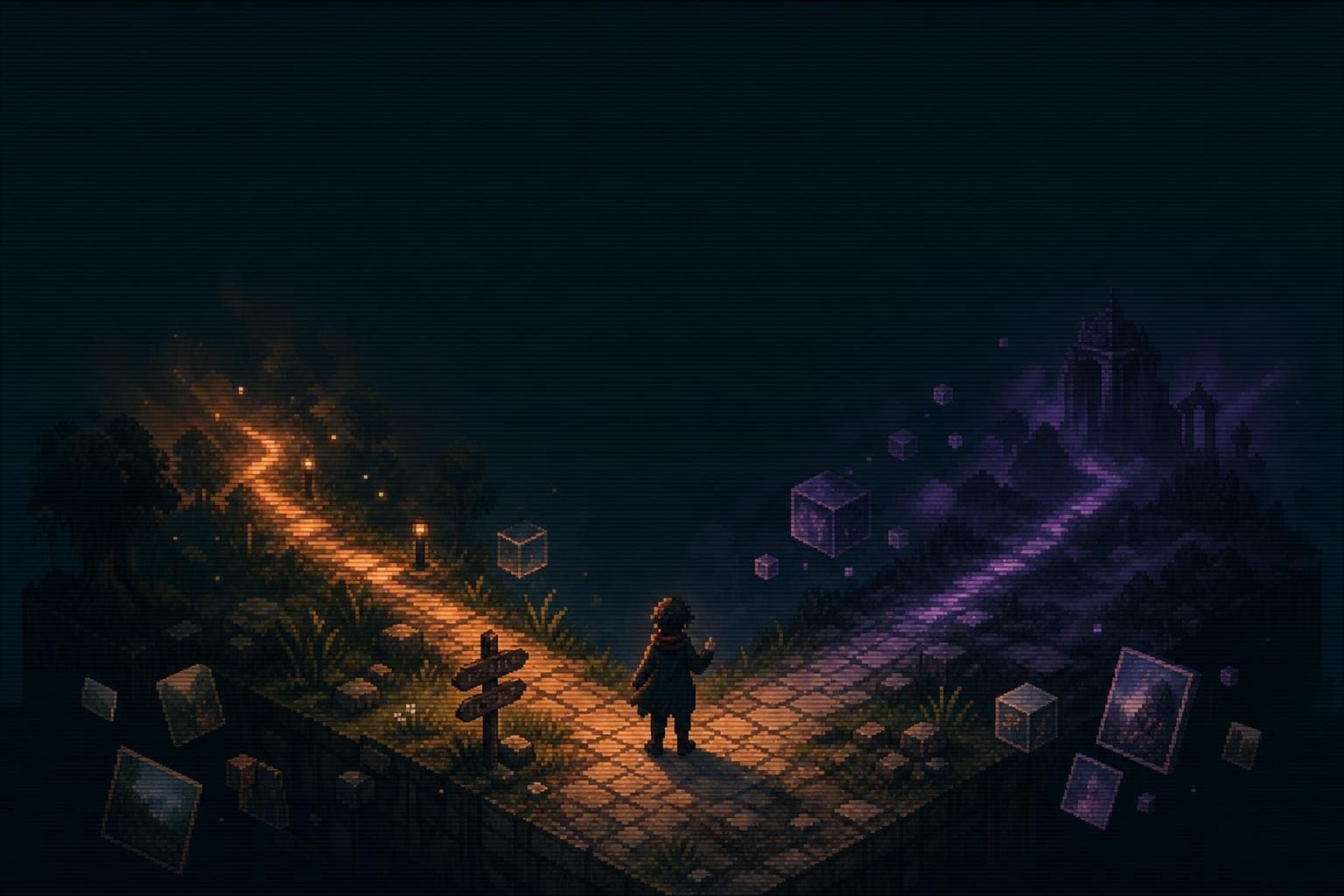

There's a game on itch.io right now that opens with a paradox. Its description reads: "You will shoot, and you will not shoot. You will ask questions, and you will not ask questions. You are not here to win." That's the entire pitch for a point-and-click narrative adventure — no screenshots, no trailer, just a contradiction and an instruction. And somehow, that's more intriguing than a hundred games with elaborate feature lists.
That tension — between agency and inevitability, between choosing and being chosen — is where the most interesting narrative indie work is happening right now. Not in games that give you more branches, but in games that interrogate what a branch even means.
The Best Narrative Games Are Questioning Their Own Premise
I've written before about how consequence-driven design separates memorable narrative games from forgettable ones. The pattern I keep seeing in the current wave goes further: the most compelling releases aren't just making your choices matter, they're making you uncertain whether you're choosing at all.
The itch.io game above — still in the wishlist-building phase — frames this explicitly in its copy. "You are not here to win" isn't a disclaimer; it's a design philosophy. Point-and-click adventures have always lived in the space between puzzle and story, but the best ones lately are collapsing that distinction entirely. The puzzle is the story. The question of when to shoot and when to hold back isn't a mechanical challenge — it's the emotional core.
This matters for budget-conscious players because this kind of design is genuinely cheap to execute well. You don't need a motion-capture budget to make a player feel the weight of a decision. You need a writer who understands that withholding is as powerful as delivering.
When the Setting Does the Narrative Work
The other thing worth paying attention to: the best narrative indie games right now are using place as a character, not just a backdrop.
Polygon's preview of Usual June makes this vivid. Finji — the Michigan studio behind Night in the Woods and Chicory: A Colorful Tale — is building their next narrative adventure around Fen Harbor, a fictional Midwest college town that game director Adam Saltsman describes as a place shaped by billionaire extraction: "When things come to an end in the Midwest, historically, it's because billionaires are done harvesting stuff there, and move on." The cemetery where protagonist June and her friends discover an astral plane threatening to erase the town isn't just a spooky set piece. It's a metaphor for what happens to places when capital moves on.
That's the kind of specificity that makes a narrative game feel like it's about something. Finji has built their publishing reputation on exactly this — Night in the Woods used a dying rust-belt town to talk about economic anxiety and mental health in ways that landed harder than any explicit treatment could. Usual June looks like it's reaching for the same register, mixing coming-of-age exploration with what Polygon describes as Devil May Cry-style combat. Genre-bending in service of theme, not novelty.
Usual June isn't out yet and its price hasn't been confirmed, so I can't call it a buy. But it's the clearest example I've seen recently of a studio treating narrative setting as load-bearing structure rather than decoration.
What "Respect Your Time" Looks Like in a Story Game
Here's the criterion I keep coming back to for narrative adventures specifically: does the game trust you to sit with ambiguity, or does it keep explaining itself?
The itch.io point-and-click mentioned above earns points just for its description — it refuses to resolve its own contradiction. That's a signal. Games that over-explain their themes in the first ten minutes rarely earn the emotional payoff they're reaching for. The ones that let you live inside uncertainty for a while, that make you feel the weight of a choice before they tell you what it meant — those are the ones you remember.
Polygon's coverage of Virtue and a Sledgehammer — a narrative adventure from Deconstructeam and Selkie Harbor, published by Devolver Digital — gets at something adjacent. The game follows Pratelle through the ruins of her childhood, where former neighbors' memories have been uploaded into cube-headed robots. The violence in the game isn't cathartic release; it's complicated, which is exactly what the neuroscience Polygon cites suggests it should be. Breaking things doesn't vent anger — it extends it. A narrative game that builds its mechanics around that truth is doing something genuinely interesting.
The through-line across all of this: the narrative indie games worth your time right now aren't the ones with the most choices. They're the ones where the act of choosing reveals something about you — or about the world the game is building — that you didn't expect to find. Watch for what Finji does with Usual June when it lands, and keep an eye on the itch.io point-and-click space, where the strangest premises are often the most honest ones.