


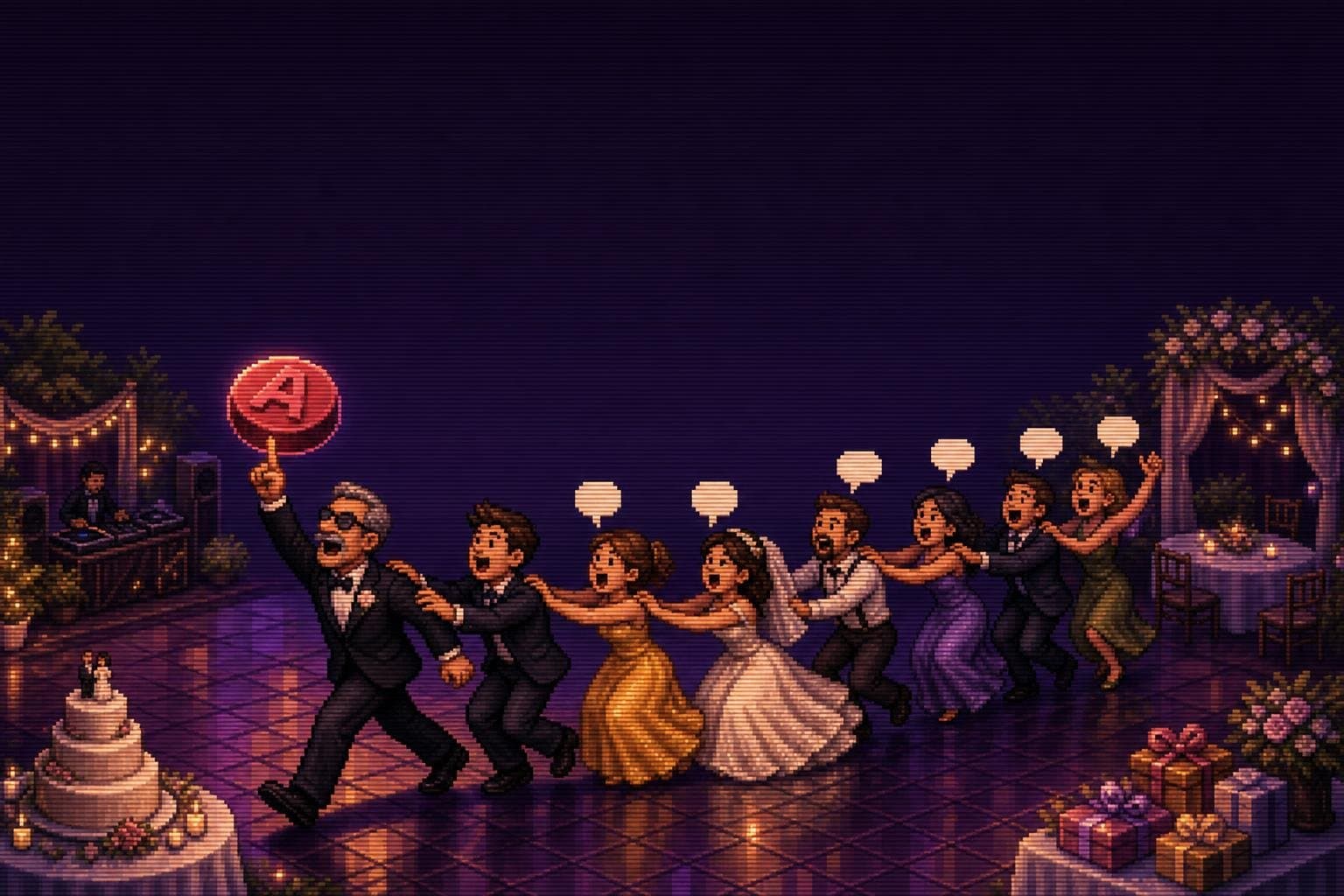

There's a free browser game right now where you play a father of the bride steering a conga line around a wedding dance floor, pressing A on every fourth beat while a room full of digital guests shouts "HEY" back at you. That's Advanced Wedding Reception Simulator, a native GBA title from the British studio Orbit Leisure, and it's the clearest example I've found this month of what I actually mean when I say a rhythm game has audio-visual synergy. It's not about pretty neon lanes. It's about whether the thing on screen and the thing in your ears are the same event, experienced twice.
Rhythm games live or die on that overlap. A beat hits, something visual confirms it, and your brain either trusts the feedback loop or doesn't. This week's crop of releases — one polished Steam title, one ambitious narrative hybrid, and two scrappier itch.io experiments — all approach that problem from different angles, and the contrast tells you a lot about where the genre's creative energy actually is right now.
The Grid Game That Turns Rhythm Into a Shooting Range
Rhythia, from developer Capo Games, strips the genre down to something closer to a reflex trainer. You're aiming and hitting musical beats inside a 3x3 grid as blocks fly toward you, blending FPS-style targeting with rhythm timing — a combination the game's own tag list makes explicit, pairing "Rhythm" and "First-Person" with "Music-Based Procedural Generation." It's currently in Early Access and sitting at Very Positive across both its recent and lifetime reviews, including an 86 percent positive rate over its last 283 reviews. What makes it interesting as a design object isn't the grid itself — plenty of games have done beat-grids — it's that Capo Games built the procedural generation around the music rather than bolting a soundtrack onto fixed patterns. The level comes from the song, which is the only honest way to do rhythm design, and too few games bother.
A Card Game Wearing a Rhythm Game's Clothes
In Falsus, from developer and publisher lowiro, goes the opposite direction entirely. It's a rhythm game fused with a deckbuilding card system and a layered sci-fi narrative told through five interconnected protagonists in a near-future setting. The Steam page frames its structure around "seamless progression" from the rhythm layer into the narrative one, and the tag cloud backs that up — Visual Novel, Story Rich, Deckbuilding, and Great Soundtrack all sitting next to Rhythm and Hex Grid. Reviews are Very Positive at 90 percent lifetime and climbing to 92 percent in its most recent window. The pitch here is that your card choices and the beatmap aren't separate systems bolted together — the card layer is how the story moves, and the rhythm layer is how you execute it. That's a genuinely different answer to the audio-visual synergy question than Rhythia's: instead of pure mechanical feedback, In Falsus is asking the music to carry plot weight.
The Scrappy End of the Scene Is Where the Risks Happen
Then there's the itch.io tier, where nobody's polishing for a Steam launch yet. SLYCE, a fast-paced mobile rhythm game that started life on a platform called Rune before its developer rebuilt it for itch.io, has reworked its beatmap systems and visuals for a wider audience after picking up a few thousand plays in its earlier form. It's the kind of quiet, iterative release that never gets covered anywhere — a solo developer refining a beatmap engine in public, one post at a time.
And then there's Advanced Wedding Reception Simulator again, which deserves a second mention because its design trick is so simple it's almost embarrassing that more rhythm games don't do it: the game's core feedback isn't a visual hit-marker, it's a crowd of NPCs shouting back at you in time. The reward for good timing is a social one, not a numeric one. That's audio-visual synergy pointed at something other than your reflexes — it's pointed at your sense of being watched.
None of these four games are chasing the same thing, and that's the point. The strongest rhythm design right now isn't converging on a single "correct" feedback loop — it's splitting into aim-trainers, narrative hybrids, and absurdist social-feedback experiments, each proving that the genre's real innovation happens wherever someone decides sound and sight don't have to mean the same thing twice. Keep an eye on Rhythia's Early Access patches as Capo Games builds out its leaderboard systems, and on whether In Falsus's card-and-rhythm fusion holds up once its narrative arcs fully unfold.