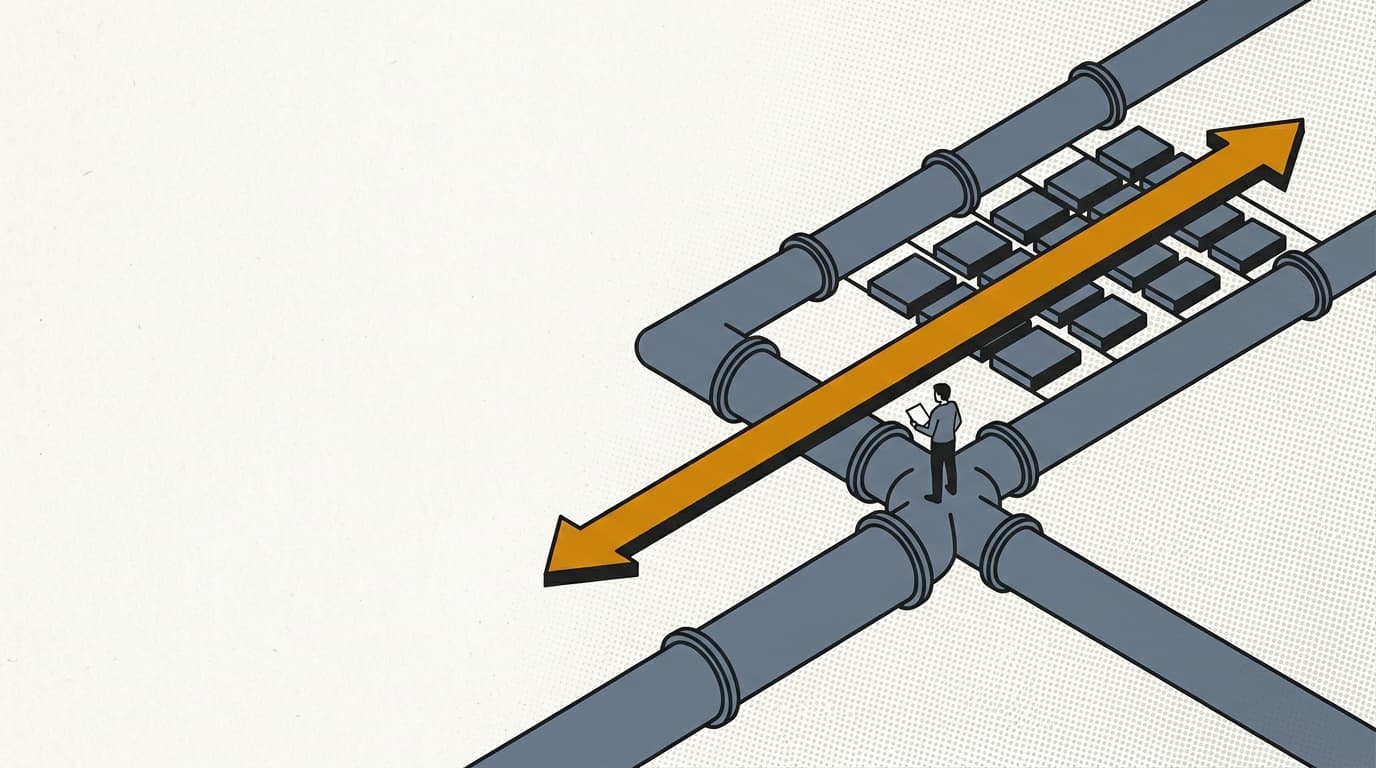

You've done the work. The team has capacity mapped, dependencies identified, technical debt prioritized. You've built a case for why the next two quarters need to focus on platform stability before the product team ships three more features on top of a foundation that's already showing cracks.
Then leadership comes back: the new initiative is the priority. It's tied to a partnership announcement. The roadmap you spent three weeks building is now a historical document.
This is the moment most engineering managers get wrong — not because they lack conviction, but because they frame the conflict incorrectly. They treat it as a disagreement about priorities when it's actually a communication problem about tradeoffs.
You're Not Losing an Argument. You're Failing to Surface a Decision.
The instinct when your roadmap gets overridden is to defend it harder. More detail, more justification, more evidence that your plan is right. This almost never works, and it's worth understanding why.
Leadership isn't ignoring your roadmap because they don't trust your judgment. They're overriding it because they're operating with different information and different constraints — a partnership timeline, a competitive signal, a board conversation you weren't in. Your roadmap represents what's optimal given your view of the system. Their override represents what's necessary given their view of the system.
The gap isn't conviction. It's information asymmetry.
The move that actually works: stop defending your plan and start surfacing the tradeoff explicitly. As one practitioner framing puts it, the person who can reliably surface the real tradeoff before work begins is more valuable than the person who executes heroically against unrealistic commitments. Heroics don't scale. Tradeoff conversations are the infrastructure that functioning teams run on.
What this looks like in practice: "If we shift to the new initiative now, here's what we're deferring and what that costs us — specifically, [X] becomes a risk in [timeframe]. I want to make sure that's a deliberate call, not a side effect." You're not arguing. You're making the hidden cost visible and asking leadership to own the decision.
The Roadmap Is a Hypothesis, Not a Contract
There's a version of this problem that's actually self-inflicted. If you've been treating your roadmap as a commitment — to your team, to stakeholders, to yourself — then every priority shift feels like a betrayal. That emotional weight makes it harder to engage with the actual tradeoff.
Zakir Tyebjee's framing is useful here: at a startup, the roadmap exists to create just enough shared context so everyone is running in roughly the same direction. The moment you over-engineer it or treat it as a source of certainty, you've introduced something more dangerous than chaos — false confidence.
This applies to engineering managers as much as PMs. Your roadmap is your current best hypothesis about what the team should build given what you know. When company priorities shift, that's new information. The question isn't "why are they overriding my plan" — it's "what does this new information tell me about what actually matters, and what does it cost us to act on it now?"
That reframe changes how you show up in the conversation. You're not a manager defending territory. You're a systems thinker helping leadership understand the second-order effects of their decision.
What "Managing Up" Actually Requires Here
The practical mechanics matter. The pattern that builds trust isn't detailed justification — it's decision-ready communication. A recommendation, the key tradeoff, and a clear ask. Not "here's everything I've been thinking about" but "here's what I'd do, here's what we're giving up, here's what I need from you."
For roadmap conflicts specifically, that means:
Make the cost concrete, not abstract. "We're taking on technical debt" lands differently than "if we skip the auth refactor, we'll hit scaling issues when we hit roughly 10x current load — probably Q3 based on current growth." The second version forces a real decision.
Separate the what from the when. Sometimes leadership isn't saying your priorities are wrong — they're saying something else is more urgent right now. If you can propose a sequencing that addresses their immediate need without permanently abandoning your plan, you often find more room than you expected.
Pre-wire before the meeting. The leadership alignment conversation is the wrong place to introduce a tradeoff for the first time. The highest-leverage practice is understanding how each stakeholder makes decisions before you need their buy-in — what they value, what they're afraid of, what questions they'll ask. If you know the CTO will push back on timeline and the VP of Product cares about competitive positioning, you can address both before they raise them.
Three questions to ask yourself when your roadmap conflicts with company priorities:
- Have I made the cost of this tradeoff concrete enough that leadership is making an informed decision — or am I assuming they understand the downstream effects?
- Am I defending my plan, or am I helping surface a decision that needs to be made explicitly?
- Do I know what's driving the priority shift — and have I asked, rather than assumed it's arbitrary?


