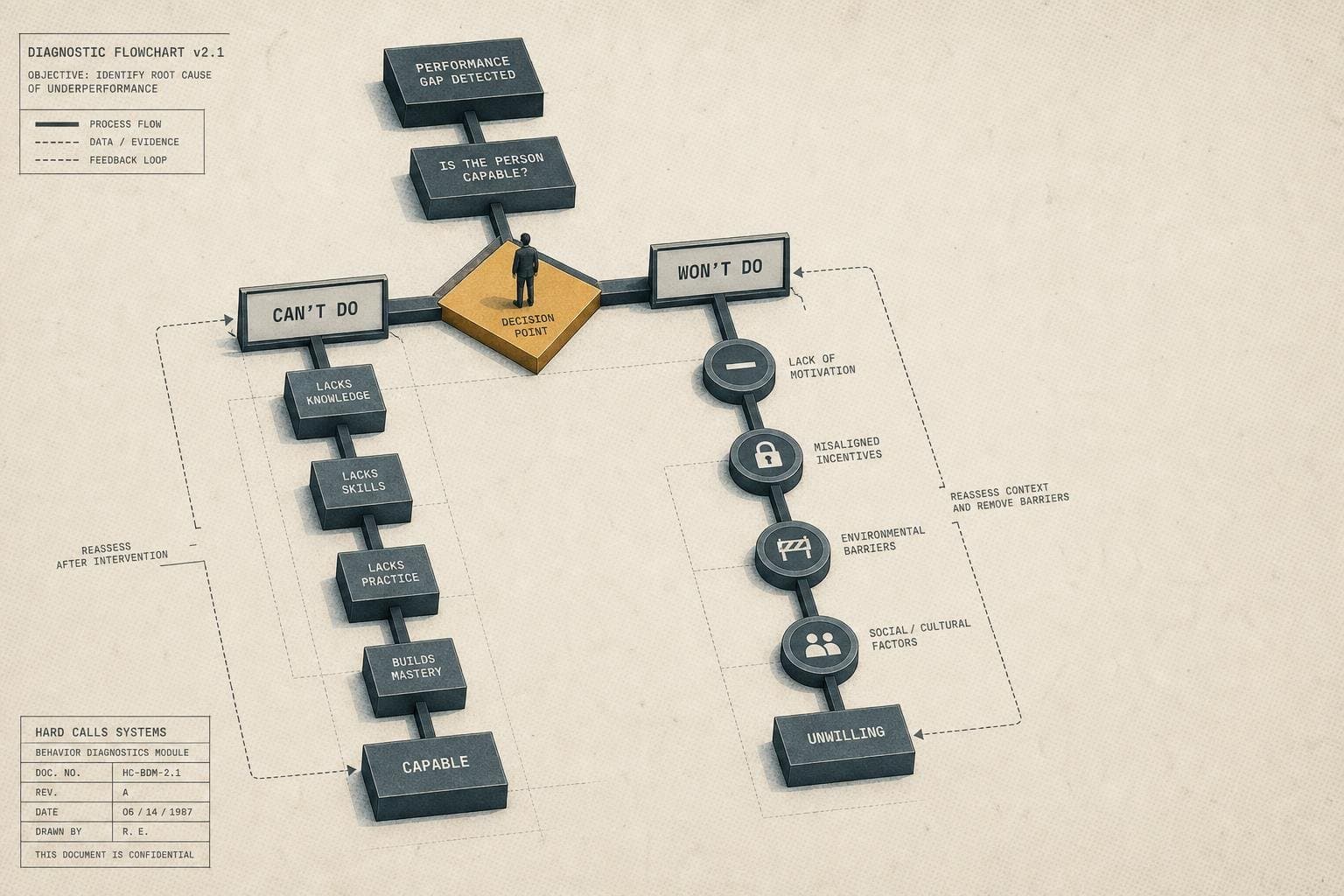

You've been managing this engineer for eighteen months. Strong output, respected by peers, never misses a deadline. Then something shifts — not their code quality, but everything around it. They're dismissive in cross-functional meetings. They route around process in ways that create downstream problems for other teams. You've had the conversation twice. Nothing changes.
Now you're sitting with a decision that most management writing handles badly: this person performs, but something about how they operate is breaking the team. Do you fire them?
The instinct is to frame this as a culture problem and move fast. The better move is to slow down and get the diagnosis right, because "skill mismatch" and "cultural misalignment" are not the same problem, they don't have the same causes, and they don't have the same solutions.
The Diagnosis Comes Before the Decision
Ayman Al-Abdullah, who scaled AppSumo from $3M to $80M, frames the core distinction cleanly: "Can't do" versus "Won't do." Performance issues mean the person lacks skills, training, or clarity on what good looks like. That's often fixable. Personality and values issues — toxic behavior, misalignment with how the team operates — don't get better with coaching. Those require faster action.
The mistake most managers make is collapsing these two categories into one. They see degraded output or friction and call it a performance problem. Or they see someone who's technically excellent but organizationally disruptive and call it a culture problem. Both framings can be wrong.
Skill mismatch is usually about role evolution outpacing the person. The engineer who was exactly right at ten engineers isn't necessarily the right person at fifty. As Al-Abdullah describes it, this is the startup CFO who was excellent at a smaller scale but isn't the person to take the company public — neither a firing nor a layoff, but an honest acknowledgment that the fit has changed. He calls this the "middle lane": a mutual separation that doesn't require manufacturing cause or pretending it's a layoff.
Cultural misalignment is different. It's about how someone operates relative to the team's norms — not whether they can do the work, but whether the way they do it is sustainable for everyone around them. And here's where it gets complicated: sometimes what looks like cultural misalignment is actually an underchallenge problem in disguise.
The Underchallenge Variable You're Probably Ignoring
Khary Penebaker describes the pattern precisely: your best people stop volunteering for things, get quieter in meetings, and their work stays excellent while the spark goes out. Six weeks later, they hand you a resignation letter. You didn't see it coming. You should have.
The behavioral signature of an underchallenged high performer — disengagement, reduced initiative, occasional friction — can look a lot like cultural misalignment if you're not paying attention. Before you decide someone's values are incompatible with the team, ask whether they've been coasting on mastered work for twelve months while you assumed everything was fine.
This matters for the firing decision because the intervention is completely different. An underchallenged engineer who's getting dismissive in meetings might need harder problems, not an exit conversation. A genuinely misaligned engineer who's routing around process to protect their own velocity is a different situation entirely — and as Al-Abdullah notes, values issues don't get better with coaching.
The diagnostic question: is this person's behavior consistent across contexts, or does it spike when they're bored, blocked, or underutilized? If it's contextual, you probably have an underchallenge problem. If it's consistent — if they're dismissive regardless of how engaged they are — you're looking at something structural.
What Vagueness Actually Costs You
If you've done the diagnosis and the decision is to separate, how you do it matters more than most managers realize — and not just for legal reasons.
James Bryton, Of Counsel at Littler Mendelson, makes a counterintuitive point: the phrases managers think are legally safe are actually the most dangerous ones. "We're going in a different direction" and "you're not a good fit" are, in his words, "the magic words for us to be in a lawsuit, not the magic words to get you out of one." When an employee is fired with a vague explanation and their last review was positive, they fill the silence with whatever dots are available — and those dots often lead to a discrimination claim.
The prescription is honesty about the actual reason: where the role has evolved beyond the person's current skills, or specifically how their operating style has created problems the team can't absorb. Vagueness protects no one. It just makes the conversation feel less uncomfortable in the moment while creating real exposure later.
For the skill mismatch case, the honest framing is usually the "middle lane" — the role changed, not the person's fundamental competence. For the cultural misalignment case, the honest framing is harder but necessary: here's specifically what we've observed, here's what we tried, here's why it hasn't changed.
The Signal That Tells You If You Got It Right
The test isn't how the conversation goes. It's what happens to the team in the thirty days after.
If you separated someone for genuine cultural misalignment, the team usually exhales. Collaboration gets easier. People who were quietly working around the friction stop having to. If you separated someone who was actually underchallenged and mismanaged, the team notices that too — and starts wondering what the threshold is for their own exits.
Get the diagnosis right before you get to the decision. The decision is the easy part.


