


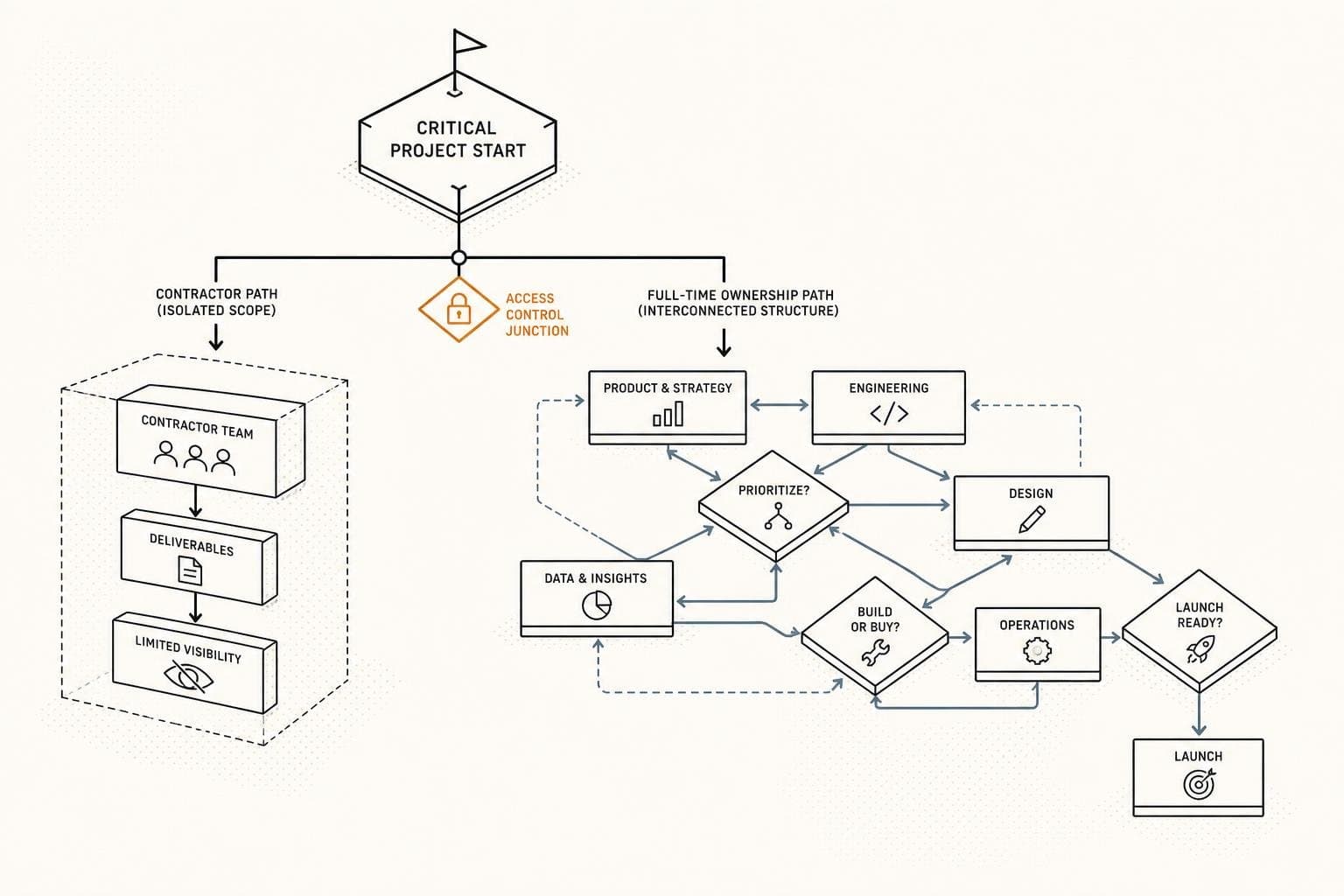

A contractor two months into a year-long engagement found a retry bug in a credit-report integration — the kind that double-fires hard inquiries on a borrower's credit file when a request times out. She posted the fix in the contractor-only Slack channel on a Tuesday, log excerpt and all. Two people reacted with an eyes emoji. No employee saw it, because no employee was in that channel. Three weeks later a borrower disputed a second hard pull, and the fix that shipped that afternoon was almost line-for-line hers — just three weeks late (KORE1).
That's the story people miss when they frame "contractor vs. full-time" as a speed-and-cost spreadsheet. The spreadsheet matters — contract engagements through a staffing partner can move from first call to start date in one to two weeks, versus six to ten weeks from application to first day for a typical full-time technical hire (Consultadd). For a project with a hard deadline, that gap alone can decide the question. But speed solves the hiring problem, not the delivery problem. The delivery problem is what happens after the contractor starts — specifically, whether they have the access and standing to actually own the critical path they were hired for.
What You're Actually Buying Isn't Time, It's a Decision Boundary
The standard framing — freelancer for defined scope, full-time for ongoing internal ownership — is a reasonable starting filter (Fueler). But "defined scope" is doing a lot of hidden work in that sentence. A six-week critical project isn't actually bounded by a calendar. It's bounded by the decisions inside it, and those decisions split into two kinds: the reversible, local calls that live entirely inside the scope you hired for, and the one-way doors — architecture choices, access patterns, anything that outlives the engagement — that should go to whoever is still around when the consequences land.
The KORE1 piece makes the case that this split should be explicit and assigned by the nature of the work, not by badge color (KORE1). Most teams never write that boundary down. They default to restricting contractor access broadly "to be safe," which feels like risk management and functions as an information embargo. The incident channel split in that story wasn't a deliberate security policy — it was a four-second approval that nobody revisited for eleven months. That's the actual failure mode on time-boxed critical projects: not that contractors lack the skill to own the work, but that the access scaffolding built to protect the org quietly prevents the person doing the work from being seen doing it.
The Continuity Argument Is Real, But It's Not the Whole Argument
The case for full-time hiring on critical work usually rests on continuity — permanent staff build institutional knowledge, stay through the next three related projects, and don't walk out the door with the context in their head (Scion Staffing). That's a legitimate cost. If the "critical project" is actually the first phase of a multi-year platform, hiring a contractor to build the foundation and then handing it to whoever gets hired next quarter is a bet that the handoff will go cleanly. Handoffs rarely go cleanly.
But notice what that argument assumes: that the project's value is in what gets built, not in who stays to maintain it. A staff-engineer framing of build-vs-buy applies almost directly here — ask what changes when the project succeeds, and what doesn't (DEV Community). If the deliverable is a bounded, well-specified piece of infrastructure that someone else will operate afterward, continuity is someone else's job, not the contractor's. If the deliverable is the kind of thing that keeps evolving — the credit-report integration that needed a production fix three weeks after launch, not three years after — you're not hiring for a sprint, you're hiring for an operating relationship, and the contract wrapper is the wrong container for it no matter how fast it got you started.
The Actual Question to Ask Before You Post Either Req
Don't start with "contractor or full-time." Start with: who needs to see this person's work while they're doing it, and who needs to be able to act on what they find? If the honest answer is "nobody but their direct manager," you've picked a scope that's genuinely contractor-shaped, and speed should win. If the honest answer involves on-call rotations, cross-team review, or anyone downstream depending on undocumented judgment calls made mid-project, you're describing a role, not an engagement — and the org chart should say so before the project starts, not eleven months after somebody created a side channel nobody meant to be permanent.