



Every engineering manager who has sat through a platform team reorg has heard some version of the same promise: centralize the infra experts, build a paved road, and every product team gets faster. Then eighteen months later someone's filing a ticket to get a new environment spun up and waiting three weeks for an answer. The platform team isn't lazy. It's drowning.
That's the actual failure mode, and it shows up with enough regularity across companies that it's worth taking seriously as a pattern rather than a one-off bad hire or a bad quarter. Will Dady, who has worked with platform teams across companies of varying size, describes the same trajectory every time: the team starts with a roadmap and a vision for developer self-service, then production breaks, pulls two people into firefighting, and within six months the platform team is an ops team with a nicer title. Product engineers stop asking for help because turnaround is too slow, so they build workarounds, which creates more drift, which creates more incidents, which pulls the platform team deeper into the hole.
The question underneath "centralize or embed" isn't really about where infra expertise lives on the org chart. It's about whether the request queue hitting your platform team grows faster than its capacity to clear it. That's a math problem before it's a structure problem, and most managers skip straight to redrawing boxes without doing the math first.
Do the Arithmetic Before You Reorganize
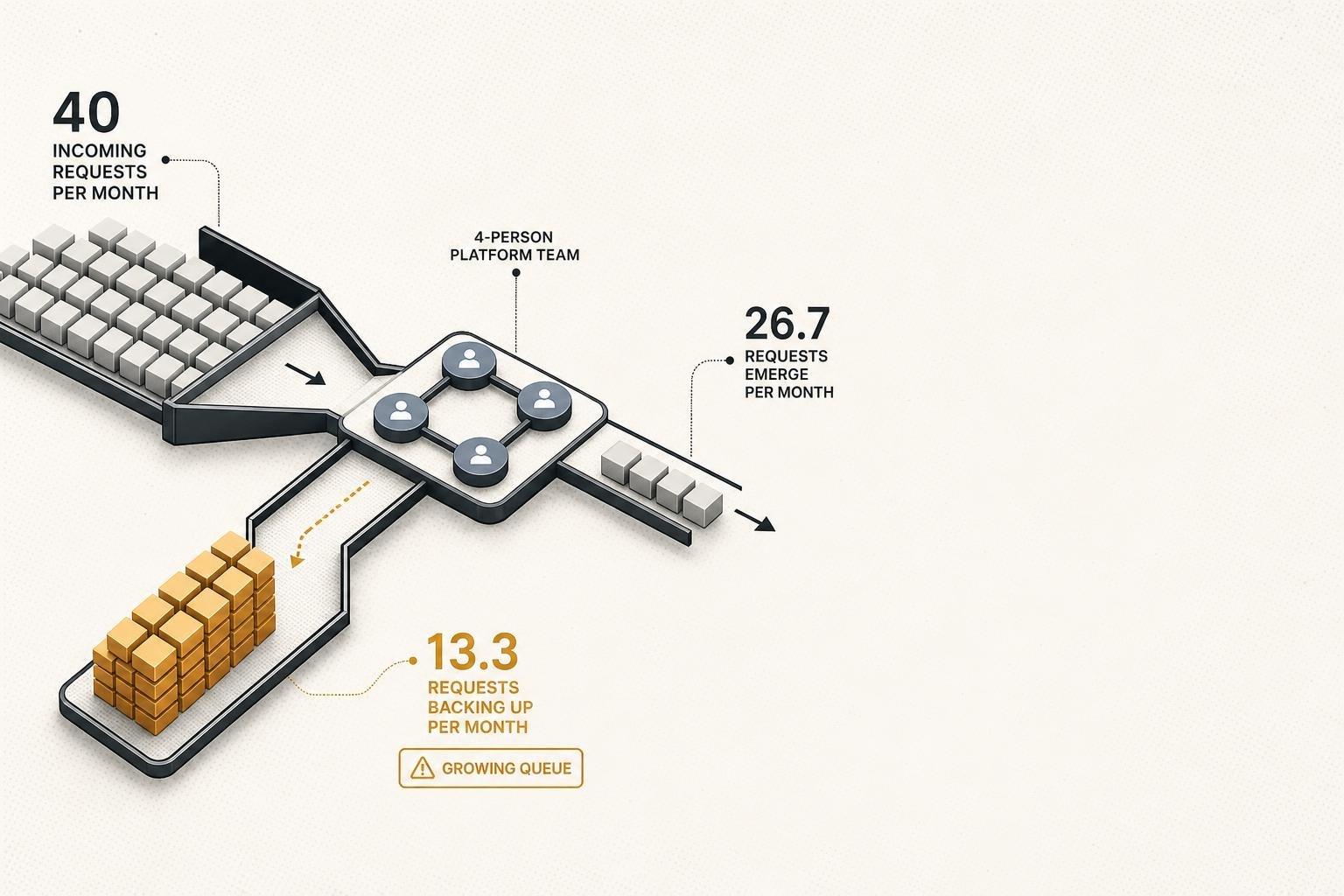
A framework from Tradeoff's breakdown of platform-vs-team-owned-stack decisions makes this concrete in a way most platform-team debates don't bother to. Their model: if product teams file 40 requests a month and each takes 1.5 engineer-days, a 4-person platform team spending half its time on requests can clear about 26.7 requests a month. The gap — 13.3 requests a month — doesn't disappear. It compounds into a backlog, and after six months you're looking at three months of wait time on anything you file. A platform team that answers by ticket does not scale. It has to offer self-service, or the queue wins.
This is the part that gets lost when managers treat "should we centralize infra" as a one-time philosophical choice. The same source models the other side of the ledger too: at six product teams of six engineers each, a central platform can net roughly ₹960,000 a year in savings once you subtract the cost of running it; at ten teams, the payback is closer to ₹9,600,000. Below that, a centralized team is often a net loss — you're paying for coordination overhead that smaller orgs don't yet need. The honest answer to "platform team or embedded" changes with headcount, and most teams pick the structure before they've counted the teams it's supposed to serve.
The Real Design Question Is What's a Policy and What's a Product
Dady's second observation is the one I'd put next to the math, because it explains why even correctly-sized platform teams still generate friction: conflating golden paths with guardrails. A golden path is a product — a starter template, a supported route — that has to earn adoption by being genuinely better than the alternative. A guardrail is policy: secrets never get committed, images come from an approved registry, full stop, no opt-out. Platform teams that try to mandate their golden path like a guardrail generate resentment and shadow infrastructure. Platform teams that treat a guardrail as optional-if-you're-busy end up with security holes dressed as "team autonomy." Most of the friction product engineers feel from a centralized platform team isn't really about centralization — it's about a team that hasn't separated what's mandatory from what's merely offered.
loveholidays' engineering org gives a working example of getting this split right at scale: small, roughly five-person stream-aligned teams backed by a dedicated platform team, plus a separate enabling unit whose job is coaching adoption rather than issuing mandates. Keeping those functions distinct — build the road, police the guardrails, coach the adoption, as three different jobs rather than one team doing all three badly — is part of what let them report higher deployment frequency alongside fewer production incidents.
What to Watch Before Your Next Reorg
If you're staring down this decision, the request-queue math is the cheapest diagnostic you have: count the tickets, count the hours, see if the gap is growing or shrinking. Analysts are already flagging that AI workload routing and agent governance will push more decisions onto platform teams through next year, which means the queue math only gets less forgiving from here — a platform team sized for last year's request volume won't survive this year's. Before you centralize or embed anyone, know whether you're solving a capacity problem or a policy problem. They look identical in a retro and they are not the same fix.