


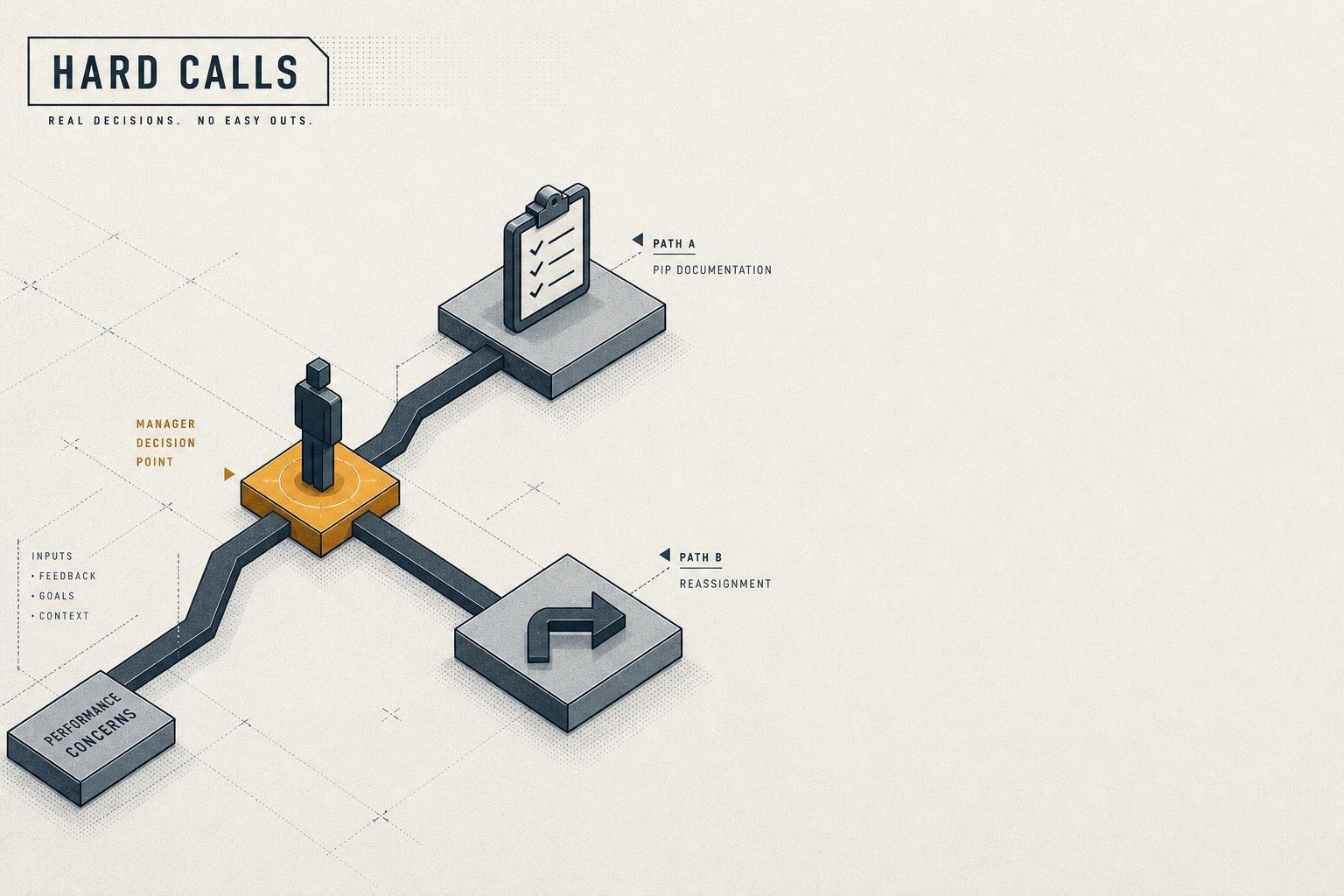

An engineer on your team has been missing marks for two quarters. Not catastrophically — nothing that triggers an incident review — but consistently enough that you've started double-checking their PRs before anyone else sees them. You have two paths in front of you: start a formal performance improvement plan, or quietly move them into a smaller, lower-stakes role and let the problem resolve itself without a paper trail. Most managers treat this as a kindness question. It's actually a documentation question, and the answer depends on which outcome you're actually steering toward.
The PIP only works if you haven't already decided the ending
A performance improvement plan is supposed to be a real roadmap with goals and a deadline, not a termination dressed up in HR language — that's the whole premise of the tool, per the breakdown in One on One. In practice, a lot of PIPs get written after the manager has already told themselves (or their peers) how this ends. That gap between the paper and the intent is exactly what gets exploited when things go sideways. Legal 500's analysis of PIP disputes across APAC found the same pattern over and over: the plan said sixty days to improve, but the manager had already told colleagues the role was being replaced, and the document didn't survive cross-examination once the mismatch surfaced. You don't need to run a multinational legal team to learn the lesson — if you're writing a PIP as cover for a decision you've already made, you're not protecting yourself, you're building the strongest piece of evidence against yourself.
So the real first question isn't "PIP or reassignment." It's: do I actually believe this person can close the gap, or have I already written the ending? If it's the latter, a PIP is dishonest theater. Skip it and have the direct conversation about what's next.
Reassignment is a real option, not a soft landing for avoiding the hard conversation
Quiet reassignment gets a bad reputation among managers who've seen it used to dodge accountability — move the underperformer somewhere low-visibility and let them coast. But that's a misuse of the tool, not the tool itself. The more honest framing, laid out in Gina Trimarco's piece on reassignment, treats it like a coach adjusting a roster: the person hasn't done anything wrong, their skills just no longer match what the role currently demands. An engineer who was a strong generalist on a five-person team can genuinely struggle once the team splits into specialized tracks, without any drop in effort or character. In that case, forcing them through a PIP built around expectations that were always going to be a mismatch isn't fair — it's a formality that burns three months before you land at the conclusion you could have reached on day one.
The signal that tells you which situation you're in: can you name a specific skill or behavior gap, with examples, that this person is capable of closing? If yes, that's PIP territory. If what you're actually describing is "the role changed underneath them," that's a reassignment conversation, and dressing it up as a performance problem just adds stress without adding clarity.
Don't skip the diagnosis to get to the decision faster
Both paths fail if you start them on thin evidence. The uncomfortable finding from Telescoped's review of rater research is that idiosyncratic effects of the individual manager accounted for roughly half to two-thirds of the variance in performance ratings in the underlying study — meaning a confident impression of "this person is underperforming" often says more about the rater than the ratee. Before you pick PIP or reassignment, you need actual evidence: what did this engineer own, what happened to it, what did other technically qualified people observe about the quality of the work. Activity counts and vibes don't qualify.
And whichever path you choose, the surprise is the actual failure. If a review (or a reassignment) lands as news, you've already lost, regardless of which document you used to get there. Keith Wyche's point about consistent, transparent evaluation applies just as much to reassignment as to a formal PIP — the person should have heard the specific concern, in plain language, well before you've decided their next move for them.
The decision in front of you isn't really PIP versus reassignment. It's whether you've done enough diagnostic work to know which one is true, and whether you're willing to let the paper trail match what you actually believe. Skip that step and both options turn into the same thing: a way to avoid telling someone the truth to their face.