
You have a senior engineer who's been carrying the team for eighteen months. They know the codebase, the customers, the history of every bad decision made before you arrived. A management role opens. Promoting them feels obvious.
Then you interview two external candidates and suddenly you're not so sure.
That uncertainty is worth examining — because it's not always signal. Sometimes it's a structural artifact of how the two options present themselves.
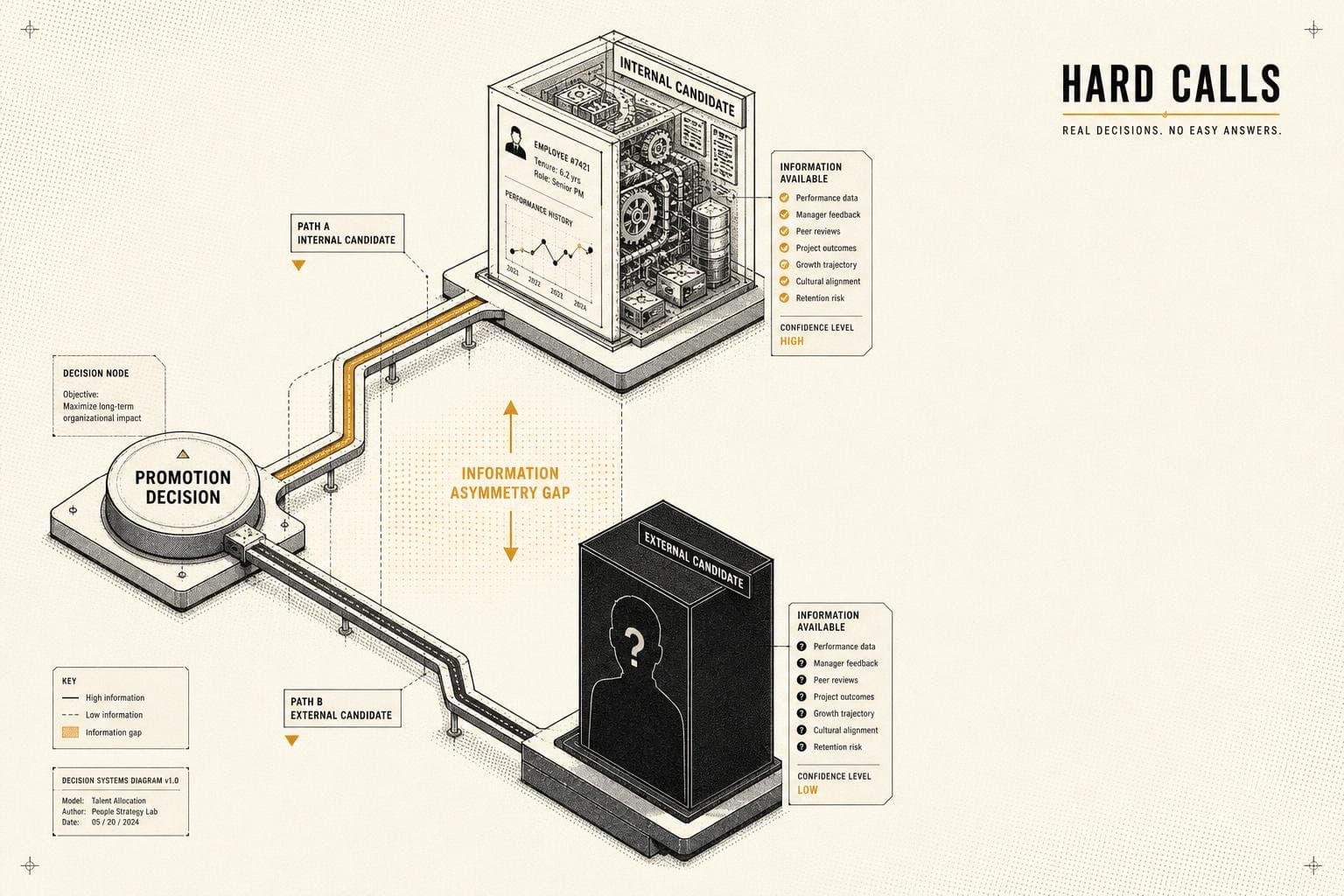
The Information Asymmetry Is Working Against You
The core problem with this decision is that you're comparing fundamentally different evidence types. Your internal candidate has a two-year record you watched happen in real conditions: how they behave when a deploy goes sideways at 11pm, whether they cut corners when you're not watching, how they handle a peer who's wrong and defensive about it. Your external candidates have ninety polished minutes and a résumé curated for exactly this moment.
Research tracked by Ardent Workshop — drawing on Wharton's Matthew Bidwell's seven-year study of internal moves versus external hires — found that external hires were paid roughly 18% more than workers promoted into equivalent roles, received lower performance ratings for their first two years, and left at higher rates. You're paying a premium, in other words, not for a better hire but for less information.
That doesn't mean always promote internally. It means you should be skeptical when an external candidate starts looking more attractive after a strong interview. The interview is doing exactly what it's designed to do.
As one practitioner framing puts it: the outsider arrives carrying potential, the insider carries history. Potential is easier to admire. History is complicated. But history is also what you're actually buying when you hire someone to manage a team you already have.
The Question That Actually Decides It
The bias problem doesn't mean you should default to promoting. It means you need to be honest about what the role actually requires — before you start evaluating candidates.
White Ash Group frames this cleanly: start with the role, not the candidate. Define what success looks like over the next 12–24 months. What problems does this person need to solve? What capabilities are essential from day one? Is the function performing well or does it need significant change?
Once you've answered those questions, the decision usually becomes less ambiguous. If the role's core skill is something your internal candidate already practices — running cross-functional projects, unblocking junior engineers, making scope calls under pressure — you have real evidence about whether they can do it. If the role requires something nobody on your bench has ever done — scaling a team from 8 to 30, rebuilding a broken on-call culture, managing through a platform migration — you're asking your internal candidate to figure it out in real time, on a live team, with their peers watching.
That's a different risk profile than it looks like from the outside. Turnkey Staffing's analysis of engineering people strategy makes the point that tenure shouldn't be mistaken for readiness — someone can be exceptional in their current role without being equipped for what the next level actually demands.
The Peer Dynamic Is a Real Variable, Not a Soft One
There's a third factor that gets underweighted: what happens to the team when a peer gets promoted above them.
This cuts both ways. A well-executed internal promotion sends a signal that strong performance creates opportunity — which matters for retention in ways that are hard to quantify but easy to feel. Employee engagement research consistently shows that career development visibility is one of the primary drivers of team engagement, and managers account for roughly 70% of team engagement variance. Promoting someone who's genuinely ready reinforces both.
But a poorly-executed one — promoting someone before they're ready, or promoting someone whose peers don't respect them in the new role — creates a different problem. The team that watched the promotion happen has an opinion about whether it was deserved. If that opinion is skeptical, your new manager starts with a credibility deficit they didn't earn and may not be able to recover from.
The question to ask: does this person already have informal authority on the team? Do people go to them when they're stuck, even when they don't have to? If yes, the promotion is likely to be received as a recognition of something real. If no — if they're strong individually but not someone the team naturally defers to — the title won't manufacture that authority.
What to Watch in the First 90 Days
If you promote internally, the signal that it's working is whether the new manager starts making decisions their peers accept without escalating to you. Not agreement — acceptance. The team doesn't have to love every call, but they should treat the manager as the legitimate decision-maker.
If you hire externally, the signal that it's working is whether the new hire is asking the right questions rather than importing solutions from their last company. External hires who struggle usually struggle because they're solving the wrong problem — the one they recognize from somewhere else, not the one actually in front of them.
Neither path is safe. The internal promotion risks promoting someone into a role they're not ready for. The external hire risks paying more for someone who takes two years to become effective, if they ever do. The decision is which risk fits your current constraints — not which option avoids risk altogether.


