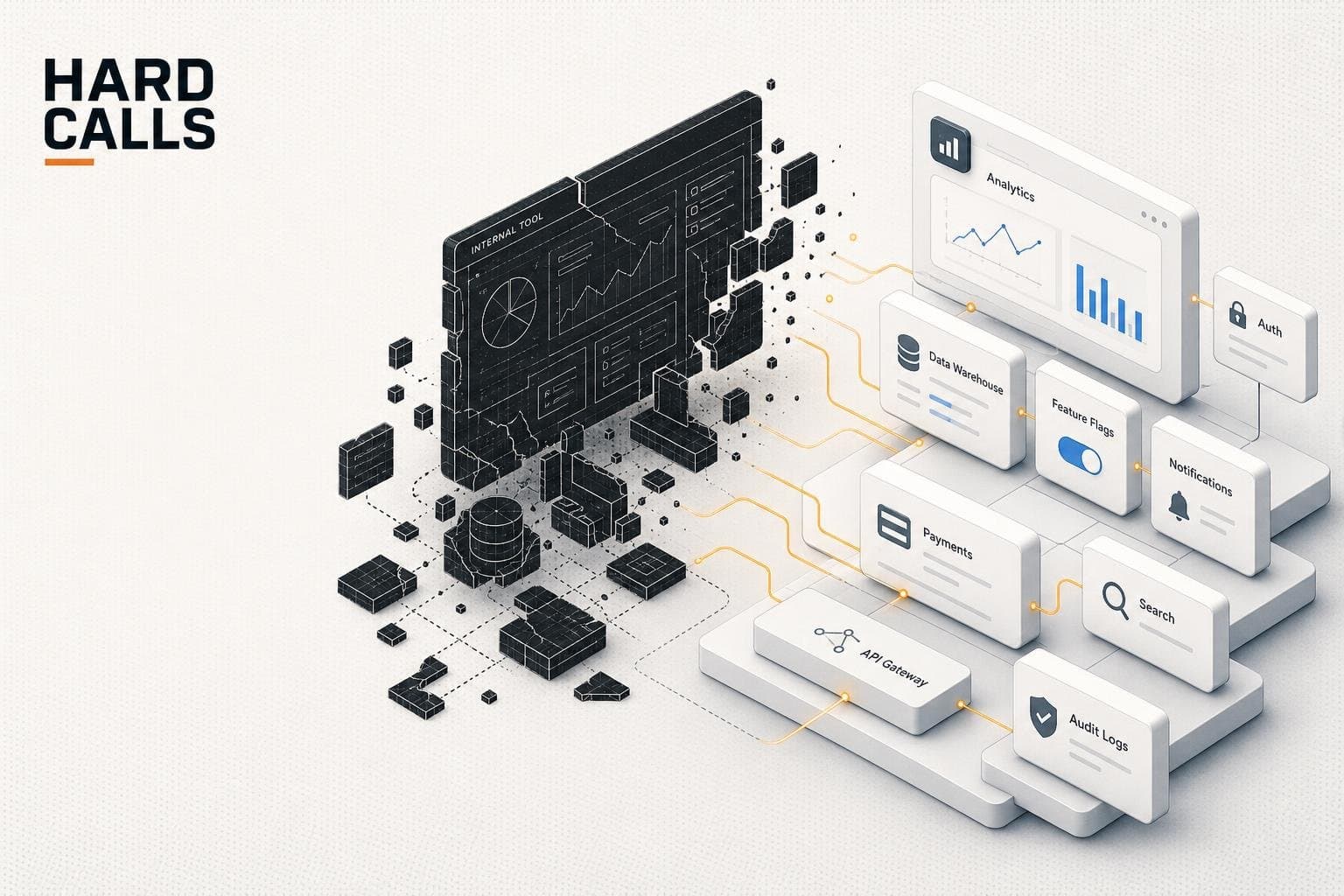

You built it eighteen months ago. A custom deployment dashboard, an internal metrics aggregator, a homegrown feature-flag system — something that felt genuinely necessary at the time. The team was proud of it. It solved a real problem that off-the-shelf tools handled badly.
Now it's a tax.
Someone owns it unofficially. It breaks in ways that are hard to reproduce. New engineers need a week to understand it before they can touch it. And every quarter, a few sprint points quietly disappear into keeping it alive. Nobody talks about this in planning. It just happens.
This is the build-vs-buy trap that mid-stage engineering teams fall into most often — not the big, visible decision to build a custom platform, but the accumulation of smaller decisions that made sense individually and became a maintenance burden collectively. The question isn't whether you should have built it. The question is whether you should keep maintaining it.
The Decision You're Actually Making Is About Competitive Positioning
Here's the frame that cuts through most of the noise: does this tool touch the workflows where your business competes, or does it support commodity functions that every engineering team needs?
That's the strategic question. Everything else — cost, timeline, vendor risk — is downstream of it.
If your internal tool is part of how you ship product faster than competitors, or how you maintain reliability that's genuinely differentiated, it deserves engineering attention. If it's deployment infrastructure, observability plumbing, or developer environment management — the undifferentiated work that every team at your stage is doing — then you're spending engineering capacity on a problem that vendors have already solved, and probably solved better.
Zethic's framing is useful here: building makes sense when the software is the actual mechanism that sets a business apart, or when compliance requirements limit which third-party tools are viable. Buying makes sense when the function is standard across your industry. The trap is treating internal tooling as automatically falling into the first category because your engineers built it.
The Hidden Cost Is Cognitive Load, Not Maintenance Hours
The maintenance hours are visible. You can count them. The cognitive load is harder to see, and it's usually larger.
A 2023 Stack Overflow Developer Survey cited by Amplify IT found that developers spend an average of 26% of their time on non-development tasks — environment setup, infrastructure maintenance, undifferentiated tooling work. That number compounds as teams scale. At ten engineers, 26% is two and a half people's worth of capacity. At fifteen, it's nearly four.
The cognitive load piece is subtler. Every custom internal tool is tribal knowledge that has to be transferred, documented, and re-learned. It's the reason new engineers take longer to get productive than you expect. It's the reason incidents that touch internal tooling take longer to resolve. You're not just paying maintenance hours — you're paying an ongoing tax on team velocity and onboarding speed that never shows up in a sprint report.
Amplify IT's analysis of internal developer platforms puts it plainly: mismanaging this decision leads to wasted engineering cycles, delayed product launches, and significant developer burnout within 12-18 months. The burnout part is underappreciated. Engineers who spend their time maintaining internal tooling instead of building product features tend to disengage. The work feels like treading water.
The Hybrid Path Is Usually the Right Exit
When you've decided a custom tool has outlived its strategic justification, the choice isn't always "rip it out and buy something." The hybrid approach — buy a platform with a strong integration layer for the standard function, then build custom extensions only for the parts that genuinely differentiate — is often the right exit ramp.
The practical version of this: identify the one or two behaviors in your custom tool that no vendor handles well. Those are worth preserving. Everything else — the auth layer, the data plumbing, the UI scaffolding — can be replaced with something you didn't have to build and don't have to maintain.
Coder Legion's framing is worth sitting with: just because you can build it doesn't mean you should. The perceived cost savings of custom builds often evaporate in maintenance. The initial build looks cheap. The ongoing commitment to keep it alive is what kills you.
The signal that you've crossed the line: when the engineer who built the tool is the only one who can safely modify it, and they're spending more than a day a month keeping it running. At that point, you're not maintaining a competitive advantage. You're maintaining a dependency.
The decision to stop reinventing isn't an admission that the original build was wrong. It's a recognition that the team you have now has different constraints than the team that built it — and that the best use of your engineers' time is probably not keeping the lights on for something a vendor has since commoditized.


