


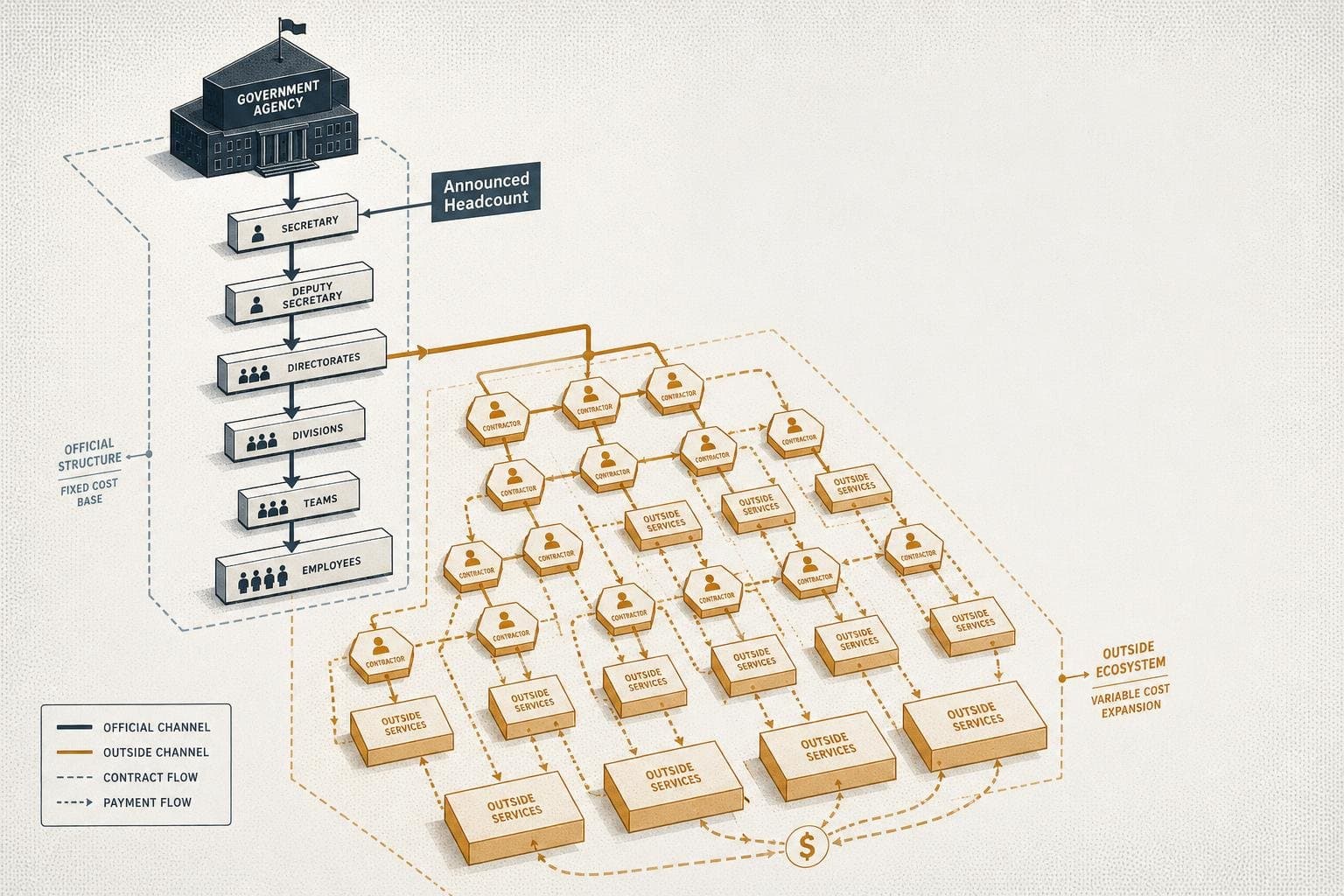

You announce the freeze. Headcount goes flat on the dashboard. Finance nods. Three months later the P&L shows a line item nobody planned for: fifty agency contractors, coded to "Outside Services," delivering the work the frozen roster can't cover. HR's roster says stable. Finance's invoices say otherwise. Daniel Šlikas at SDG Group calls this the Headcount-to-Cost Gap, and it's the clearest evidence I've seen that "freeze vs. grow" is the wrong frame for the decision engineering managers actually face during a downturn. The real decision is where the money goes when you stop pretending headcount is the only lever.
The Freeze You Announce Isn't the Freeze You Get
Here's the mechanism, and it's worth sitting with because it's not a communication failure — it's structural. Operations still has delivery commitments. The freeze didn't remove the commitments, it removed the formal channel for meeting them. So the work routes around the freeze: contractors, "urgent" premium-rate hires that slip past approval, headcount you carry because nobody wants to be the team that missed the deadline. Šlikas's point is that HR and Finance data don't speak the same language, so this leakage is invisible until the invoices clear, usually 30 to 60 days after the fact. If you're an EM sitting under a freeze mandate right now, the question worth asking your VP isn't "can I hire" — it's "where is the shadow spend already happening on my team, and does anyone outside my org see it."
That matters more this cycle than in past downturns. The broader market context is grim by most tracking: 365 layoff events and over 209,000 people affected in 2026 so far, per aggregated tracker data, which is less a shock than a long reset that's been running since 2022. A frozen team under sustained delivery pressure isn't stable, it's compressed. Compression finds an outlet, and contractor spend is usually the path of least resistance because it doesn't touch the headcount number leadership is watching.
Capping Headcount on Purpose Is a Different Decision Than Freezing It in a Panic
There's a useful contrast in how Weglot's co-founder Augustin Prot approached team size — not as a downturn response, but as a standing design constraint. Prot treated every hire as a permanent dilution of margin and individual contribution, not a proof point of progress, and capped the team against direct pressure from his own investors to spend faster. The discipline showed up as a raised hiring bar rather than a blanket freeze: people who joined were expected to scale with the company, and several early hires are now running functions — the first employee is now CTO.
The distinction matters for how you read your own freeze. A freeze imposed reactively, after revenue softens, is a symptom of headcount decisions made without a margin model in the first place. A cap set deliberately, tied to what the business can actually support, doesn't need to be lifted or reinstated every time revenue wobbles — it was never elastic to begin with. If your team's size has swung with fundraising news rather than with unit economics, the freeze you're living through now is the bill for that pattern, not a standalone crisis.
The People Who Leave During a Freeze Aren't Random
Freezes also change who walks, and the data on why engineers leave is unforgiving here: compensation drifting 10% or more below market carries roughly a 60% probability of resignation within 12 months, and a freeze is exactly the condition that lets comp drift unnoticed while comp bands elsewhere keep moving. Layer on the emerging scarcity around senior engineers who can actually direct AI-assisted work rather than just produce code next to it — a shortage several practitioners are now flagging explicitly — and a freeze that quietly bleeds your best people is a worse outcome than one that never happened. The tighter framing is that the shortage isn't of engineers, it's of judgment, and judgment is precisely what a freeze-driven exodus takes with it.
Before you defend the freeze in your next leadership review, check three things: contractor spend that isn't showing up on your roster, comp bands for anyone approaching the 18-month mark, and whether the people threatening to leave are the ones you'd fight to keep or the ones you'd quietly let go. The freeze protects a number on a dashboard. It doesn't automatically protect the team.