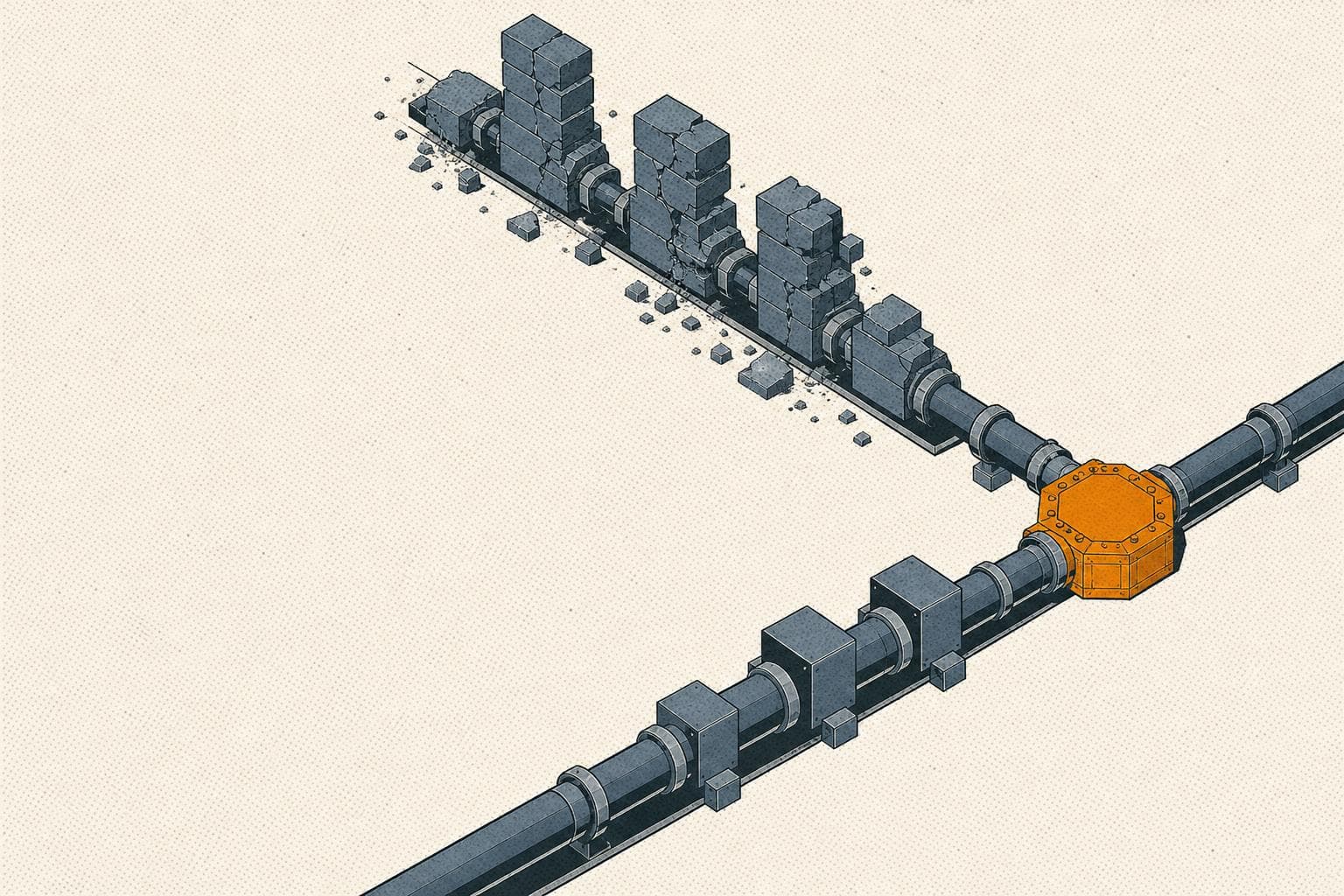

You have a sprint planning meeting in two days. Your product lead wants three new features scoped. Your tech lead wants to spend the next two weeks on refactoring the event processing layer before it causes another incident. Both of them are right. You have to pick one.
This is the decision most engineering managers handle badly — not because they choose wrong, but because they're optimizing for the wrong thing when they choose. The debt-vs-features debate almost always gets framed as a quality argument. It should be framed as a constraint argument.
What You're Actually Optimizing For
The useful question isn't "should we fix the debt?" It's "what is the debt actually costing us right now, and what does that cost compound into?"
Zulbera's founder guide to technical debt puts it cleanly: technical debt is the future cost of decisions you make today to ship faster. That framing matters because it implies the cost is deferred, not eliminated. The question is whether you're paying interest at a rate you can afford.
Sometimes you can. A startup that hits a market window with a debt-laden v1 beats one that misses it with a clean v2 — that's not a controversial take, it's just how early-stage product development works. The debt was rational when you took it on. The question is whether it's still rational to carry it.
The signal that changes the calculus: when debt stops slowing you down and starts blocking you. Comet Studio's framework draws a useful line between technical debt and strategic debt. Technical debt is messy but functional — it slows development but doesn't determine what you can build. Strategic debt constrains business options: which markets you can enter, which customers you can serve, which features you can actually ship. When your architecture is actively fighting your product roadmap, you're no longer in a quality conversation. You're in a capability conversation.
That distinction is the one worth making before your sprint planning meeting.
The Hidden Constraint Nobody Names
Here's what usually goes wrong in this decision: managers treat it as binary. Fix debt or ship features. The real constraint is almost always sequencing, not allocation.
Ratul Hasan's account of building Flow Recorder is worth reading for the specifics. He took shortcuts on event processing and database indexing to ship fast — rational call at the time. When the app scaled to millions of daily events, those shortcuts became bottlenecks. He spent three months refactoring instead of building. The cost wasn't just the engineering time; it was customer churn from reliability issues and the opportunity cost of features he couldn't build during that window.
The failure wasn't taking on debt. It was not having a concrete plan for when to pay it back. The mental note to "clean it up later" is where most teams actually lose the decision — not in the original tradeoff, but in the absence of a trigger condition for revisiting it.
Good debt decisions have explicit exit criteria. You're taking on this shortcut, and you'll revisit it when: query latency crosses X threshold, or the team spends more than Y% of sprint capacity on maintenance, or a specific architectural change becomes necessary for the next product phase. Without those conditions named in advance, "later" becomes never, and the debt compounds silently.
When the Feature Freeze Is Actually the Right Call
Comet Studio's checklist names four conditions where stopping feature work is warranted: new features are creating more bugs than they solve problems; the team spends more time on maintenance than development; customer churn is driven by reliability issues rather than feature gaps; the architecture is actively fighting the product roadmap.
If you're hitting two or more of those, the features aren't actually the priority — they're the distraction. Shipping into a broken foundation doesn't accelerate you; it accelerates the debt.
The HLD Handbook's framing on tradeoffs applies here: a free-lunch claim in a design review should make you look for the hidden cost. "We'll ship the features and fix the debt later" is a free-lunch claim. The hidden cost is that the debt doesn't pause while you ship — it compounds. Every new feature built on a shaky foundation makes the eventual refactor larger and more expensive.
Three Questions to Ask Before You Decide
Is this debt technical or strategic? If it's slowing you down, you can manage it. If it's blocking specific product decisions or customer requirements, it's already a business problem, not an engineering one.
What's the trigger condition for paying it back? If you can't name a specific threshold — latency, maintenance load, churn signal — you don't have a plan, you have a hope.
What does the next six months of feature work look like if you don't fix it? Map the actual dependencies. If three of your next five roadmap items require touching the debt-laden system, the "ship features now" option is an illusion — you're going to pay the refactor cost anyway, just with more complexity on top of it.
The debt decision isn't about discipline or code quality. It's about whether you're carrying debt at a rate you can afford, toward a plan you've actually named.


