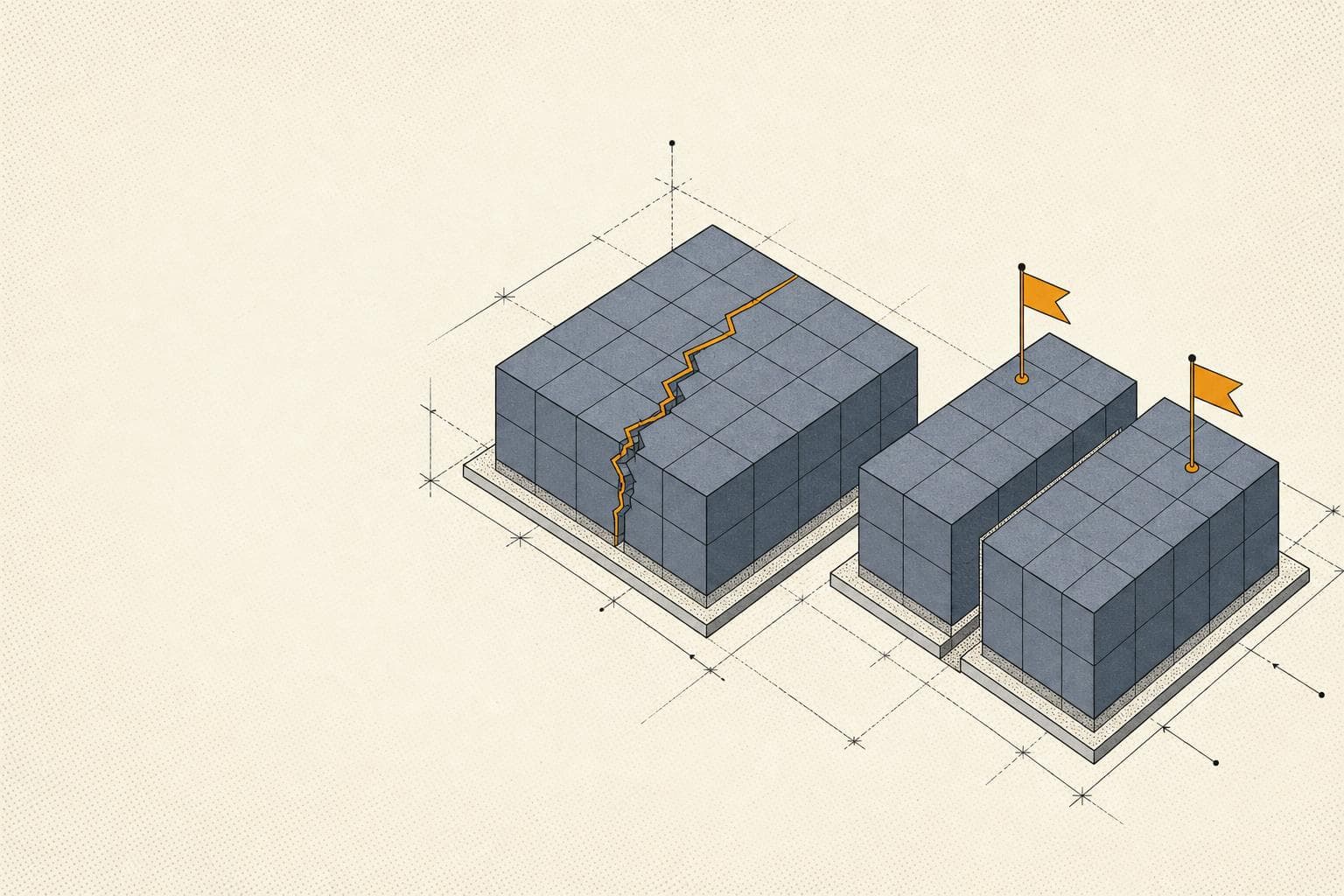

You have two teams that keep stepping on each other. Shared components, overlapping roadmaps, a Slack channel that's become a permanent escalation queue. The obvious fix feels like consolidation — put them under one leader, align the priorities, stop the friction.
That instinct is usually wrong.
The friction you're seeing is almost never caused by having two teams. It's caused by unclear ownership of the work between them. Consolidation doesn't fix that. It just moves the ambiguity inside a single org chart, where it's harder to see and slower to resolve.
The Test You're Actually Running
The real question isn't "should these teams be one or two?" It's: where does the friction live?
There are two kinds of friction in team structure. The first lives inside the work — shared customer outcomes, shared data contracts, decisions that genuinely can't be made independently. When that's the problem, separation creates handoff cost that no amount of process will erase. Combining teams under one leader makes sense because the work itself is coupled.
The second kind of friction lives in the coordination overhead — the meetings, the escalations, the conflict resolution that exists specifically because two teams share one leader whose attention is divided. That's not a coupling problem. That's a leadership bandwidth problem. Splitting gives each team independent ownership and removes the bottleneck.
Most managers misdiagnose which kind they have. They see two teams fighting over priorities and assume the solution is unification. But if the underlying work is loosely coupled — if each team could, in principle, ship independently — then consolidation just creates a larger team with the same ambiguity and a leader who now has twice the surface area to manage.
What "Ownership" Actually Requires
Here's the thing about ownership that sounds obvious but isn't: it only works when one team, with one set of priorities, is responsible for everything within a boundary. The moment two teams share ownership of a component, changes require negotiation, priorities conflict, and the component tends toward stability rather than evolution — because moving requires alignment that's expensive to achieve.
This is why the consolidation instinct backfires. You merge two teams to reduce coordination overhead, but if the ownership boundaries aren't redrawn cleanly, you've just internalized the coordination problem. Now it's not two teams negotiating across a boundary — it's two informal factions negotiating inside a team meeting. Same friction, less visibility.
The consolidation question is really an ownership question: after the merge, who owns what, and are those boundaries clean enough that one person can make the call without escalating?
If you can't answer that before you restructure, the restructure won't help.
The People Problem Is Entangled in This
There's a reason these decisions drag. The structural question and the people question are entangled — and most managers delay the structural decision to avoid the people conversation.
Consolidating two teams implicitly answers: is the current leader capable of running the combined function? Splitting implicitly answers: do we have two people ready for independent ownership? Neither answer is comfortable when you're not sure.
But here's the failure mode I see most often: managers consolidate because it feels like a structural fix, when what they actually need is to have a direct conversation about whether someone is ready for a larger scope. The restructure becomes a way to avoid the performance conversation. Six months later, the combined team is struggling, and now you have a structural problem and a people problem.
The cleaner path is to separate the diagnosis. Is this a structural problem — wrong boundaries, wrong coupling — or is it a leadership problem — the wrong person in the role? Unclear decision ownership is usually what's actually slowing execution, not the org chart itself. Fix the ownership clarity first. Then decide if the structure needs to change.
How You Know If It's Working
Three signals that a consolidation or split was the right call:
Decisions close faster. If you merged teams and the same escalations are still happening, you moved the boundary without fixing the ownership. If you split teams and each one is now shipping independently without waiting for the other, the coupling was loose enough to support separation.
The leader stops being the bottleneck. In a well-structured consolidation, one leader holds the full context and makes calls that used to require two people in a room. In a well-structured split, each leader makes calls that used to require escalation. Either way, decisions should be moving down, not up.
Conflict becomes productive. Some tension between teams is healthy — it surfaces tradeoffs. What you're watching for is whether disagreements now resolve at the team level or still require manager intervention. Persistent escalation means the ownership boundary is still wrong, regardless of what the org chart says.
Three questions to ask before you restructure:
- Is the friction in the work itself, or in the coordination overhead around the work?
- Can you draw clean ownership boundaries after the change — boundaries where one person makes the call?
- Are you solving a structural problem, or avoiding a conversation about whether someone is ready for more scope?
The org chart is the last thing to change. Get the ownership clarity first.


