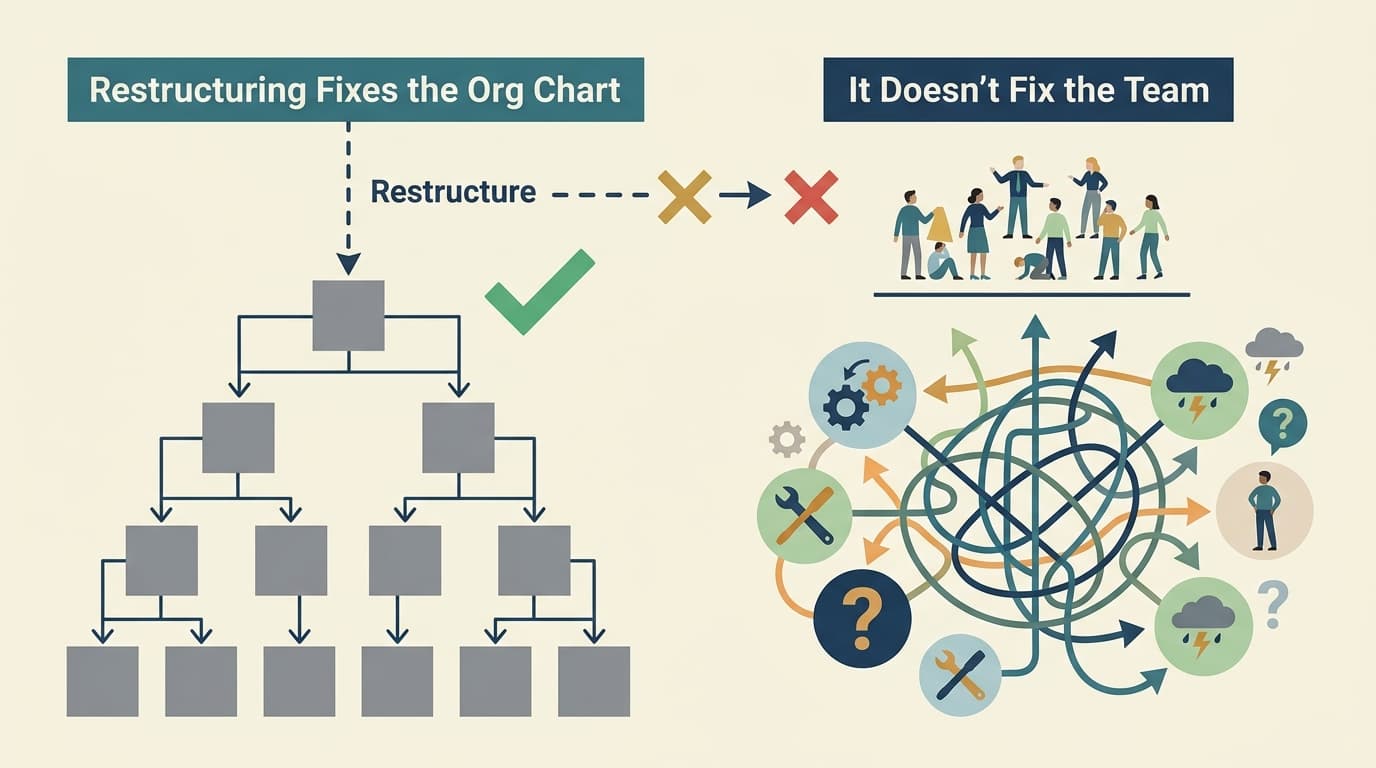

You've got two engineers who can't work together. Every sprint review turns into a blame exchange, the product manager has started routing around both of them, and the team's velocity has been quietly declining for two months. Someone suggests a restructure — split the team, give each of them their own domain, problem solved.
Six months later, the same dysfunction is playing out at the seam between the two teams. Different names on the calendar invites, same underlying problem.
This is the most common failure mode in engineering team restructuring: using org chart changes to avoid the conversations that actually need to happen. The structure changes; the system doesn't.
What You're Actually Optimizing For (And What You're Pretending To)
Most restructuring decisions get framed as organizational improvements — better ownership, cleaner interfaces, faster delivery. Sometimes that's genuinely what's driving it. But it's worth being honest about the other reasons restructuring happens: avoiding a hard personnel conversation, responding to pressure from above to "do something," or signaling momentum when the real problem is harder to name.
The tell is whether the restructure changes the actual decision-making architecture or just the reporting lines. If the same people are still making the same calls with the same information, you've moved boxes on a slide deck. The work hasn't changed.
A restructure that works is solving a real structural problem — ownership that's genuinely ambiguous, a team that's grown past the point where one person can hold context across all of it, a domain that's become large enough to warrant dedicated focus. Scaling engineering teams without losing velocity depends on smaller, autonomous teams with clear ownership operating with low overhead. The key word is autonomous. If the new teams still need to coordinate on every decision, you haven't created autonomy — you've created a coordination tax with extra steps.
The Hidden Constraints Nobody Puts in the Proposal
The restructure proposal usually shows the future state. It rarely shows the transition cost.
The first hidden constraint is institutional knowledge distribution. When you split a team, you're also splitting the accumulated context about how things work, why certain decisions were made, and where the bodies are buried. If that knowledge lives primarily in one or two people, the new team boundaries may leave one half functionally blind for months.
The second is the support function problem. Scaling only developer headcount while leaving testing, architecture review, and operational support under-resourced means development speed creates bottlenecks instead of progress. The same logic applies to restructuring: if you split a team but don't think through how QA coverage, on-call rotations, and architectural review get redistributed, you've created two teams that are each slower than the original.
The third constraint — and the one that bites hardest — is the interpersonal one. Working around interpersonal conflicts through restructuring postpones inevitable conversations. Management karma always comes due. The engineers who couldn't collaborate on one team will find ways to create friction at the new team boundary. Now you have an organizational interface where the conflict can live indefinitely, because neither team owns the problem.
The Three Ways Restructures Usually Go Wrong
The restructure happens before the diagnosis is complete. Someone identifies a symptom — slow delivery, unclear ownership, too many meetings — and jumps to a structural solution before understanding the root cause. Slow delivery might be a team size problem, or it might be technical debt, unclear requirements, or a single bottleneck engineer. Restructuring for the wrong diagnosis is expensive and demoralizing.
The new structure creates more coordination overhead than it eliminates. High-performing agile teams rely on structured models and strategic alignment, not just reorganized talent. If the new team boundaries don't map cleanly to the actual domain boundaries in the codebase and the product, every cross-team feature becomes a negotiation. You've traded internal coordination for external coordination, and external coordination is almost always more expensive.
The restructure substitutes for the real work. This is the one that's hardest to say out loud in a planning meeting. Sometimes a restructure is chosen because it's actionable and visible, while the actual problem — a manager who needs coaching, a technical architecture that needs rework, a product strategy that keeps shifting — is harder and slower. The org chart change ships. The underlying problem compounds.
How You Know If It's Actually Working
The signal isn't team happiness in the first month. People are usually energized by change, even change that's ultimately wrong. The real signals show up at 90 days.
Are the new teams making decisions independently, or are they still escalating to the same people they escalated to before? If the decision-making hasn't changed, the structure hasn't changed anything that matters.
Are the team boundaries reducing coordination or just relocating it? Count the cross-team dependencies in the first sprint after the restructure. If that number is growing, the domain split was wrong.
Did the original problem actually go away, or did it migrate? If the conflict, the bottleneck, or the ambiguity that prompted the restructure has reappeared at the new team interface, you've confirmed the diagnosis was structural in name only.
Before restructuring, scaling, or hiring, the more useful question is whether the current structure reflects how decisions are actually being made and where time and energy are actually going. The org chart should describe reality, not aspire to it.
Three Questions to Ask Before You Restructure
What specific decision is currently being made badly, and does this restructure change who makes it? If the answer is no — if the same people are still accountable for the same calls — the restructure won't fix the problem.
What's the coordination cost of the new boundary, and have you mapped it against the actual codebase and product domains? Clean org chart lines drawn across messy technical boundaries create permanent friction. The structure has to fit the work, not the other way around.
What conversation are you avoiding by restructuring instead? This one's uncomfortable to ask in a room full of people who've already bought into the plan. Ask it anyway. If there's a personnel issue, a technical debt reckoning, or a strategic ambiguity that the restructure is quietly papering over, it will still be there when the new team names are on the Slack channels.
Restructuring is sometimes the right call. But it's right when it solves a structural problem, not when it performs the appearance of solving a human one.


