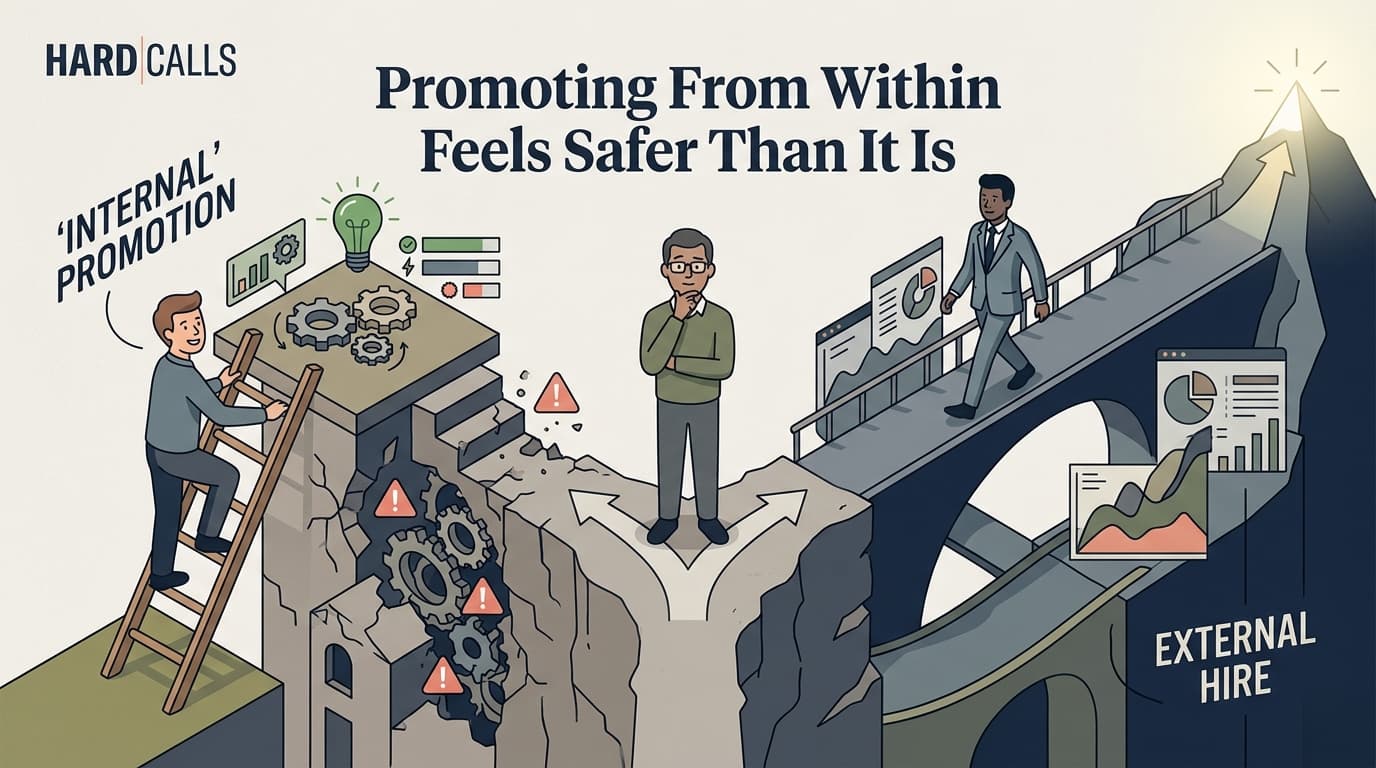

You have a senior engineering role to fill. Maybe a tech lead slot opened up because someone left, or you're growing fast enough that you need another layer of technical leadership. You look at your team and there's an obvious candidate — solid engineer, two years in, people respect them. Promoting feels like the right call. It rewards loyalty, it's faster, it's cheaper.
Then six months later, you're managing a performance problem you didn't see coming, your team is frustrated, and you're quietly wondering if you made a mistake.
This is one of the most common failure modes in mid-stage engineering management, and it almost never gets diagnosed correctly. The problem usually isn't that you promoted the wrong person. It's that you were optimizing for the wrong thing when you made the call.
What You're Actually Optimizing For
Most managers frame this as a retention and cost question: promoting is cheaper and sends a good signal to the team. Both are true. Research from Wharton's Matthew Bidwell found that external hires are paid roughly 18–20% more than internal promotions for equivalent roles, and still tend to receive lower performance evaluations during their first two years. On paper, internal promotion wins.
But cost and retention signal are lagging indicators. They tell you about the first 90 days. The question that actually matters is: what does this role need to do in 12 months, and does this person have a plausible path to doing it?
Those are different questions. The first is about avoiding short-term friction. The second is about whether you're setting someone up to succeed or setting them up to struggle in public.
The Hidden Constraints
The reason this decision is harder than it looks comes down to three variables that most managers underweight.
The role is probably not what it was. If you're filling a vacancy, the role existed before — but the team is different now, the technical challenges are different, and what you actually need may have shifted. Promoting someone into a role that no longer matches its original description is a setup for misalignment. Before you decide who fills it, be specific about what the role needs to accomplish in the next year.
Your internal candidate's ceiling is unknown. You know what they've done. You don't know what they'll do when the job changes. As Lena Reinhard notes in her writing on early-stage management structures, the inflection point from IC to leadership requires a fundamentally different set of skills — and the people who were excellent at the previous job often struggle with the ambiguity of the new one. That's not a character flaw. It's a structural mismatch.
Promotion changes the team dynamic in ways you can't fully predict. When someone moves from peer to senior, the relationships shift. Some people will be supportive; others will quietly resent it. The promoted person will feel pressure to prove themselves, which can push them toward either over-managing or retreating into the technical work they're comfortable with. Neither is what you need.
The Common Failure Modes
Promoting the most technically skilled person. Technical excellence is necessary but not sufficient for a senior leadership role. The pattern is well-documented: someone gets promoted because they're brilliant at the work, then finds themselves in a role that demands influence, mentorship, and ambiguity tolerance — none of which they were trained for, and none of which were part of the evaluation criteria when you made the call.
Hiring externally to avoid a hard conversation. Sometimes managers go external not because the role genuinely needs outside perspective, but because they don't want to choose between internal candidates, or because they've already mentally written off their team's growth potential. That's a different problem, and an external hire won't solve it.
Treating the decision as permanent. Both paths carry risk. The question isn't which option is safer — it's which risk you're better positioned to manage. A promoted internal candidate who struggles is a coaching and support problem. An external hire who doesn't fit the culture is a much harder unwind.
What Signals Tell You If It's Working
For an internal promotion, the early signal isn't performance — it's whether the person is operating in the new role or still operating in the old one. Are they making decisions, or are they waiting to be told what to do? Are they having the hard conversations, or are they avoiding them to preserve peer relationships? The first 60–90 days will tell you whether they've made the identity shift the role requires.
For an external hire, the signal is integration speed. Are they building relationships, or staying in their lane? Are they asking questions that suggest they're trying to understand the system, or are they already proposing changes before they've earned the context? Wharton's research suggests external hires who stay past two years tend to get promoted faster than internal ones — but the two-year window is where most of the attrition happens. The question is whether you're giving them enough support to get there.
Three Questions to Ask Before You Decide
What does this role need to do in the next 12 months that it hasn't had to do before? If the answer is "more of the same," internal promotion is probably the right call. If the answer involves a genuine capability gap — a new technical domain, a different kind of stakeholder management, a scale the team hasn't operated at — be honest about whether your internal candidate can close that gap in time.
If you promote this person and it doesn't work out, what's your plan? Not as a pessimistic exercise, but as a forcing function. If you don't have a clear answer, you're not ready to make the call. The plan doesn't have to be detailed — but it needs to exist.
Are you promoting this person because they're ready, or because it's easier than the alternative? The honest answer to this question will tell you more than any framework.


