


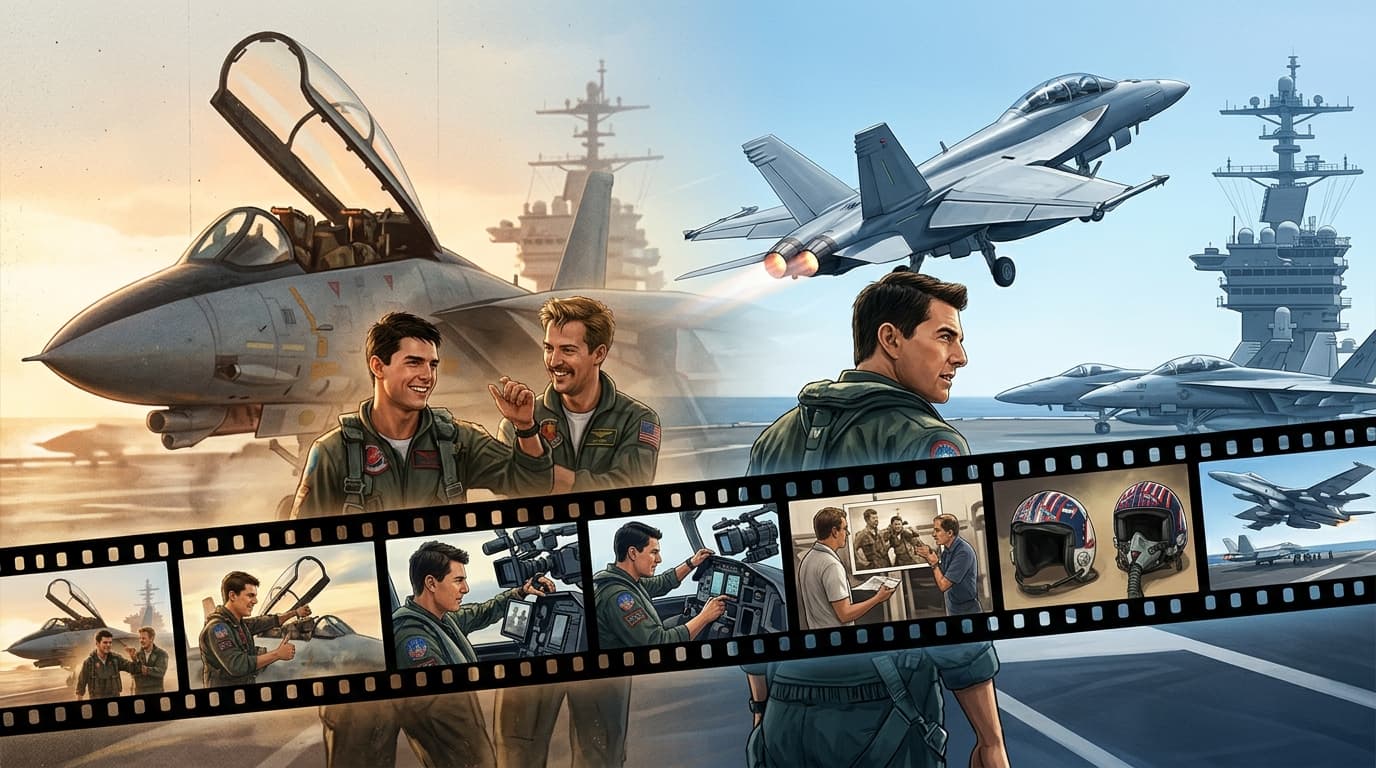

The original Top Gun cost somewhere between $13 and $15 million to make in 1986 and grossed $357 million worldwide. By any measure, a hit. But it wasn't a franchise. There was no sequel, no expanded universe, no annual installment. For 36 years, Top Gun existed as a single cultural artifact — a movie that defined a decade's aesthetic and then stopped.
Maverick didn't continue that franchise. It monetized the memory of it.
Nostalgia as the Product, Not the Marketing
The distinction matters. Most legacy sequels use nostalgia as a hook — a familiar face, a callback, a needle drop — to get audiences into seats for a new story. Maverick inverted that. The nostalgia was the story. Maverick is still flying the same jets, still defying the same institutional authority, still processing the same grief over Goose. The film's emotional architecture is built almost entirely on the audience's relationship with the 1986 original. New characters exist largely to receive the mythology, not to generate their own.
That's not a criticism — it's a business observation. Paramount and Skydance weren't selling a sequel. They were selling a reunion. The product on offer was the feeling of watching Top Gun for the first time, delivered with 2022 production values and a budget of $170–177 million. The gamble was enormous. The payoff was $1.496 billion at the global box office — making it one of the highest-grossing films ever released.
What's striking is how little of that success depended on franchise infrastructure. No cinematic universe. No mid-credits scene teasing the next installment. No merchandise ecosystem. Just Tom Cruise, some F/A-18s, and the precise emotional frequency of 1986.
The Val Kilmer Problem Solved Everything
The film's most revealing creative decision is how it handles Iceman. Val Kilmer's health had severely limited his ability to speak by the time production began, and rather than recasting or writing the character out, the filmmakers built his condition directly into the scene. Iceman communicates through a tablet. The reunion is brief, tender, and unmistakably final.
It's a genuinely moving sequence — and it also demonstrates something important about how Maverick operates. The film doesn't pretend the past is intact. It acknowledges that time has passed, that people have changed, that some things are gone. That honesty is what separates effective nostalgia economics from cynical nostalgia economics. Audiences aren't stupid. They know 36 years have elapsed. A film that pretends otherwise feels hollow. Maverick earns its emotional weight by letting the original film age on screen.
The Kilmer scene isn't a workaround. It's the thesis statement.
What $1.5 Billion Actually Bought
The commercial logic here is worth sitting with. Maverick returned to the U.S. streaming top 10 on Paramount+ in early 2026 — nearly four years after its theatrical release. That's unusual staying power, and it points to something the box office numbers alone don't capture: the film functions as a repeatable experience in a way that most blockbusters don't.
Part of that is craft. Joseph Kosinski's commitment to practical aerial photography — cameras mounted inside actual F/A-18s, actors trained to withstand G-forces — produced imagery that holds up on rewatch in ways that CGI-heavy spectacle often doesn't. The action sequences feel earned because they're physically real. That's a production philosophy, but it's also an economic argument: spend more on authenticity, extend the film's shelf life.
The pattern suggests something the industry is still working out: nostalgia economics only work when the new film is genuinely good. Maverick isn't successful because it reminded people of Top Gun. It's successful because it reminded people of Top Gun and then delivered something worth the memory. The films that try to replicate this formula without that second part — and there are many — tend to demonstrate the difference between monetizing nostalgia and being consumed by it.
Whether Paramount can build anything durable from here is a separate question. A third film would face a different problem entirely: the nostalgia has now been spent. The reunion already happened. What's left to sell?